 Add to Chrome
 Add to Firefox
 Add to Edge
HyperAgent: Planning and Acting over Tool-Schema Hypergraphs for Tool-Use LLM Agents
Jul 31, 2026
Large language model (LLM) agents increasingly rely on external tools to complete complex real-world tasks. However, reliable tool-use planning remains challenging due to the limitations of implicit reasoning and the evolving nature of real-world execution environments. Existing tool-use agents typically rely on LLMs to infer tool compositions from textual descriptions, which can lead to inefficient exploration and unreliable execution in complex tasks. To address these challenges, we model tool relations at the schema level and construct a directed Tool--Schema Hypergraph, in which tools are represented as hyperedges from their required input-schema nodes to their output-schema nodes. Furthermore, we propose HyperAgent, a Tool--Schema Hypergraph-guided framework for dynamic planning and execution. Given a task, HyperAgent first extracts a task-relevant tool context graph and uses it to guide the construction of a schema-aware Task DAG. During execution, HyperAgent dynamically realizes each subtask by constructing a state-conditioned tool support graph through deficit-oriented expansion, which identifies unresolved requirements and retrieves supporting producer tools according to the current agent state. Experiments on AppWorld demonstrate that HyperAgent improves task completion performance while reducing redundant API calls, LLM interactions, and token consumption compared with existing agent baselines.

Adapting Unsigned Graph Neural Networks for Signed Graphs: A Few-Shot Prompt Tuning Approach
Dec 11, 2024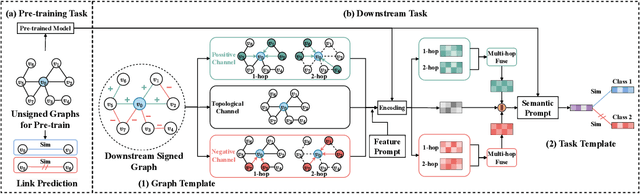
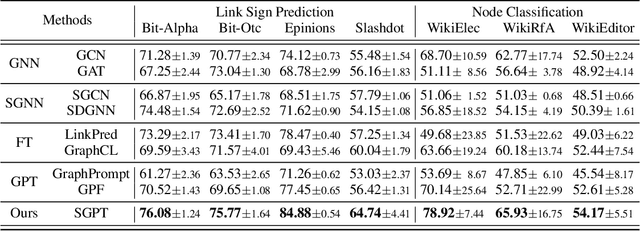
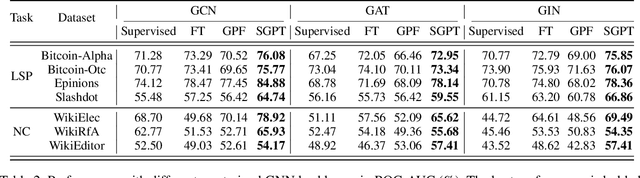
Signed Graph Neural Networks (SGNNs) are powerful tools for signed graph representation learning but struggle with limited generalization and heavy dependence on labeled data. While recent advancements in "graph pre-training and prompt tuning" have reduced label dependence in Graph Neural Networks (GNNs) and improved their generalization abilities by leveraging pre-training knowledge, these efforts have focused exclusively on unsigned graphs. The scarcity of publicly available signed graph datasets makes it essential to transfer knowledge from unsigned graphs to signed graph tasks. However, this transfer introduces significant challenges due to the graph-level and task-level divergences between the pre-training and downstream phases. To address these challenges, we propose Signed Graph Prompt Tuning (SGPT) in this paper. Specifically, SGPT employs a graph template and a semantic prompt to segregate mixed link semantics in the signed graph and then adaptively integrate the distinctive semantic information according to the needs of downstream tasks, thereby unifying the pre-training and downstream graphs. Additionally, SGPT utilizes a task template and a feature prompt to reformulate the downstream signed graph tasks, aligning them with pre-training tasks to ensure a unified optimization objective and consistent feature space across tasks. Finally, extensive experiments are conducted on popular signed graph datasets, demonstrating the superiority of SGPT over state-of-the-art methods.