 Add to Chrome
 Add to Firefox
 Add to Edge
QSIM: Mitigating Overestimation in Multi-Agent Reinforcement Learning via Action Similarity Weighted Q-Learning
Feb 26, 2026
Value decomposition (VD) methods have achieved remarkable success in cooperative multi-agent reinforcement learning (MARL). However, their reliance on the max operator for temporal-difference (TD) target calculation leads to systematic Q-value overestimation. This issue is particularly severe in MARL due to the combinatorial explosion of the joint action space, which often results in unstable learning and suboptimal policies. To address this problem, we propose QSIM, a similarity weighted Q-learning framework that reconstructs the TD target using action similarity. Instead of using the greedy joint action directly, QSIM forms a similarity weighted expectation over a structured near-greedy joint action space. This formulation allows the target to integrate Q-values from diverse yet behaviorally related actions while assigning greater influence to those that are more similar to the greedy choice. By smoothing the target with structurally relevant alternatives, QSIM effectively mitigates overestimation and improves learning stability. Extensive experiments demonstrate that QSIM can be seamlessly integrated with various VD methods, consistently yielding superior performance and stability compared to the original algorithms. Furthermore, empirical analysis confirms that QSIM significantly mitigates the systematic value overestimation in MARL. Code is available at https://github.com/MaoMaoLYJ/pymarl-qsim.

QLLM: Do We Really Need a Mixing Network for Credit Assignment in Multi-Agent Reinforcement Learning?
Apr 17, 2025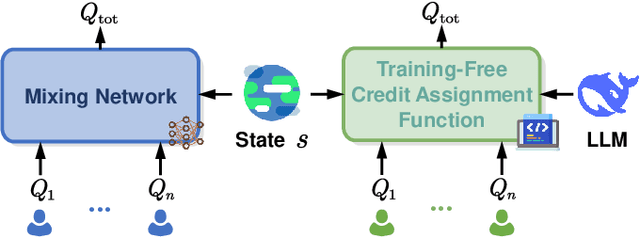
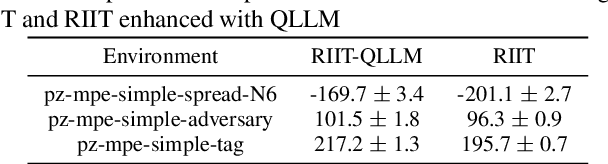
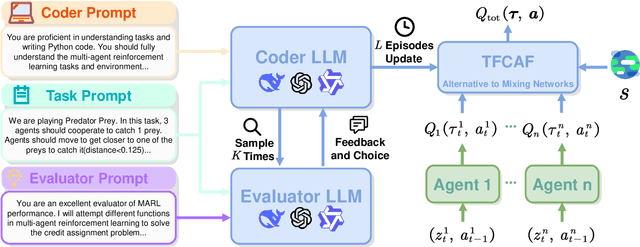
Credit assignment has remained a fundamental challenge in multi-agent reinforcement learning (MARL). Previous studies have primarily addressed this issue through value decomposition methods under the centralized training with decentralized execution paradigm, where neural networks are utilized to approximate the nonlinear relationship between individual Q-values and the global Q-value. Although these approaches have achieved considerable success in various benchmark tasks, they still suffer from several limitations, including imprecise attribution of contributions, limited interpretability, and poor scalability in high-dimensional state spaces. To address these challenges, we propose a novel algorithm, \textbf{QLLM}, which facilitates the automatic construction of credit assignment functions using large language models (LLMs). Specifically, the concept of \textbf{TFCAF} is introduced, wherein the credit allocation process is represented as a direct and expressive nonlinear functional formulation. A custom-designed \textit{coder-evaluator} framework is further employed to guide the generation, verification, and refinement of executable code by LLMs, significantly mitigating issues such as hallucination and shallow reasoning during inference. Extensive experiments conducted on several standard MARL benchmarks demonstrate that the proposed method consistently outperforms existing state-of-the-art baselines. Moreover, QLLM exhibits strong generalization capability and maintains compatibility with a wide range of MARL algorithms that utilize mixing networks, positioning it as a promising and versatile solution for complex multi-agent scenarios.