 Add to Chrome
 Add to Firefox
 Add to Edge
Multicluster Design and Control of Large-Scale Affine Formations
Mar 27, 2026
Conventional affine formation control (AFC) empowers a network of agents with flexible but collective motions - a potential which has not yet been exploited for large-scale swarms. One of the key bottlenecks lies in the design of an interaction graph, characterized by the Laplacian-like stress matrix. Efficient and scalable design solutions often yield suboptimal solutions on various performance metrics, e.g., convergence speed and communication cost, to name a few. The current state-of-the-art algorithms for finding optimal solutions are computationally expensive and therefore not scalable. In this work, we propose a more efficient optimal design for any generic configuration, with the potential to further reduce complexity for a large class of nongeneric rotationally symmetric configurations. Furthermore, we introduce a multicluster control framework that offers an additional scalability improvement, enabling not only collective affine motions as in conventional AFC but also partially independent motions naturally desired for large-scale swarms. The overall design is compatible with a swarm size of several hundred agents with fast formation convergence, as compared to up to only a few dozen agents by existing methods. Experimentally, we benchmark the performance of our algorithm compared with several state-of-the-art solutions and demonstrate the capabilities of our proposed control strategies.

Robust Affine Formation Control of Multiagent Systems
Jul 04, 2024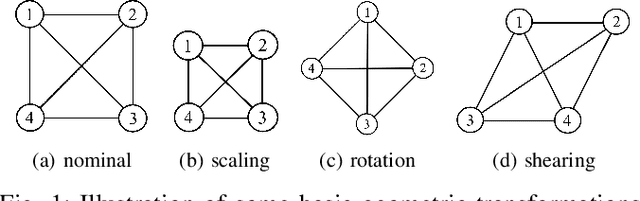
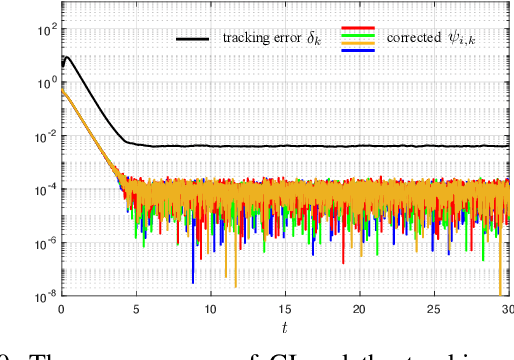
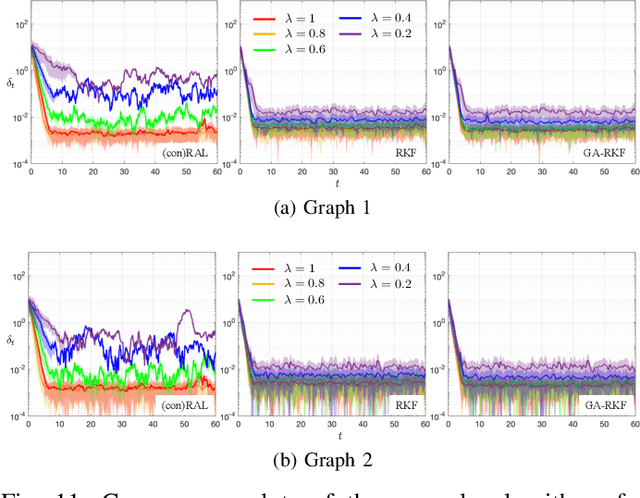
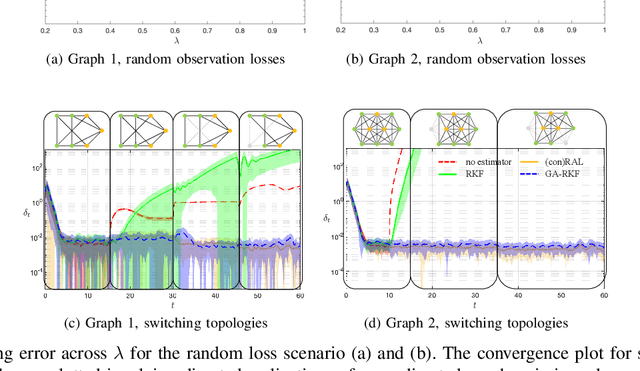
Affine formation control is a subset of formation control methods, which has gained increasing popularity for its flexibility and maneuverability in diverse applications. Affine formation control is inherently distributed in nature, where the local controllers onboard each agent are linearly dependent on the relative position measurements of the neighboring agents. The unavailability of these measurements in practice, due to node failure or missing links, leads to a change in the underlying graph topology, and subsequently causes instability and sub-optimal performance. In this paper, we propose an estimation framework to enhance the robustness of distributed affine formation control systems against these topology changes. Our estimation framework features an adaptive fusion of both temporal information from the dynamics of agents and spatial information which is derived from the geometry of the affine formations. We propose a suite of algorithms under this framework to tackle various practical scenarios, and numerically verify our proposed estimator on stability, convergence rate, and optimality criterion. Simulations show the performance of our proposed algorithms as compared to the state-of-the-art methods, and we summarize them with future research directions.