 Add to Chrome
 Add to Firefox
 Add to Edge
AMP2026: A Multi-Platform Marine Robotics Dataset for Tracking and Mapping
Mar 04, 2026
Marine environments present significant challenges for perception and autonomy due to dynamic surfaces, limited visibility, and complex interactions between aerial, surface, and submerged sensing modalities. This paper introduces the Aerial Marine Perception Dataset (AMP2026), a multi-platform marine robotics dataset collected across multiple field deployments designed to support research in two primary areas: multi-view tracking and marine environment mapping. The dataset includes synchronized data from aerial drones, boat-mounted cameras, and submerged robotic platforms, along with associated localization and telemetry information. The goal of this work is to provide a publicly available dataset enabling research in marine perception and multi-robot observation scenarios. This paper describes the data collection methodology, sensor configurations, dataset organization, and intended research tasks supported by the dataset.

Multi-Agent Model-Based Reinforcement Learning with Joint State-Action Learned Embeddings
Feb 13, 2026Learning to coordinate many agents in partially observable and highly dynamic environments requires both informative representations and data-efficient training. To address this challenge, we present a novel model-based multi-agent reinforcement learning framework that unifies joint state-action representation learning with imaginative roll-outs. We design a world model trained with variational auto-encoders and augment the model using the state-action learned embedding (SALE). SALE is injected into both the imagination module that forecasts plausible future roll-outs and the joint agent network whose individual action values are combined through a mixing network to estimate the joint action-value function. By coupling imagined trajectories with SALE-based action values, the agents acquire a richer understanding of how their choices influence collective outcomes, leading to improved long-term planning and optimization under limited real-environment interactions. Empirical studies on well-established multi-agent benchmarks, including StarCraft II Micro-Management, Multi-Agent MuJoCo, and Level-Based Foraging challenges, demonstrate consistent gains of our method over baseline algorithms and highlight the effectiveness of joint state-action learned embeddings within a multi-agent model-based paradigm.
Leveraging World Model Disentanglement in Value-Based Multi-Agent Reinforcement Learning
Sep 08, 2023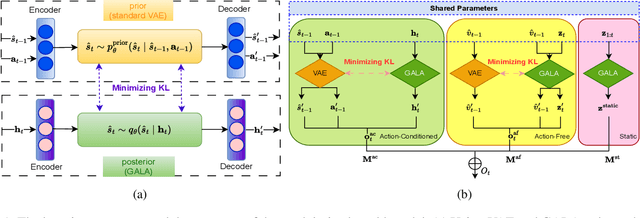
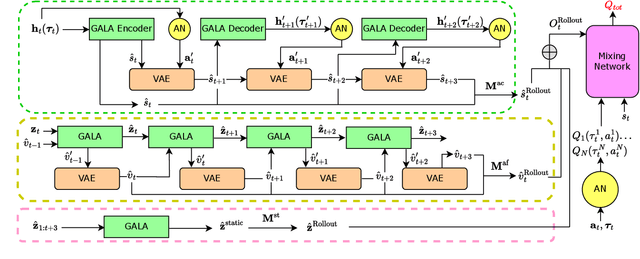
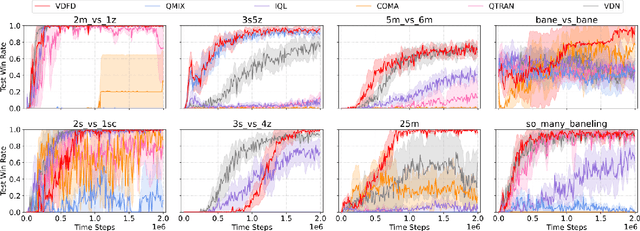
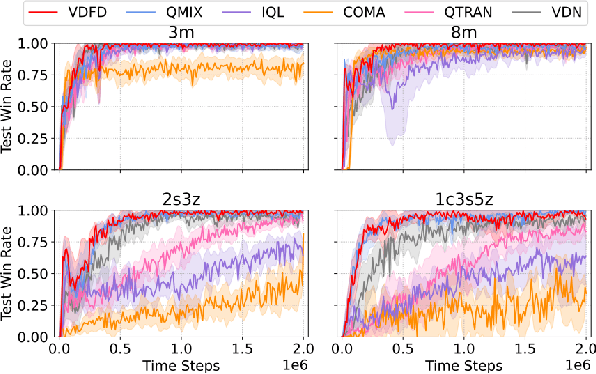
In this paper, we propose a novel model-based multi-agent reinforcement learning approach named Value Decomposition Framework with Disentangled World Model to address the challenge of achieving a common goal of multiple agents interacting in the same environment with reduced sample complexity. Due to scalability and non-stationarity problems posed by multi-agent systems, model-free methods rely on a considerable number of samples for training. In contrast, we use a modularized world model, composed of action-conditioned, action-free, and static branches, to unravel the environment dynamics and produce imagined outcomes based on past experience, without sampling directly from the real environment. We employ variational auto-encoders and variational graph auto-encoders to learn the latent representations for the world model, which is merged with a value-based framework to predict the joint action-value function and optimize the overall training objective. We present experimental results in Easy, Hard, and Super-Hard StarCraft II micro-management challenges to demonstrate that our method achieves high sample efficiency and exhibits superior performance in defeating the enemy armies compared to other baselines.