 Add to Chrome
 Add to Firefox
 Add to Edge
TimeSeries2Report prompting enables adaptive large language model management of lithium-ion batteries
Dec 18, 2025
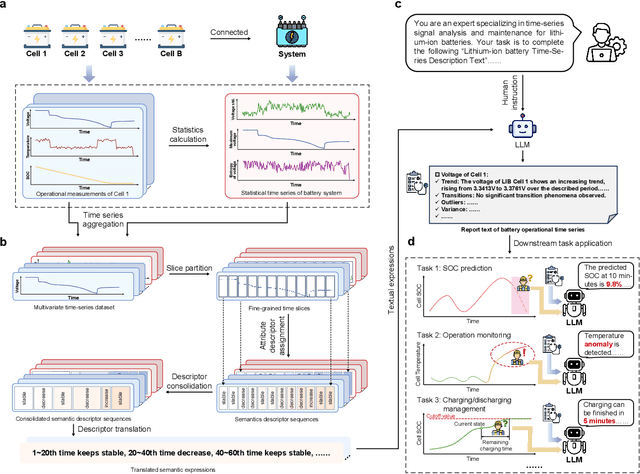

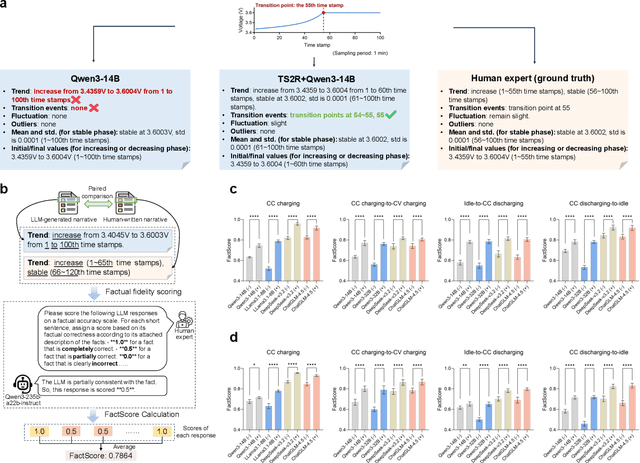
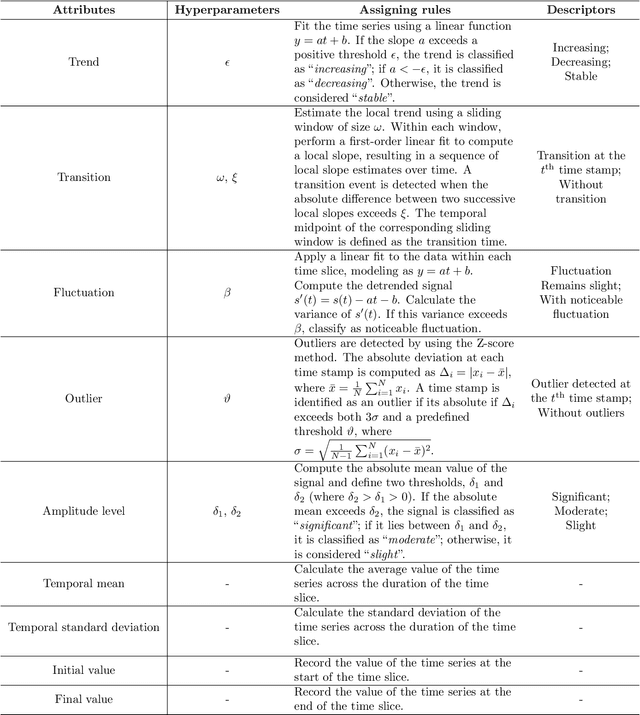
Large language models (LLMs) offer promising capabilities for interpreting multivariate time-series data, yet their application to real-world battery energy storage system (BESS) operation and maintenance remains largely unexplored. Here, we present TimeSeries2Report (TS2R), a prompting framework that converts raw lithium-ion battery operational time-series into structured, semantically enriched reports, enabling LLMs to reason, predict, and make decisions in BESS management scenarios. TS2R encodes short-term temporal dynamics into natural language through a combination of segmentation, semantic abstraction, and rule-based interpretation, effectively bridging low-level sensor signals with high-level contextual insights. We benchmark TS2R across both lab-scale and real-world datasets, evaluating report quality and downstream task performance in anomaly detection, state-of-charge prediction, and charging/discharging management. Compared with vision-, embedding-, and text-based prompting baselines, report-based prompting via TS2R consistently improves LLM performance in terms of across accuracy, robustness, and explainability metrics. Notably, TS2R-integrated LLMs achieve expert-level decision quality and predictive consistency without retraining or architecture modification, establishing a practical path for adaptive, LLM-driven battery intelligence.

OpenGCD: Assisting Open World Recognition with Generalized Category Discovery
Aug 14, 2023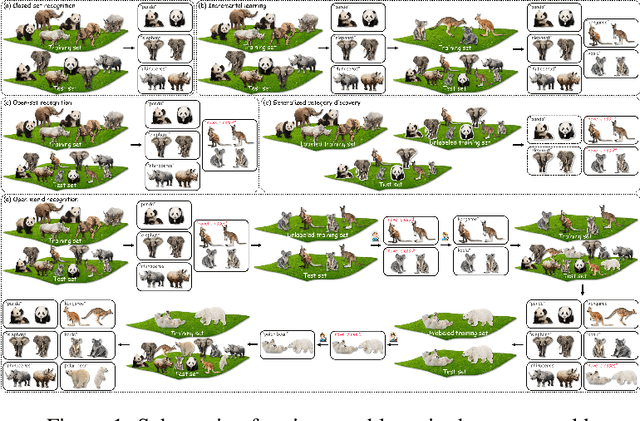
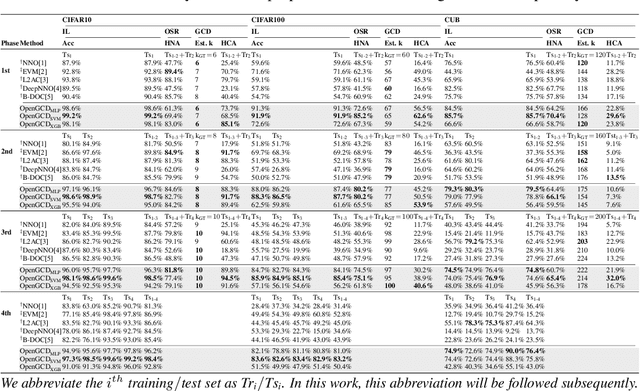
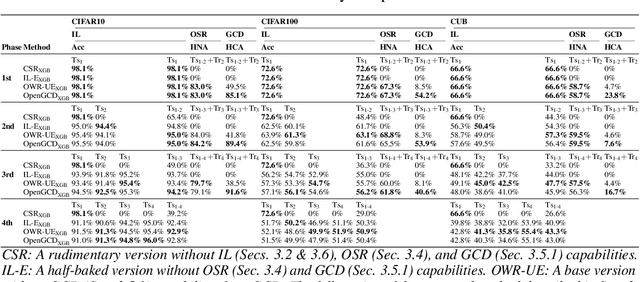
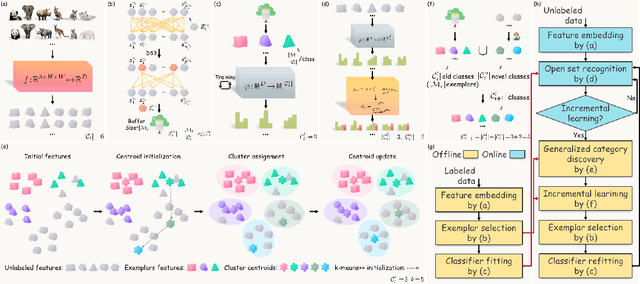
A desirable open world recognition (OWR) system requires performing three tasks: (1) Open set recognition (OSR), i.e., classifying the known (classes seen during training) and rejecting the unknown (unseen$/$novel classes) online; (2) Grouping and labeling these unknown as novel known classes; (3) Incremental learning (IL), i.e., continual learning these novel classes and retaining the memory of old classes. Ideally, all of these steps should be automated. However, existing methods mostly assume that the second task is completely done manually. To bridge this gap, we propose OpenGCD that combines three key ideas to solve the above problems sequentially: (a) We score the origin of instances (unknown or specifically known) based on the uncertainty of the classifier's prediction; (b) For the first time, we introduce generalized category discovery (GCD) techniques in OWR to assist humans in grouping unlabeled data; (c) For the smooth execution of IL and GCD, we retain an equal number of informative exemplars for each class with diversity as the goal. Moreover, we present a new performance evaluation metric for GCD called harmonic clustering accuracy. Experiments on two standard classification benchmarks and a challenging dataset demonstrate that OpenGCD not only offers excellent compatibility but also substantially outperforms other baselines. Code: https://github.com/Fulin-Gao/OpenGCD.