 Add to Chrome
 Add to Firefox
 Add to Edge
Initiation Safety: A Missing Dimension in Generalist-Robot Safety
Jul 08, 2026
Safety for generalist robots is usually discussed in terms of motion or dialogue. We argue a third question is missing: should the robot take its first hard-to-undo social action at all, such as a greeting, an uninvited grasp, or stepping into someone's space? We call this initiation authorization. Current frameworks rarely treat it as a separate safety layer. Today's stacks often skip this step: a high engagement score or a confident VLA rollout is treated as permission to act. But seeing a person is not the same as having their consent to be addressed. We frame initiation authorization within generalist-robot safety and contrast it with post-plan VLA guardrails, implementing PAS (probe-authorize-speak) on a doorway humanoid, comparing it with direct-init on logged traces, and proposing a three-condition user study, with open questions on metrics, governance, and where initiation ends and foundation-model generation begins.

PERCY: A Multimodal Dataset and Conversational System for Personalized and Emotionally Aware Human-Robot Interaction
Dec 06, 2024
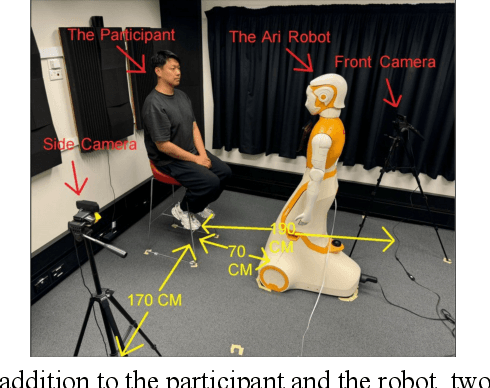


The integration of conversational agents into our daily lives has become increasingly common, yet many of these agents cannot engage in deep interactions with humans. Despite this, there is a noticeable shortage of datasets that capture multimodal information from human-robot interaction dialogues. To address this gap, we have developed a Personal Emotional Robotic Conversational sYstem (PERCY) and recorded a novel multimodal dataset that encompasses rich embodied interaction data. The process involved asking participants to complete a questionnaire and gathering their profiles on ten topics, such as hobbies and favourite music. Subsequently, we initiated conversations between the robot and the participants, leveraging GPT-4 to generate contextually appropriate responses based on the participant's profile and emotional state, as determined by facial expression recognition and sentiment analysis. Automatic and user evaluations were conducted to assess the overall quality of the collected data. The results of both evaluations indicated a high level of naturalness, engagement, fluency, consistency, and relevance in the conversation, as well as the robot's ability to provide empathetic responses. It is worth noting that the dataset is derived from genuine interactions with the robot, involving participants who provided personal information and conveyed actual emotions.