 Add to Chrome
 Add to Firefox
 Add to Edge
CoGen3D: An Agentic Human-AI Co-Design Pipeline for 3D Asset Generation for Virtual Reality
Jul 04, 2026
Creating 3D assets for virtual reality requires modeling expertise, which restricts the authorship of immersive experiences. Existing generative AI tools rely on unconstrained, command-driven prompting, lacking the conversational scaffolding needed for users to articulate their intent and validate designs prior to rendering. To address this, we introduce CoGen3D, an agentic human-AI co-design pipeline that proactively guides users through conversational intent elicitation, a concept image confirmation, and image-to-3D generation that directly deploys to immersive scenes. We evaluated this system through a user study (N=120) across six affectively diverse immersive scenes, observing 60 Design group participants who co-created 3D assets for the scenes, and 60 Validation group participants who experienced the scenes with generated assets. Our findings show that co-designed assets are associated with higher scene engagement and shifted affective responses, while participants generally preferred concept images over the final 3D assets, with no increased leniency toward degradation in their own creations. Analysis of the human-AI conversations further shows that target environments shape users' conversational patterns. Our results suggest that our staged, intent-based co-design can democratize virtual reality authoring and shift immersive content creation from technical execution toward collaborative spatial design.

Advancing Urban Renewal: An Automated Approach to Generating Historical Arcade Facades with Stable Diffusion Models
Nov 20, 2023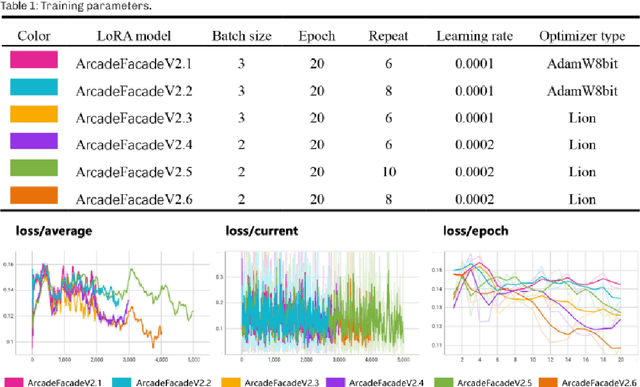
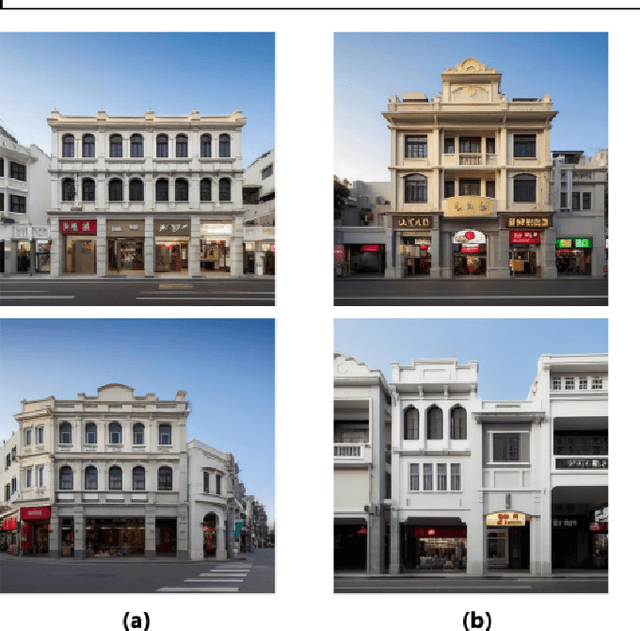
Urban renewal and transformation processes necessitate the preservation of the historical urban fabric, particularly in districts known for their architectural and historical significance. These regions, with their diverse architectural styles, have traditionally required extensive preliminary research, often leading to subjective results. However, the advent of machine learning models has opened up new avenues for generating building facade images. Despite this, creating high-quality images for historical district renovations remains challenging, due to the complexity and diversity inherent in such districts. In response to these challenges, our study introduces a new methodology for automatically generating images of historical arcade facades, utilizing Stable Diffusion models conditioned on textual descriptions. By classifying and tagging a variety of arcade styles, we have constructed several realistic arcade facade image datasets. We trained multiple low-rank adaptation (LoRA) models to control the stylistic aspects of the generated images, supplemented by ControlNet models for improved precision and authenticity. Our approach has demonstrated high levels of precision, authenticity, and diversity in the generated images, showing promising potential for real-world urban renewal projects. This new methodology offers a more efficient and accurate alternative to conventional design processes in urban renewal, bypassing issues of unconvincing image details, lack of precision, and limited stylistic variety. Future research could focus on integrating this two-dimensional image generation with three-dimensional modeling techniques, providing a more comprehensive solution for renovating architectural facades in historical districts.