 Add to Chrome
 Add to Firefox
 Add to Edge
Compiler-Driven Approximation Tuning for Hyperdimensional Computing
Jun 25, 2026
As Moore's law reaches its physical and economic limits, domain-specific approaches are increasingly employed to accelerate machine learning workloads. Hyperdimensional Computing (HDC) represents one such emerging paradigm, offering an alternative to conventional deep learning techniques. Rooted in cognitive models of computation, HDC is designed bottom-up with hardware efficiency as a first-class objective. HDC workloads map naturally to heterogeneous hardware platforms, including CPUs, GPUs, and FPGAs, as well as emerging in-memory computing technologies such as Resistive RAM (ReRAM) and Phase-Change Memory (PCM). HDC algorithms are intrinsically tolerant to noise and approximation, enabling substantial performance gains with minimal accuracy loss. In this work, we introduce ApproxHDC, a framework for automated identification and application of domain-specific approximations in HDC workloads. ApproxHDC extends the HPVM-HDC compiler infrastructure to enable retargetable compilation across diverse hardware backends, including CPUs, GPUs, and simulated ReRAM and PCM-based accelerators. The space of possible approximations is exponentially large; ApproxHDC employs efficient search and analysis to navigate it and identify high-impact configurations spanning both software and hardware levels.

SpecPCM: A Low-power PCM-based In-Memory Computing Accelerator for Full-stack Mass Spectrometry Analysis
Nov 14, 2024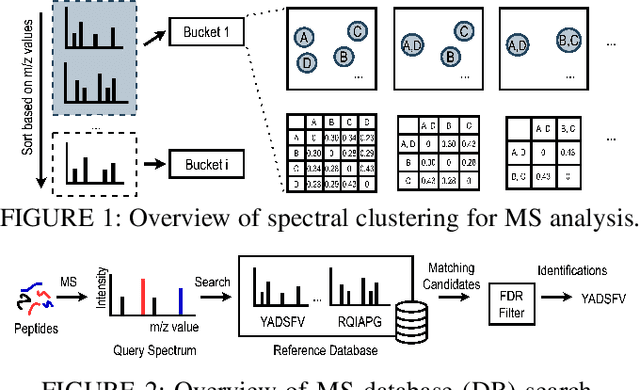
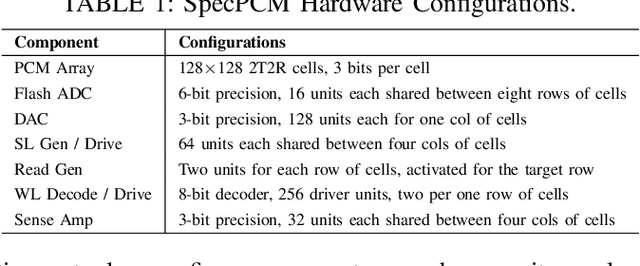
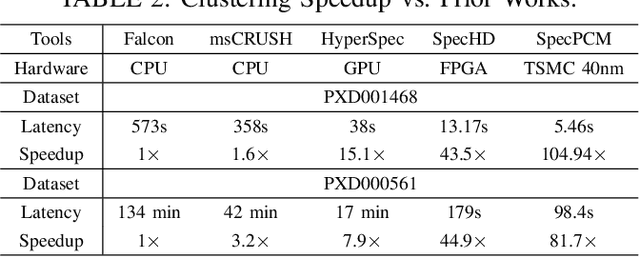
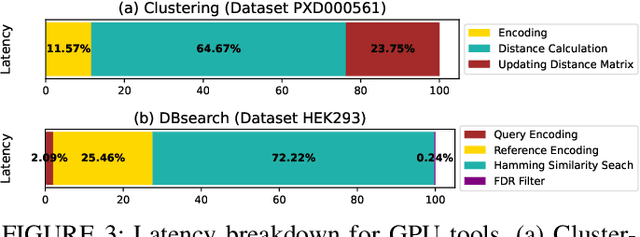
Mass spectrometry (MS) is essential for proteomics and metabolomics but faces impending challenges in efficiently processing the vast volumes of data. This paper introduces SpecPCM, an in-memory computing (IMC) accelerator designed to achieve substantial improvements in energy and delay efficiency for both MS spectral clustering and database (DB) search. SpecPCM employs analog processing with low-voltage swing and utilizes recently introduced phase change memory (PCM) devices based on superlattice materials, optimized for low-voltage and low-power programming. Our approach integrates contributions across multiple levels: application, algorithm, circuit, device, and instruction sets. We leverage a robust hyperdimensional computing (HD) algorithm with a novel dimension-packing method and develop specialized hardware for the end-to-end MS pipeline to overcome the non-ideal behavior of PCM devices. We further optimize multi-level PCM devices for different tasks by using different materials. We also perform a comprehensive design exploration to improve energy and delay efficiency while maintaining accuracy, exploring various combinations of hardware and software parameters controlled by the instruction set architecture (ISA). SpecPCM, with up to three bits per cell, achieves speedups of up to 82x and 143x for MS clustering and DB search tasks, respectively, along with a four-orders-of-magnitude improvement in energy efficiency compared with state-of-the-art CPU/GPU tools.