 Add to Chrome
 Add to Firefox
 Add to Edge
Proactive Rejection and Grounded Execution: A Dual-Stage Intent Analysis Paradigm for Safe and Efficient AIoT Smart Homes
Mar 17, 2026
As Large Language Models (LLMs) transition from information providers to embodied agents in the Internet of Things (IoT), they face significant challenges regarding reliability and interaction efficiency. Direct execution of LLM-generated commands often leads to entity hallucinations (e.g., trying to control non-existent devices). Meanwhile, existing iterative frameworks (e.g., SAGE) suffer from the Interaction Frequency Dilemma, oscillating between reckless execution and excessive user questioning. To address these issues, we propose a Dual-Stage Intent-Aware (DS-IA) Framework. This framework separates high-level user intent understanding from low-level physical execution. Specifically, Stage 1 serves as a semantic firewall to filter out invalid instructions and resolve vague commands by checking the current state of the home. Stage 2 then employs a deterministic cascade verifier-a strict, step-by-step rule checker that verifies the room, device, and capability in sequence-to ensure the action is actually physically possible before execution. Extensive experiments on the HomeBench and SAGE benchmarks demonstrate that DS-IA achieves an Exact Match (EM) rate of 58.56% (outperforming baselines by over 28%) and improves the rejection rate of invalid instructions to 87.04%. Evaluations on the SAGE benchmark further reveal that DS-IA resolves the Interaction Frequency Dilemma by balancing proactive querying with state-based inference. Specifically, it boosts the Autonomous Success Rate (resolving tasks without unnecessary user intervention) from 42.86% to 71.43%, while maintaining high precision in identifying irreducible ambiguities that truly necessitate human clarification. These results underscore the framework's ability to minimize user disturbance through accurate environmental grounding.

Toward a Sustainable Federated Learning Ecosystem: A Practical Least Core Mechanism for Payoff Allocation
Feb 03, 2026Emerging network paradigms and applications increasingly rely on federated learning (FL) to enable collaborative intelligence while preserving privacy. However, the sustainability of such collaborative environments hinges on a fair and stable payoff allocation mechanism. Focusing on coalition stability, this paper introduces a payoff allocation framework based on the least core (LC) concept. Unlike traditional methods, the LC prioritizes the cohesion of the federation by minimizing the maximum dissatisfaction among all potential subgroups, ensuring that no participant has an incentive to break away. To adapt this game-theoretic concept to practical, large-scale networks, we propose a streamlined implementation with a stack-based pruning algorithm, effectively balancing computational efficiency with allocation precision. Case studies in federated intrusion detection demonstrate that our mechanism correctly identifies pivotal contributors and strategic alliances. The results confirm that the practical LC framework promotes stable collaboration and fosters a sustainable FL ecosystem.
Prompt Framework for Role-playing: Generation and Evaluation
Jun 02, 2024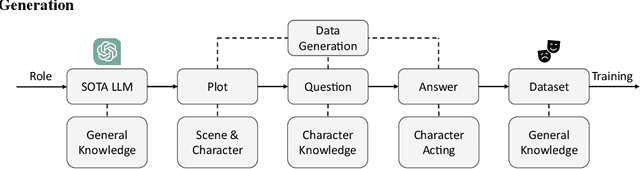
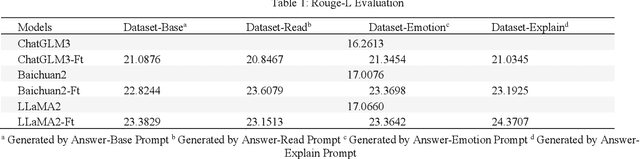
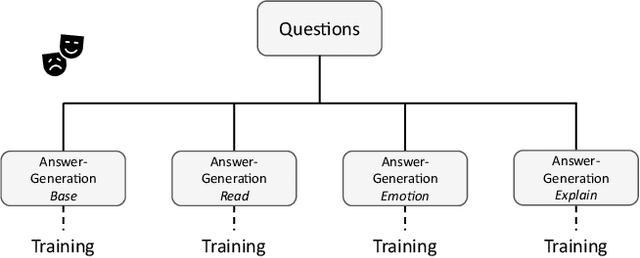
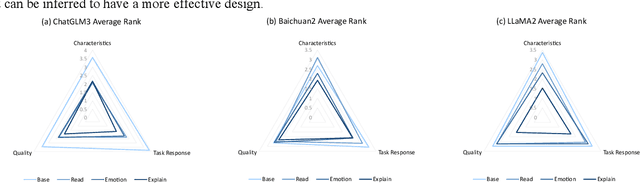
Large language models (LLM) have demonstrated remarkable abilities in generating natural language, understanding user instruction, and mimicking human language use. These capabilities have garnered considerable interest in applications such as role-playing. However, the process of collecting individual role scripts (or profiles) data and manually evaluating the performance can be costly. We introduce a framework that uses prompts to leverage the state-of-the-art (SOTA) LLMs to construct role-playing dialogue datasets and evaluate the role-playing performance. Additionally, we employ recall-oriented evaluation Rouge-L metric to support the result of the LLM evaluator.