 Add to Chrome
 Add to Firefox
 Add to Edge
Beyond Function Calling: Benchmarking Tool-Using Agents under Tool-Environment Unreliability
Jun 24, 2026
Large language models are increasingly deployed as agents that solve tasks by interacting with external tool environments. Although recent tool-use benchmarks increasingly cover complex task settings, they still largely assume clean, stable, and trustworthy tool environments, leaving tool-environment unreliability insufficiently examined. We introduce ToolBench-X, a benchmark for evaluating agents under recoverable reliability hazards. ToolBench-X contains executable multi-step tasks across diverse domains and sequential, parallel, and mixed workflows, each paired with deterministic tools and a canonical final answer for automatic evaluation. Starting from clean tool environments, ToolBench-X injects five structured hazard types: Specification Drift, Invocation Error, Execution Failure, Output Drift, and Cross-source Conflict. Crucially, each injected instance remains solvable through at least one valid recovery path, such as retrying, fallback, verification, or cross-checking. Experiments reveal a substantial reliability gap: agents that perform well with reliable tools often fail under recoverable hazards. Further analysis shows that failures are driven less by tool-use volume or inference budget than by limited hazard diagnosis and ineffective recovery. Targeted recovery hints recover many failed tasks, while test-time scaling yields more limited gains. These results suggest that tool-use evaluation should move beyond function-call accuracy toward task completion under unreliable tool environments. The code and data is available at https://github.com/Foreverskyou/ToolBench-X.

CRE-LLM: A Domain-Specific Chinese Relation Extraction Framework with Fine-tuned Large Language Model
Apr 28, 2024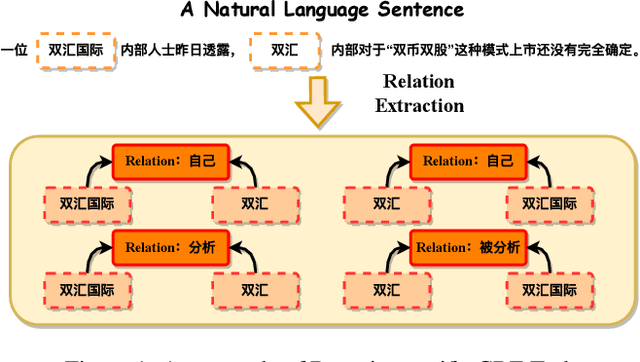
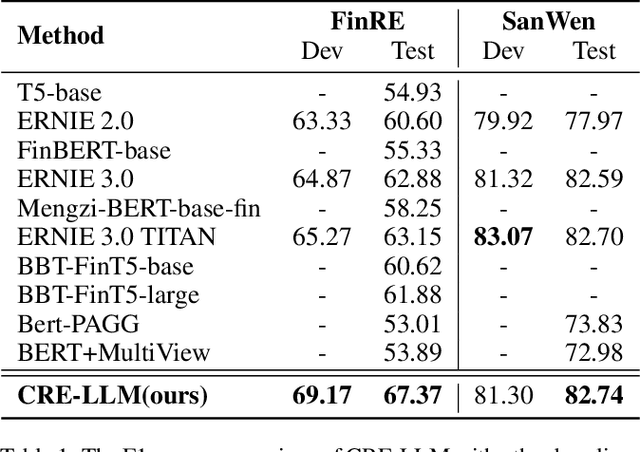
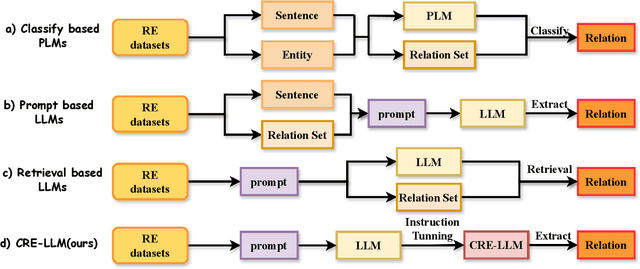
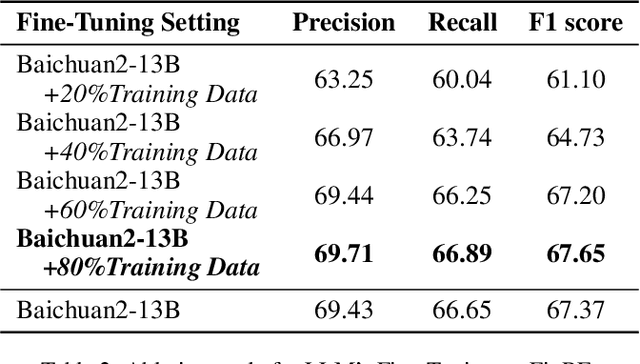
Domain-Specific Chinese Relation Extraction (DSCRE) aims to extract relations between entities from domain-specific Chinese text. Despite the rapid development of PLMs in recent years, especially LLMs, DSCRE still faces three core challenges: complex network structure design, poor awareness, and high consumption of fine-tuning. Given the impressive performance of large language models (LLMs) in natural language processing, we propose a new framework called CRE-LLM. This framework is based on fine-tuning open-source LLMs, such as Llama-2, ChatGLM2, and Baichuan2. CRE-LLM enhances the logic-awareness and generative capabilities of the model by constructing an appropriate prompt and utilizing open-source LLMs for instruction-supervised fine-tuning. And then it directly extracts the relations of the given entities in the input textual data, which improving the CRE approach. To demonstrate the effectiveness of the proposed framework, we conducted extensive experiments on two domain-specific CRE datasets, FinRE and SanWen. The experimental results show that CRE-LLM is significantly superior and robust, achieving state-of-the-art (SOTA) performance on the FinRE dataset. This paper introduces a novel approach to domain-specific relation extraction (DSCRE) tasks that are semantically more complex by combining LLMs with triples. Our code is publicly available.