 Add to Chrome
 Add to Firefox
 Add to Edge
FedFG: Privacy-Preserving and Robust Federated Learning via Flow-Matching Generation
Mar 30, 2026
Federated learning (FL) enables distributed clients to collaboratively train a global model using local private data. Nevertheless, recent studies show that conventional FL algorithms still exhibit deficiencies in privacy protection, and the server lacks a reliable and stable aggregation rule for updating the global model. This situation creates opportunities for adversaries: on the one hand, they may eavesdrop on uploaded gradients or model parameters, potentially leaking benign clients' private data; on the other hand, they may compromise clients to launch poisoning attacks that corrupt the global model. To balance accuracy and security, we propose FedFG, a robust FL framework based on flow-matching generation that simultaneously preserves client privacy and resists sophisticated poisoning attacks. On the client side, each local network is decoupled into a private feature extractor and a public classifier. Each client is further equipped with a flow-matching generator that replaces the extractor when interacting with the server, thereby protecting private features while learning an approximation of the underlying data distribution. Complementing the client-side design, the server employs a client-update verification scheme and a novel robust aggregation mechanism driven by synthetic samples produced by the flow-matching generator. Experiments on MNIST, FMNIST, and CIFAR-10 demonstrate that, compared with prior work, our approach adapts to multiple attack strategies and achieves higher accuracy while maintaining strong privacy protection.

Sequential Condition Evolved Interaction Knowledge Graph for Traditional Chinese Medicine Recommendation
May 29, 2023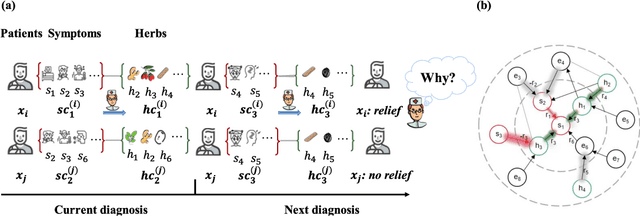
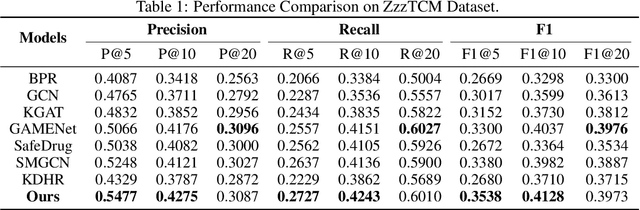
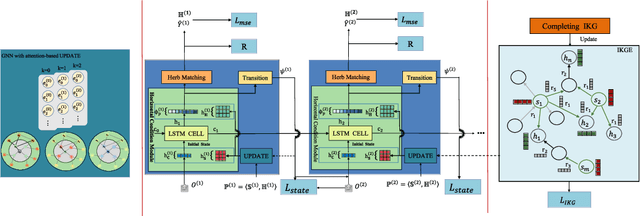
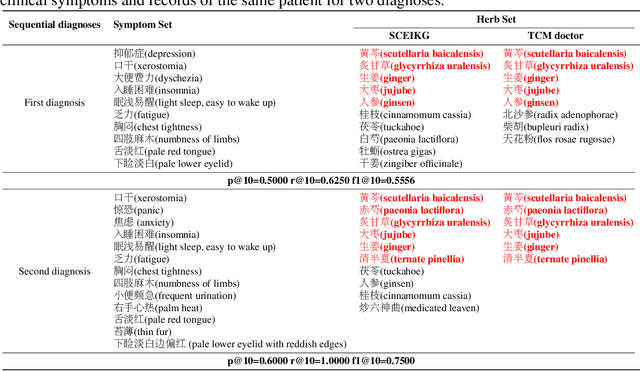
Traditional Chinese Medicine (TCM) has a rich history of utilizing natural herbs to treat a diversity of illnesses. In practice, TCM diagnosis and treatment are highly personalized and organically holistic, requiring comprehensive consideration of the patient's state and symptoms over time. However, existing TCM recommendation approaches overlook the changes in patient status and only explore potential patterns between symptoms and prescriptions. In this paper, we propose a novel Sequential Condition Evolved Interaction Knowledge Graph (SCEIKG), a framework that treats the model as a sequential prescription-making problem by considering the dynamics of the patient's condition across multiple visits. In addition, we incorporate an interaction knowledge graph to enhance the accuracy of recommendations by considering the interactions between different herbs and the patient's condition. Experimental results on a real-world dataset demonstrate that our approach outperforms existing TCM recommendation methods, achieving state-of-the-art performance.