 Add to Chrome
 Add to Firefox
 Add to Edge
TextHOI-3D: Text-to-3D Hand-Object Interaction via Discrete Multi-View Generation and Joint Mesh Optimization
Jun 10, 2026
Text-conditioned 3D generation has progressed rapidly for images and isolated objects, but producing a hand-object mesh remains challenging: the output must preserve language semantics, cross-view consistency, object geometry, articulated hand shape, and physically plausible contact. We present TextHOI-3D, a staged framework that uses generated multi-view observations as an explicit interface between text-conditioned visual generation and geometry-aware hand-object recovery. TextHOI-3D learns a compact VQ token space for fixed-camera hand-object observations, predicts multi-view visual tokens from text with a CLIP-conditioned visual autoregressive model, and recovers a unified hand-object mesh through prior initialization, multi-view joint optimization, and anti-penetration refinement. The design separates semantic generation from geometric recovery while keeping both stages connected by a discrete multi-view representation. On HO3D-derived evaluations, the multi-view setting reduces object CD from 17.26 mm to 4.92 mm and penetration volume from 5.3721 cm^3 to 0.2193 cm^3 compared with a single-view counterpart, while improving hand errors and surface F-scores. These results support multi-view visual tokens as an effective intermediate representation for text-driven 3D hand-object mesh creation.

CCSD: Cross-Modal Compositional Self-Distillation for Robust Brain Tumor Segmentation with Missing Modalities
Nov 18, 2025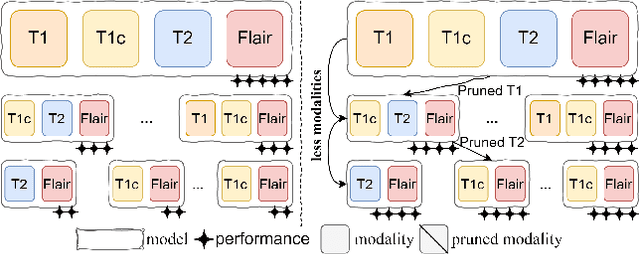
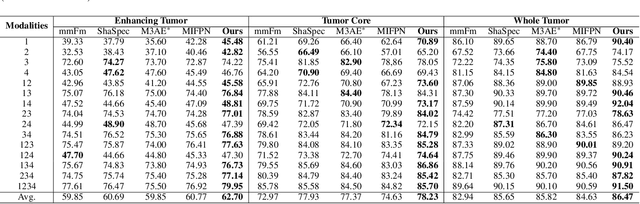
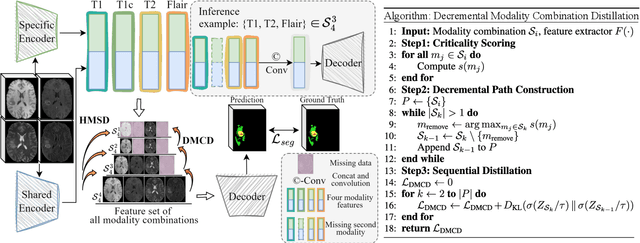
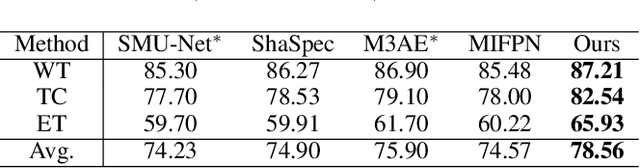
The accurate segmentation of brain tumors from multi-modal MRI is critical for clinical diagnosis and treatment planning. While integrating complementary information from various MRI sequences is a common practice, the frequent absence of one or more modalities in real-world clinical settings poses a significant challenge, severely compromising the performance and generalizability of deep learning-based segmentation models. To address this challenge, we propose a novel Cross-Modal Compositional Self-Distillation (CCSD) framework that can flexibly handle arbitrary combinations of input modalities. CCSD adopts a shared-specific encoder-decoder architecture and incorporates two self-distillation strategies: (i) a hierarchical modality self-distillation mechanism that transfers knowledge across modality hierarchies to reduce semantic discrepancies, and (ii) a progressive modality combination distillation approach that enhances robustness to missing modalities by simulating gradual modality dropout during training. Extensive experiments on public brain tumor segmentation benchmarks demonstrate that CCSD achieves state-of-the-art performance across various missing-modality scenarios, with strong generalization and stability.