 Add to Chrome
 Add to Firefox
 Add to Edge
Beyond Action Imitation: Learning a Decision-Aware User Simulator for Online Advertising
Jul 29, 2026
Recent advances in LLM-based user simulation have shown promise for offline evaluation of recommendation and advertising systems. However, existing simulators typically infer user preferences from single-domain interaction histories and are primarily optimized to reproduce observable actions such as clicks. Consequently, they capture only a partial view of user preferences, while action-only prediction easily induces model shortcuts and limits both the fidelity and diagnostic value of simulation. To address these challenges, we propose DASH, a decision-aware user simulator that jointly generates thinking traces and predicts behavioral actions from heterogeneous cross-domain histories. DASH first introduces a Context Engineering stage that folds heterogeneous cross-domain histories into decision-relevant context, together with prompt optimization for effective reasoning over the folded context. To train a user simulator, DASH distills thinking trajectories from strong LLMs as SFT data, and further tailors a rubric-based reward model that evaluates thinking traces along form, content, and logic for RL training. Combined with the action reward, these signals jointly improve action prediction and thinking quality. Extensive experiments on real-world Tencent advertising data spanning five heterogeneous content domains demonstrate the effectiveness, efficiency, fidelity, and diagnostic value of DASH.

A Plug-and-Play Untrained Neural Network for Full Waveform Inversion in Reconstructing Sound Speed Images of Ultrasound Computed Tomography
Jun 14, 2024
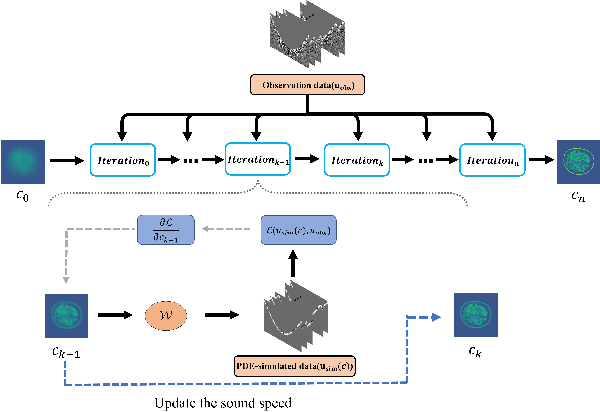
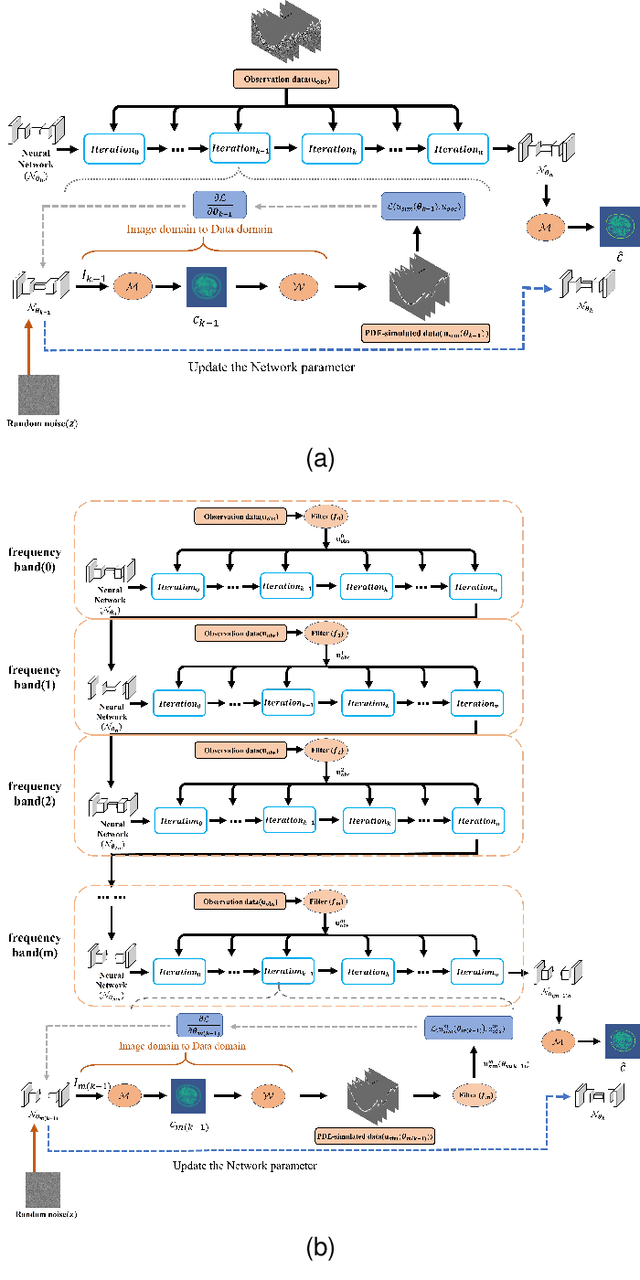
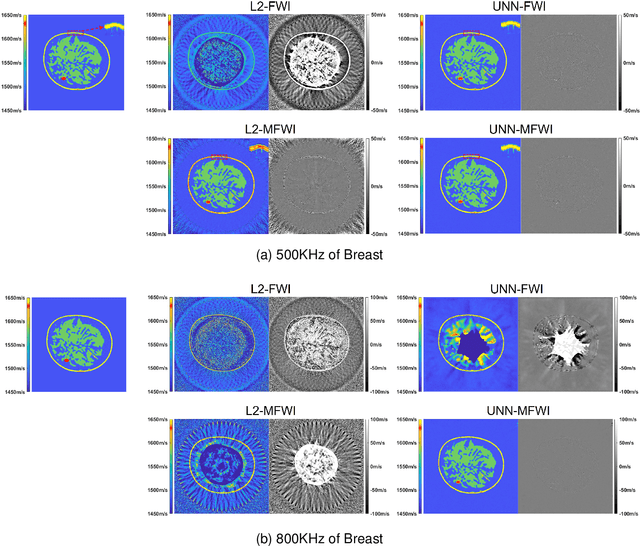
Ultrasound computed tomography (USCT), as an emerging technology, can provide multiple quantitative parametric images of human tissue, such as sound speed and attenuation images, distinguishing it from conventional B-mode (reflection) ultrasound imaging. Full waveform inversion (FWI) is acknowledged as a technique with the greatest potential for reconstructing high-resolution sound speed images in USCT. However, traditional FWI for sound speed image reconstruction suffers from high sensitivity to the initial model caused by its strong non-convex nonlinearity, resulting in poor performance when ultrasound signals are at high frequencies. This limitation significantly restricts the application of FWI in the USCT imaging field. In this paper, we propose an untrained neural network (UNN) that can be integrated into the traditional iteration-based FWI framework as an implicit regularization prior. This integration allows for seamless deployment as a plug-and-play module within existing FWI algorithms or their variants. Notably, the proposed UNN method can be trained in an unsupervised fashion, a vital aspect in medical imaging where ground truth data is often unavailable. Evaluations of the numerical simulation and phantom experiment of the breast demonstrate that the proposed UNN improves the robustness of image reconstruction, reduces image artifacts, and achieves great image contrast. To the best of our knowledge, this study represents the first attempt to propose an implicit UNN for FWI in reconstructing sound speed images for USCT.