 Add to Chrome
 Add to Firefox
 Add to Edge
From fragmented data to actionable design: Physics-calibrated learning for plastic upcycling
Aug 03, 2026
Thermochemical upgrading of plastic waste is a key upcycling pathway, yet the experimental literature is fragmented by heterogeneous conditions and incomplete reporting. Complete-case learning would retain only 10.99% of the curated experiments, while target imputation can introduce biased supervision. Here we develop a Physics-Calibrated, Missingness-Gated, and Load-Balanced Mixture-of-Experts (PC-MG-MoE) framework that converts structured missingness into an informative learning signal. PC-MG-MoE learns directly from partially observed experiments without target imputation, reconstructs physically consistent product distributions, accommodates cross-laboratory heterogeneity, and provides interpretable model behaviour rather than black-box prediction alone. Under stringent source-grouped validation, it achieved the lowest aggregate absolute error among the evaluated models, supporting engineering screening under cross-laboratory heterogeneity. Wet-lab experiments provide an external comparison, showing key composition-dependent trends. Implemented as an interactive web-based workflow, PC-MG-MoE enables forward screening, physics-grounded constrained inverse design, targeted experimental planning that supports reduced experimental workload and trial-and-error, and laboratory-specific adaptation with new platform-specific data. This work establishes a transferable framework for converting fragmented literature data into experimentally actionable guidance for model-guided plastic upcycling and broader thermochemical systems.

A Plug-and-Play Untrained Neural Network for Full Waveform Inversion in Reconstructing Sound Speed Images of Ultrasound Computed Tomography
Jun 14, 2024
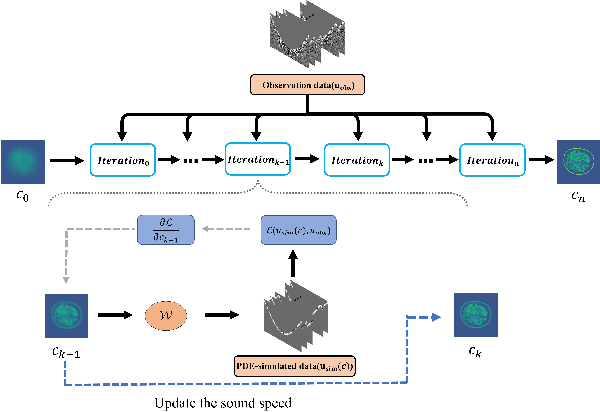
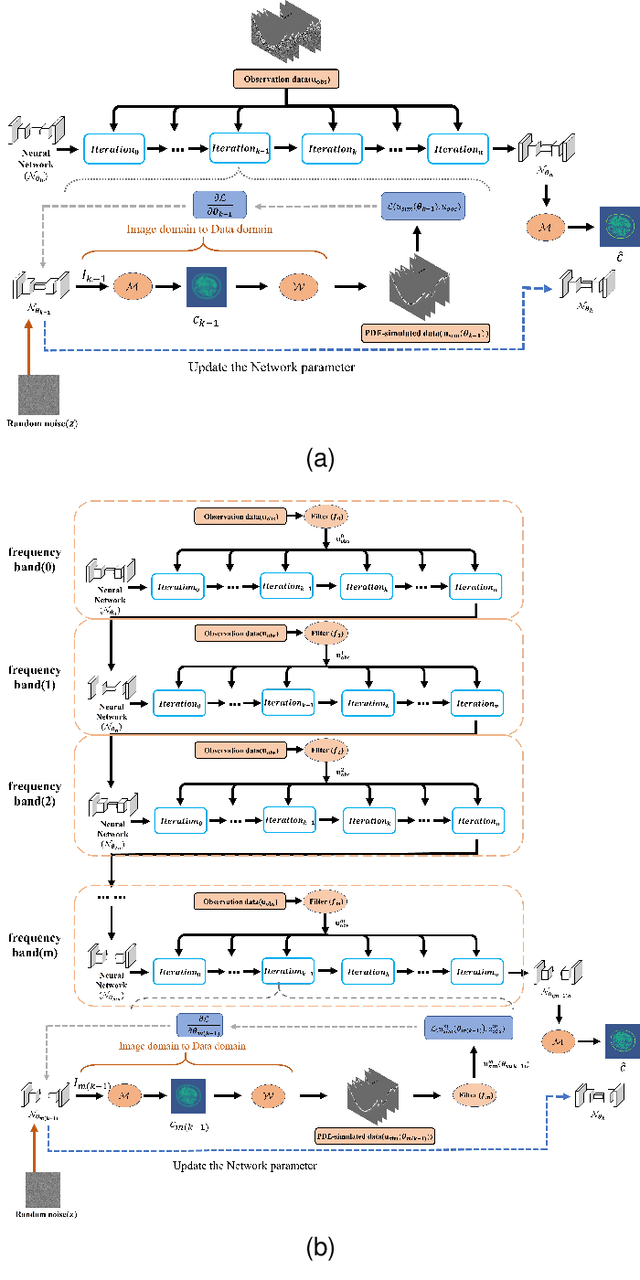
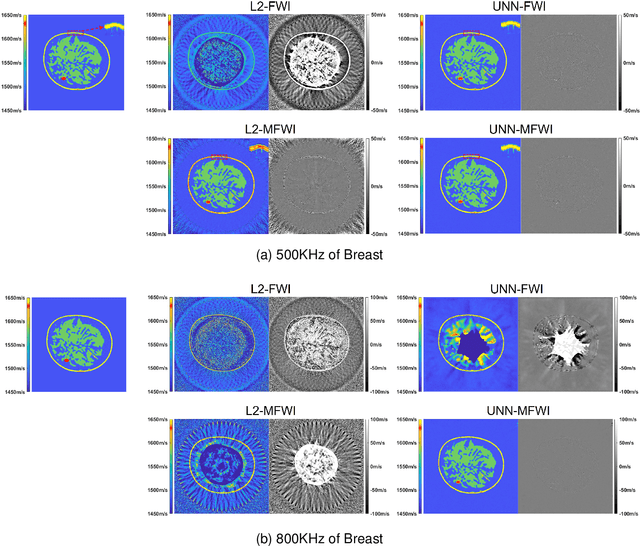
Ultrasound computed tomography (USCT), as an emerging technology, can provide multiple quantitative parametric images of human tissue, such as sound speed and attenuation images, distinguishing it from conventional B-mode (reflection) ultrasound imaging. Full waveform inversion (FWI) is acknowledged as a technique with the greatest potential for reconstructing high-resolution sound speed images in USCT. However, traditional FWI for sound speed image reconstruction suffers from high sensitivity to the initial model caused by its strong non-convex nonlinearity, resulting in poor performance when ultrasound signals are at high frequencies. This limitation significantly restricts the application of FWI in the USCT imaging field. In this paper, we propose an untrained neural network (UNN) that can be integrated into the traditional iteration-based FWI framework as an implicit regularization prior. This integration allows for seamless deployment as a plug-and-play module within existing FWI algorithms or their variants. Notably, the proposed UNN method can be trained in an unsupervised fashion, a vital aspect in medical imaging where ground truth data is often unavailable. Evaluations of the numerical simulation and phantom experiment of the breast demonstrate that the proposed UNN improves the robustness of image reconstruction, reduces image artifacts, and achieves great image contrast. To the best of our knowledge, this study represents the first attempt to propose an implicit UNN for FWI in reconstructing sound speed images for USCT.