 Add to Chrome
 Add to Firefox
 Add to Edge
RECO: Region-Aware Compensation for Extrinsic Perturbations in Roadside 3D Detection
Jul 23, 2026
In intelligent transportation systems, roadside 3D object detection provides wide-area perception crucial for traffic understanding, cooperative early warning, and safe autonomous driving. However, existing methods suffer from high sensitivity to camera extrinsics; even slight deviations (whether manifesting as transient jitter or persistent drift) can be significantly amplified by projective geometry. This cascade results in severe feature misalignment and degraded localization. To mitigate this limitation, we propose RECO, a region-aware extrinsic compensation framework that corrects extrinsics using piecewise 6-DoF pose offsets. RECO predicts a learnable range boundary to partition the scene into near and far regions, estimating region-specific pose corrections. A differentiable sigmoid gate then smoothly blends the two compensated geometries to preserve continuous BEV sampling and facilitate stable optimization. To supervise the refinement of extrinsics, we introduce an auxiliary reprojection loss that compares 2D bounding boxes projected from 3D ground truth against 2D annotations, optimizing it jointly with the standard detection objective. Extensive experiments on the DAIR-V2X-I and Rope3D benchmarks under extrinsic perturbations demonstrate consistent improvements over state-of-the-art baselines across both yaw and $z$-axis deviations. RECO also generalizes from transient perturbations to persistent shifts, maintaining highly competitive performance under strict calibration uncertainty.

Potential Destination Prediction Based on Knowledge Graph Under Low Predictability Data Condition
Jan 30, 2022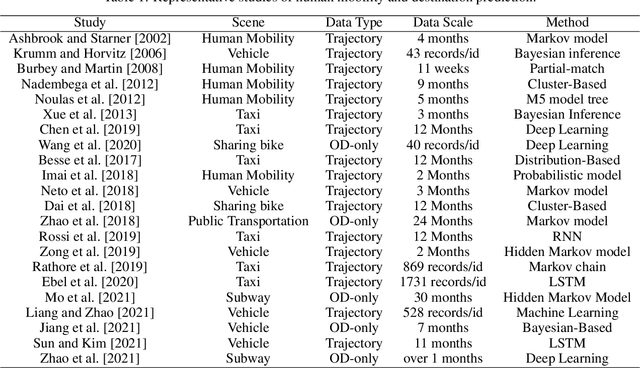
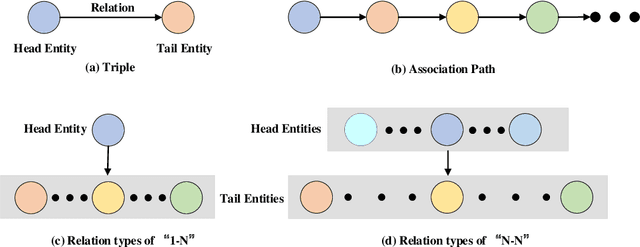
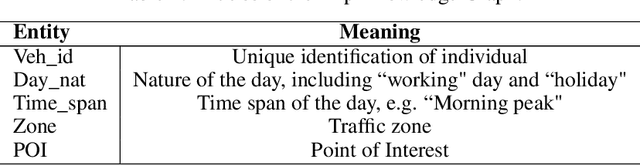
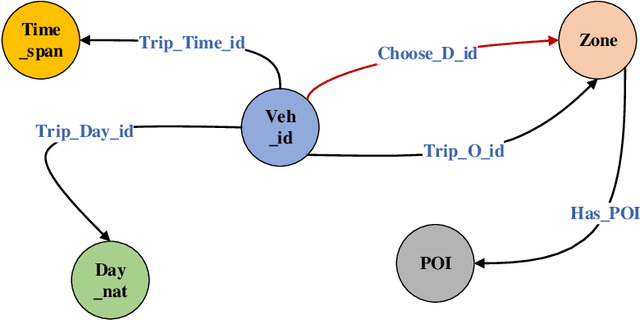
Destination prediction has been a critical topic in transportation research, and there are a large number of studies. However, almost all existing studies are based on high predictability data conditions while pay less attention to the data condition with low predictability, where the regularity of single individuals is not exposed. Based on a certain period of observation, there is a fact that individuals may choose destinations beyond observation, which we call "potential destinations". The number of potential destinations is very large and can't be ignored for the data condition with low predictability formed by short-term observation.To reveal the choice pattern of potential destination of individuals under the data condition with low predictability, we propose a global optimization method based on knowledge graph embedding. First, we joint the trip data of all individuals by constructing Trip Knowledge Graph(TKG). Next, we optimize the general algorithm of knowledge graph embedding for our data and task in training strategy and objective function, then implement it on TKG. It can achieve global optimization for association paths that exist between almost any two entities in TKG. On this basis, a method for potential destination prediction is proposed, giving the possible ranking of unobserved destinations for each individual. In addition, we improve the performance by fusing static statistical information that is not passed to TKG. Finally, we validate our method in a real-world dataset, and the prediction results are highly consistent with individuals' potential destination choice behaviour.