 Add to Chrome
 Add to Firefox
 Add to Edge
Semantic-Edge Response Decoding of SAM3 for Zero-Shot Crack Segmentation
Jul 14, 2026
Crack segmentation is essential for infrastructure inspection and structural health assessment, but existing high-performance methods typically require task-specific pixel-level annotations and training. Text-promptable vision foundation models enable zero-shot deployment, yet their final mask proposals are poorly suited to thin, fragmented, and low-contrast cracks, whose evidence may be suppressed, truncated, or over-expanded during mask generation. We find that language-conditioned semantic responses within the SAM3 decoder preserve more continuous and complete crack evidence than its final masks. Based on this observation, we propose Semantic-Edge Response Decoding (SERD), which interprets internal responses as a dense crack-likelihood field, calibrates them with a lightweight edge prior, and generates crack masks using a unified global threshold, without annotation or fine-tuning. Experiments on six public datasets show that SERD consistently improves over native SAM3 and outperforms the compared zero-shot and open-vocabulary segmentation methods, achieving an average Crack IoU of 61.14\%, 4.63 points higher than SAM3. Further analyses show that most gains arise from directly decoding internal semantic responses, while edge calibration improves structural recovery and false-positive control without increasing end-to-end inference overhead. These results suggest that, for thin and non-compact targets, internal continuous responses can provide a more transferable interface than the final masks of foundation models. Code is available at: https://github.com/xauat-liushipeng/SERD

Contrastive Learning for Image Complexity Representation
Aug 06, 2024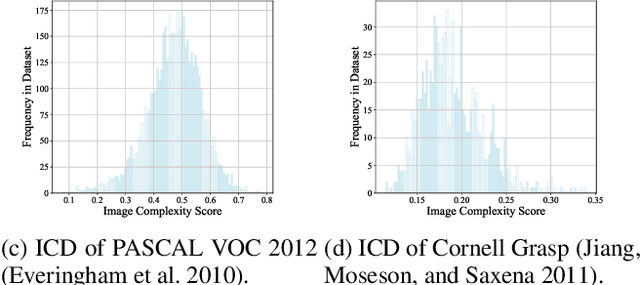
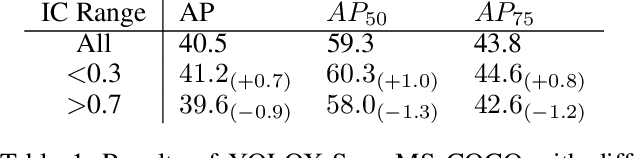

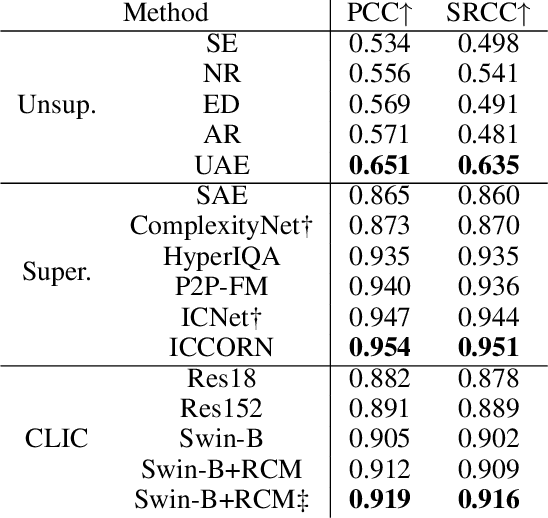
Quantifying and evaluating image complexity can be instrumental in enhancing the performance of various computer vision tasks. Supervised learning can effectively learn image complexity features from well-annotated datasets. However, creating such datasets requires expensive manual annotation costs. The models may learn human subjective biases from it. In this work, we introduce the MoCo v2 framework. We utilize contrastive learning to represent image complexity, named CLIC (Contrastive Learning for Image Complexity). We find that there are complexity differences between different local regions of an image, and propose Random Crop and Mix (RCM), which can produce positive samples consisting of multi-scale local crops. RCM can also expand the train set and increase data diversity without introducing additional data. We conduct extensive experiments with CLIC, comparing it with both unsupervised and supervised methods. The results demonstrate that the performance of CLIC is comparable to that of state-of-the-art supervised methods. In addition, we establish the pipelines that can apply CLIC to computer vision tasks to effectively improve their performance.