 Add to Chrome
 Add to Firefox
 Add to Edge
Text region detection in historical astronomical diagrams
Jun 14, 2026
Text detection is a crucial task in the analysis of historical documents. While datasets and benchmarks exist for text detection in manuscripts and maps, the study of text in mathematical diagrams has received little attention. To address this, we introduce a large-scale, diverse, open-access dataset of 948 historical astronomical diagrams containing 10,940 oriented polygonal text regions. Our dataset spans ten centuries (8th to 18th) and seven main linguistic traditions: Arabic and Persian (115), Chinese (332), Byzantine (233), Latin (185), Hebrew (48), and Sanskrit (35). It captures a wide range of diagram styles and textual content, from symbols to multi-line paragraphs. Each text instance is annotated with ordered polygons that precisely delineate text regions and encode the reading direction. In addition, we annotated the 2,293 regions in Latin diagrams with 20 class labels. We evaluated several strong baselines on our dataset, including TESTR, DeepSolo++, and Poly-DETR, a simple extension of DINO-DETR that we design to predict ordered polygon vertices. Poly-DETR achieves state-of-the-art performance on the MTHv2 and cBAD2019 benchmarks and provides a solid, simple baseline on our dataset. Code and dataset available online.

Deep sprite-based image models: An analysis
Apr 21, 2026While foundation models drive steady progress in image segmentation and diffusion algorithms compose always more realistic images, the seemingly simple problem of identifying recurrent patterns in a collection of images remains very much open. In this paper, we focus on sprite-based image decomposition models, which have shown some promise for clustering and image decomposition and are appealing because of their high interpretability. These models come in different flavors, need to be tailored to specific datasets, and struggle to scale to images with many objects. We dive into the details of their design, identify their core components, and perform an extensive analysis on clustering benchmarks. We leverage this analysis to propose a deep sprite-based image decomposition method that performs on par with state-of-the-art unsupervised class-aware image segmentation methods on the standard CLEVR benchmark, scales linearly with the number of objects, identifies explicitly object categories, and fully models images in an easily interpretable way.
Intrinsic Dimensionality as a Model-Free Measure of Class Imbalance
Nov 13, 2025Imbalance in classification tasks is commonly quantified by the cardinalities of examples across classes. This, however, disregards the presence of redundant examples and inherent differences in the learning difficulties of classes. Alternatively, one can use complex measures such as training loss and uncertainty, which, however, depend on training a machine learning model. Our paper proposes using data Intrinsic Dimensionality (ID) as an easy-to-compute, model-free measure of imbalance that can be seamlessly incorporated into various imbalance mitigation methods. Our results across five different datasets with a diverse range of imbalance ratios show that ID consistently outperforms cardinality-based re-weighting and re-sampling techniques used in the literature. Moreover, we show that combining ID with cardinality can further improve performance. Code: https://github.com/cagries/IDIM.
Generalized Mask-aware IoU for Anchor Assignment for Real-time Instance Segmentation
Dec 28, 2023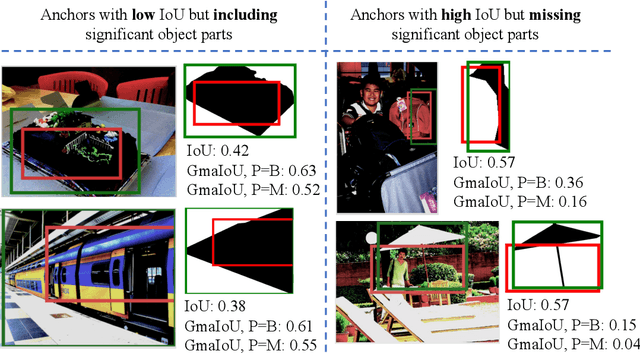
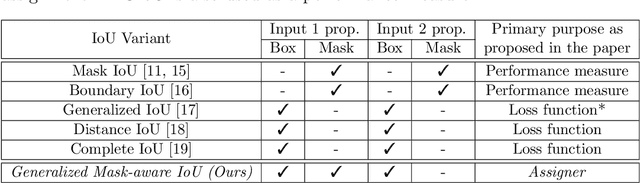
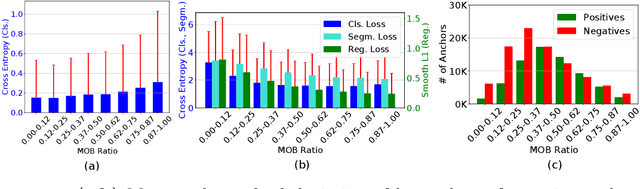
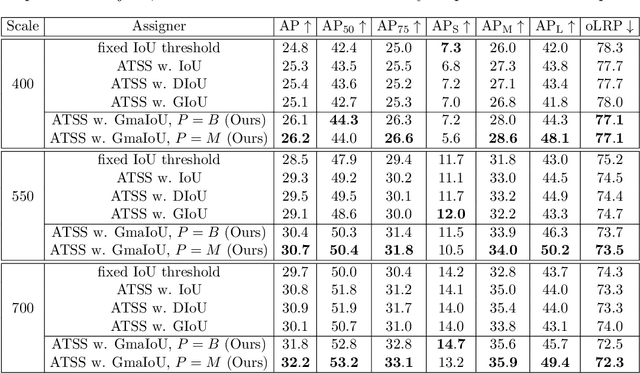
This paper introduces Generalized Mask-aware Intersection-over-Union (GmaIoU) as a new measure for positive-negative assignment of anchor boxes during training of instance segmentation methods. Unlike conventional IoU measure or its variants, which only consider the proximity of anchor and ground-truth boxes; GmaIoU additionally takes into account the segmentation mask. This enables GmaIoU to provide more accurate supervision during training. We demonstrate the effectiveness of GmaIoU by replacing IoU with our GmaIoU in ATSS, a state-of-the-art (SOTA) assigner. Then, we train YOLACT, a real-time instance segmentation method, using our GmaIoU-based ATSS assigner. The resulting YOLACT based on the GmaIoU assigner outperforms (i) ATSS with IoU by $\sim 1.0-1.5$ mask AP, (ii) YOLACT with a fixed IoU threshold assigner by $\sim 1.5-2$ mask AP over different image sizes and (iii) decreases the inference time by $25 \%$ owing to using less anchors. Taking advantage of this efficiency, we further devise GmaYOLACT, a faster and $+7$ mask AP points more accurate detector than YOLACT. Our best model achieves $38.7$ mask AP at $26$ fps on COCO test-dev establishing a new state-of-the-art for real-time instance segmentation.