 Add to Chrome
 Add to Firefox
 Add to Edge
COGENT: Continuous Graph Emulators with Neural Ordinary Differential Equations for Long-Term Physical Forecasting
Jun 09, 2026
In this work, we present COGENT, a continuous graph emulator with Neural Ordinary Differential Equations for long-term physical forecasting on irregular geospatial meshes. COGENT encodes a finite history of system states and associated forcing fields and external forcings with a graph-based history encoder, producing node-wise context vectors that capture both local spatial interactions and temporal evolution. These context vectors initialize and condition a latent Neural Ordinary Differential Equation whose dynamics are driven by interpolated future forcings and explicit relative rollout time. By modeling the forecast trajectory as a continuous latent dynamical system, COGENT can generate predictions at arbitrary future times rather than being restricted to a fixed temporal discretization. A residual decoder maps the resulting latent trajectories back to future physical states, enabling direct multi-step forecasting without repeatedly feeding predicted states back into the model. This formulation combines graph-based spatial representation, history-conditioned latent dynamics, and continuous-time rollout in a unified framework for mesh-based physical simulation emulation. In order to stabilize training with long-horizon supervision, we also propose effective rollout-horizon sampling and a progressive rollout-horizon scheduling strategy. We evaluate COGENT on transient ice-sheet simulations generated by the Ice-sheet and Sea-level System Model, demonstrating improved long-range stability over autoregressive graph baselines. These results suggest that continuous graph Neural ODEs provide a promising methodology for scalable physical forecasting on irregular geospatial meshes, particularly in applications that require stable long-horizon predictions and the ability to query system states at arbitrary times.

From Short Histories to Long Futures: Horizon-Aware Graph Neural Networks for Long Horizon Forecasting
May 28, 2026Accurate long-range prediction of geophysical systems is difficult due to strongly nonlinear dynamics, the high computational cost of full-physics simulations, and the error accumulation that arise when one-step autoregressive surrogates are rolled out over decades. Deep neural network can serve as efficient emulators, but most are trained only for next-step prediction and often drift or become unstable as the forecast horizon grows. We propose a multi-horizon graph neural network emulator that learns state-to-state transitions from a single current time to multiple future lead times within one unified model. The physical domain is represented as a graph, where nodes correspond to spatial locations with time-varying geophysical attributes and edges encode local spatial interactions. Given the current graph state, the model predicts the future evolution of key fields, ice thickness and ice velocities at all nodes, using a shared graph backbone with separate output branches for each target variable. To improve stability, the network predicts state increments relative to the current state, which are then added back to reconstruct future states. Training jointly optimizes all lead times with a unified regression objective, and inference uses a coarse-to-fine rollout that advances with larger jumps and selectively refines with shorter jumps to reduce drift and avoid redundant computation. Experiments on multi-decadal Pine Island Glacier simulations show that our approach achieves higher long-range accuracy and improved stability than both (i) an initial-state baseline that predicts each future time directly from the starting state and (ii) a standard single-step autoregressive rollout, producing a more reliable emulator for downstream climate and sea-level studies.
DA-SegFormer: Damage-Aware Semantic Segmentation for Fine-Grained Disaster Assessment
May 11, 2026Rapid and accurate damage assessment following natural disasters is critical for effective emergency response. However, identifying fine-grained damage levels (e.g., distinguishing minor from major roof damage) in UAV imagery remains challenging due to the degradation of texture cues during resizing and extreme class imbalance. We propose DA-SegFormer, a damage-aware adaptation of the SegFormer architecture optimized for high-resolution disaster imagery. Our method introduces a Class-Aware Sampling strategy to guarantee exposure to rare damage features, and it integrates Online Hard Example Mining (OHEM) with Dice Loss to dynamically focus on underrepresented classes. In addition, we employ a resolution-preserving inference protocol that maintains native texture details. Evaluated on the RescueNet dataset, DA-SegFormer achieves 74.61\% mIoU, outperforming the baseline by 2.55\%. Notably, our improvements yield double-digit gains in critical damage classes: Minor Damage (+11.7%) and Major Damage (+21.3%).
Physics-Conditioned Synthesis of Internal Ice-Layer Thickness for Incomplete Layer Traces
Apr 22, 2026Internal ice layers imaged by radar provide key evidence of snow accumulation and ice dynamics, but radar-derived layer boundary observations are often incomplete, with discontinuous traces and sometimes entirely missing layers, due to limited resolution, sensor noise, and signal loss. Existing graph-based models for ice stratigraphy generally assume sufficiently complete layer profiles and focus on predicting deeper-layer thickness from reliably traced shallow layers. In this work, we address the layer-completion problem itself by synthesizing complete ice-layer thickness annotations from incomplete radar-derived layer traces by conditioning on colocated physical features synchronized from physical climate models. The proposed network combines geometric learning to aggregate within-layer spatial context with a transformer-based temporal module that propagates information across layers to encourage coherent stratigraphy and consistent thickness evolution. To learn from incomplete supervision, we optimize a mask-aware robust regression objective that evaluates errors only at observed thickness values and normalizes by the number of valid entries, enabling stable training under varying sparsity without imputation and steering completions toward physically plausible values. The model preserves observed thickness where available and infers only missing regions, recovering fragmented segments and even fully absent layers while remaining consistent with measured traces. As an additional benefit, the synthesized thickness stacks provide effective pretraining supervision for a downstream deep-layer predictor, improving fine-tuned accuracy over training from scratch on the same fully traced data.
K-STEMIT: Knowledge-Informed Spatio-Temporal Efficient Multi-Branch Graph Neural Network for Subsurface Stratigraphy Thickness Estimation from Radar Data
Apr 10, 2026Subsurface stratigraphy contains important spatio-temporal information about accumulation, deformation, and layer formation in polar ice sheets. In particular, variations in internal ice layer thickness provide valuable constraints for snow mass balance estimation and projections of ice sheet change. Although radar sensors can capture these layered structures as depth-resolved radargrams, convolutional neural networks applied directly to radar images are often sensitive to speckle noise and acquisition artifacts. In addition, purely data-driven methods may underuse physical knowledge, leading to unrealistic thickness estimates under spatial or temporal extrapolation. To address these challenges, we develop K-STEMIT, a novel knowledge-informed, efficient, multi-branch spatio-temporal graph neural network that combines a geometric framework for spatial learning with temporal convolution to capture temporal dynamics, and incorporates physical data synchronized from the Model Atmospheric Regional physical weather model. An adaptive feature fusion strategy is employed to dynamically combine features learned from different branches. Extensive experiments have been conducted to compare K-STEMIT against current state-of-the-art methods in both knowledge-informed and non-knowledge-informed settings, as well as other existing methods. Results show that K-STEMIT consistently achieves the highest accuracy while maintaining near-optimal efficiency. Most notably, incorporating adaptive feature fusion and physical priors reduces the root mean-squared error by 21.01% with negligible additional cost compared to its conventional multi-branch variants. Additionally, our proposed K-STEMIT achieves consistently lower per-year relative MAE, enabling reliable, continuous spatiotemporal assessment of snow accumulation variability across large spatial regions.
GRIT: Graph Transformer For Internal Ice Layer Thickness Prediction
Jul 10, 2025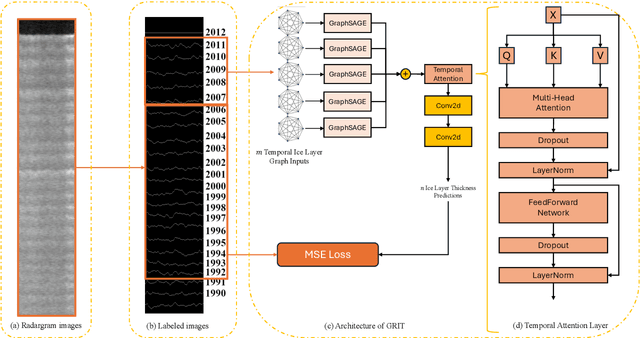
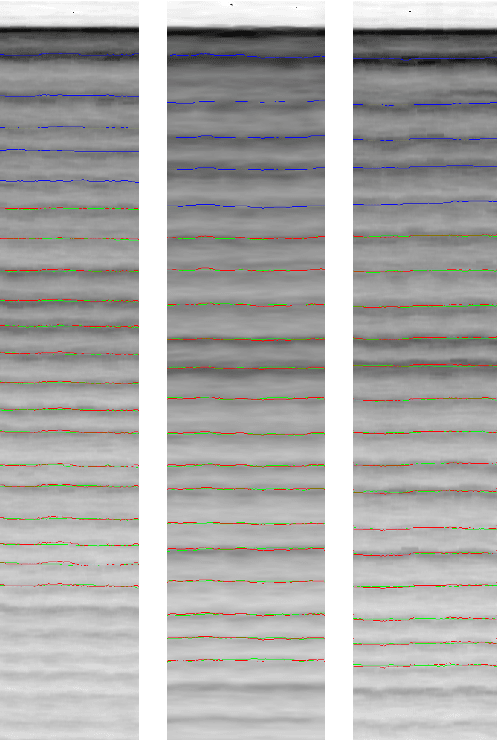
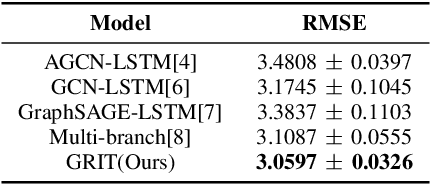
Gaining a deeper understanding of the thickness and variability of internal ice layers in Radar imagery is essential in monitoring the snow accumulation, better evaluating ice dynamics processes, and minimizing uncertainties in climate models. Radar sensors, capable of penetrating ice, capture detailed radargram images of internal ice layers. In this work, we introduce GRIT, graph transformer for ice layer thickness. GRIT integrates an inductive geometric graph learning framework with an attention mechanism, designed to map the relationships between shallow and deeper ice layers. Compared to baseline graph neural networks, GRIT demonstrates consistently lower prediction errors. These results highlight the attention mechanism's effectiveness in capturing temporal changes across ice layers, while the graph transformer combines the strengths of transformers for learning long-range dependencies with graph neural networks for capturing spatial patterns, enabling robust modeling of complex spatiotemporal dynamics.
ST-GRIT: Spatio-Temporal Graph Transformer For Internal Ice Layer Thickness Prediction
Jul 10, 2025Understanding the thickness and variability of internal ice layers in radar imagery is crucial for monitoring snow accumulation, assessing ice dynamics, and reducing uncertainties in climate models. Radar sensors, capable of penetrating ice, provide detailed radargram images of these internal layers. In this work, we present ST-GRIT, a spatio-temporal graph transformer for ice layer thickness, designed to process these radargrams and capture the spatiotemporal relationships between shallow and deep ice layers. ST-GRIT leverages an inductive geometric graph learning framework to extract local spatial features as feature embeddings and employs a series of temporal and spatial attention blocks separately to model long-range dependencies effectively in both dimensions. Experimental evaluation on radargram data from the Greenland ice sheet demonstrates that ST-GRIT consistently outperforms current state-of-the-art methods and other baseline graph neural networks by achieving lower root mean-squared error. These results highlight the advantages of self-attention mechanisms on graphs over pure graph neural networks, including the ability to handle noise, avoid oversmoothing, and capture long-range dependencies. Moreover, the use of separate spatial and temporal attention blocks allows for distinct and robust learning of spatial relationships and temporal patterns, providing a more comprehensive and effective approach.
Multi-branch Spatio-Temporal Graph Neural Network For Efficient Ice Layer Thickness Prediction
Nov 06, 2024Understanding spatio-temporal patterns in polar ice layers is essential for tracking changes in ice sheet balance and assessing ice dynamics. While convolutional neural networks are widely used in learning ice layer patterns from raw echogram images captured by airborne snow radar sensors, noise in the echogram images prevents researchers from getting high-quality results. Instead, we focus on geometric deep learning using graph neural networks, aiming to build a spatio-temporal graph neural network that learns from thickness information of the top ice layers and predicts for deeper layers. In this paper, we developed a novel multi-branch spatio-temporal graph neural network that used the GraphSAGE framework for spatio features learning and a temporal convolution operation to capture temporal changes, enabling different branches of the network to be more specialized and focusing on a single learning task. We found that our proposed multi-branch network can consistently outperform the current fused spatio-temporal graph neural network in both accuracy and efficiency.
Learning Spatio-Temporal Patterns of Polar Ice Layers With Physics-Informed Graph Neural Network
Jun 21, 2024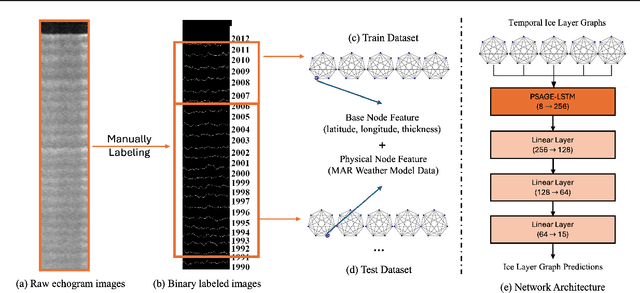
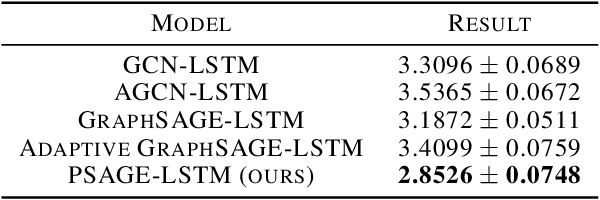
Learning spatio-temporal patterns of polar ice layers is crucial for monitoring the change in ice sheet balance and evaluating ice dynamic processes. While a few researchers focus on learning ice layer patterns from echogram images captured by airborne snow radar sensors via different convolutional neural networks, the noise in the echogram images proves to be a major obstacle. Instead, we focus on geometric deep learning based on graph neural networks to learn the spatio-temporal patterns from thickness information of shallow ice layers and make predictions for deep layers. In this paper, we propose a physics-informed hybrid graph neural network that combines the GraphSAGE framework for graph feature learning with the long short-term memory (LSTM) structure for learning temporal changes, and introduce measurements of physical ice properties from Model Atmospheric Regional (MAR) weather model as physical node features. We found that our proposed network can consistently outperform the current non-inductive or non-physical model in predicting deep ice layer thickness.
Physics-Informed Machine Learning On Polar Ice: A Survey
Apr 30, 2024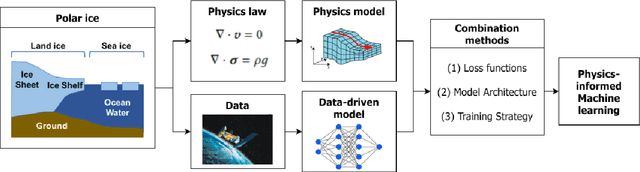
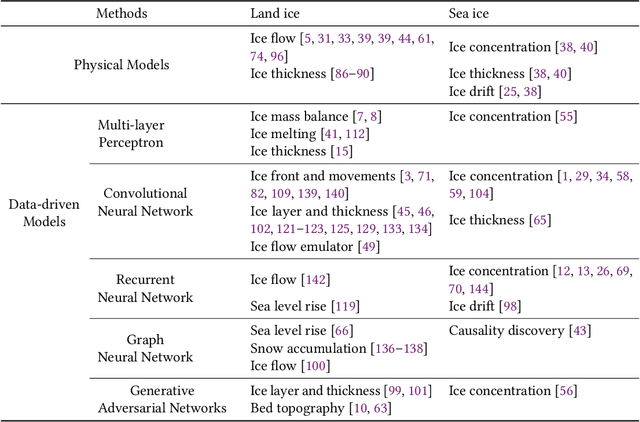
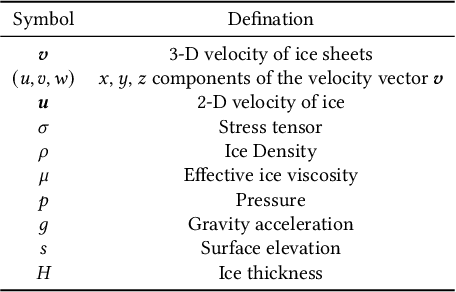
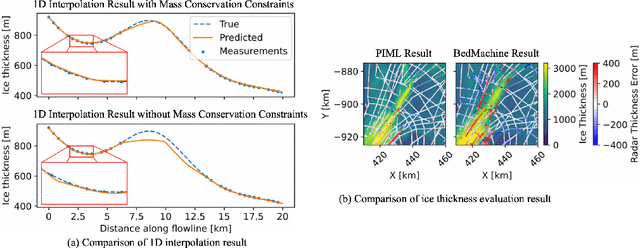
The mass loss of the polar ice sheets contributes considerably to ongoing sea-level rise and changing ocean circulation, leading to coastal flooding and risking the homes and livelihoods of tens of millions of people globally. To address the complex problem of ice behavior, physical models and data-driven models have been proposed in the literature. Although traditional physical models can guarantee physically meaningful results, they have limitations in producing high-resolution results. On the other hand, data-driven approaches require large amounts of high-quality and labeled data, which is rarely available in the polar regions. Hence, as a promising framework that leverages the advantages of physical models and data-driven methods, physics-informed machine learning (PIML) has been widely studied in recent years. In this paper, we review the existing algorithms of PIML, provide our own taxonomy based on the methods of combining physics and data-driven approaches, and analyze the advantages of PIML in the aspects of accuracy and efficiency. Further, our survey discusses some current challenges and highlights future opportunities, including PIML on sea ice studies, PIML with different combination methods and backbone networks, and neural operator methods.