 Add to Chrome
 Add to Firefox
 Add to Edge
Abnormalities and Disease Detection in Gastro-Intestinal Tract Images
Mar 23, 2026
Gastrointestinal (GI) tract image analysis plays a crucial role in medical diagnosis. This research addresses the challenge of accurately classifying and segmenting GI images for real-time applications, where traditional methods often struggle due to the diversity and complexity of abnormalities. The high computational demands of this domain require efficient and adaptable solutions. This PhD thesis presents a multifaceted approach to GI image analysis. Initially, texture-based feature extraction and classification methods were explored, achieving high processing speed (over 4000 FPS) and strong performance (F1-score: 0.76, Accuracy: 0.98) on the Kvasir V2 dataset. The study then transitions to deep learning, where an optimized model combined with data bagging techniques improved performance, reaching an accuracy of 0.92 and an F1-score of 0.60 on the HyperKvasir dataset, and an F1-score of 0.88 on Kvasir V2. To support real-time detection, a streamlined neural network integrating texture and local binary patterns was developed. By addressing inter-class similarity and intra-class variation through a learned threshold, the system achieved 41 FPS with high accuracy (0.99) and an F1-score of 0.91 on HyperKvasir. Additionally, two segmentation tools are proposed to enhance usability, leveraging Depth-Wise Separable Convolution and neural network ensembles for improved detection, particularly in low-FPS scenarios. Overall, this research introduces novel and adaptable methodologies, progressing from traditional texture-based techniques to deep learning and ensemble approaches, providing a comprehensive framework for advancing GI image analysis.

Textual analysis of End User License Agreement for red-flagging potentially malicious software
Mar 11, 2024New software and updates are downloaded by end users every day. Each dowloaded software has associated with it an End Users License Agreements (EULA), but this is rarely read. An EULA includes information to avoid legal repercussions. However,this proposes a host of potential problems such as spyware or producing an unwanted affect in the target system. End users do not read these EULA's because of length of the document and users find it extremely difficult to understand. Text summarization is one of the relevant solution to these kind of problems. This require a solution which can summarize the EULA and classify the EULA as "Benign" or "Malicious". We propose a solution in which we have summarize the EULA and classify the EULA as "Benign" or "Malicious". We extract EULA text of different sofware's then we classify the text using eight different supervised classifiers. we use ensemble learning to classify the EULA as benign or malicious using five different text summarization methods. An accuracy of $95.8$\% shows the effectiveness of the presented approach.
An objective validation of polyp and instrument segmentation methods in colonoscopy through Medico 2020 polyp segmentation and MedAI 2021 transparency challenges
Jul 30, 2023
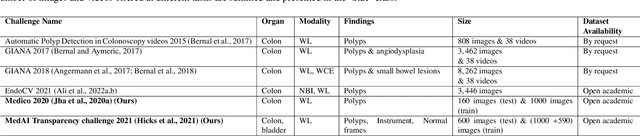
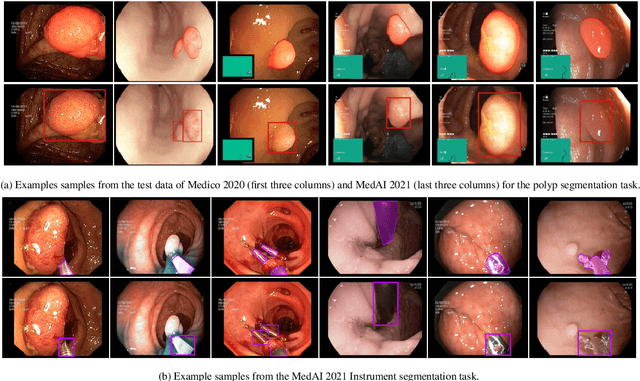
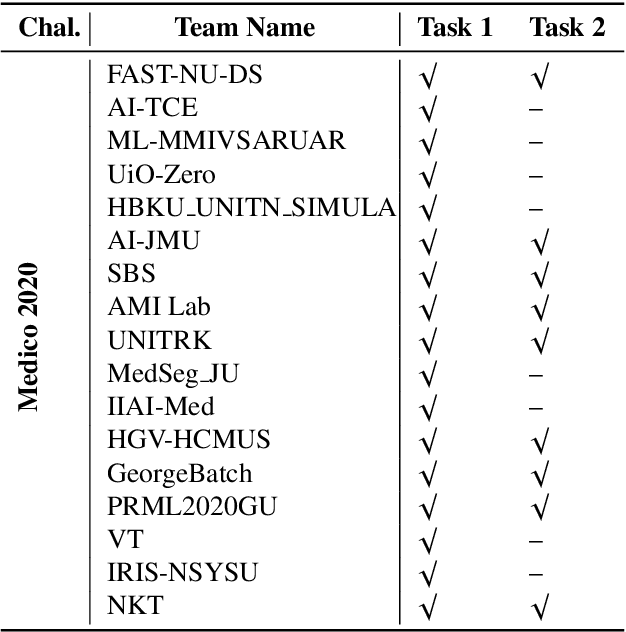
Automatic analysis of colonoscopy images has been an active field of research motivated by the importance of early detection of precancerous polyps. However, detecting polyps during the live examination can be challenging due to various factors such as variation of skills and experience among the endoscopists, lack of attentiveness, and fatigue leading to a high polyp miss-rate. Deep learning has emerged as a promising solution to this challenge as it can assist endoscopists in detecting and classifying overlooked polyps and abnormalities in real time. In addition to the algorithm's accuracy, transparency and interpretability are crucial to explaining the whys and hows of the algorithm's prediction. Further, most algorithms are developed in private data, closed source, or proprietary software, and methods lack reproducibility. Therefore, to promote the development of efficient and transparent methods, we have organized the "Medico automatic polyp segmentation (Medico 2020)" and "MedAI: Transparency in Medical Image Segmentation (MedAI 2021)" competitions. We present a comprehensive summary and analyze each contribution, highlight the strength of the best-performing methods, and discuss the possibility of clinical translations of such methods into the clinic. For the transparency task, a multi-disciplinary team, including expert gastroenterologists, accessed each submission and evaluated the team based on open-source practices, failure case analysis, ablation studies, usability and understandability of evaluations to gain a deeper understanding of the models' credibility for clinical deployment. Through the comprehensive analysis of the challenge, we not only highlight the advancements in polyp and surgical instrument segmentation but also encourage qualitative evaluation for building more transparent and understandable AI-based colonoscopy systems.