 Add to Chrome
 Add to Firefox
 Add to Edge
SketchPlay: Intuitive Creation of Physically Realistic VR Content with Gesture-Driven Sketching
Dec 26, 2025
Creating physically realistic content in VR often requires complex modeling tools or predefined 3D models, textures, and animations, which present significant barriers for non-expert users. In this paper, we propose SketchPlay, a novel VR interaction framework that transforms humans' air-drawn sketches and gestures into dynamic, physically realistic scenes, making content creation intuitive and playful like drawing. Specifically, sketches capture the structure and spatial arrangement of objects and scenes, while gestures convey physical cues such as velocity, direction, and force that define movement and behavior. By combining these complementary forms of input, SketchPlay captures both the structure and dynamics of user-created content, enabling the generation of a wide range of complex physical phenomena, such as rigid body motion, elastic deformation, and cloth dynamics. Experimental results demonstrate that, compared to traditional text-driven methods, SketchPlay offers significant advantages in expressiveness, and user experience. By providing an intuitive and engaging creation process, SketchPlay lowers the entry barrier for non-expert users and shows strong potential for applications in education, art, and immersive storytelling.

Efficient Multi-disparity Transformer for Light Field Image Super-resolution
Jul 22, 2024This paper presents the Multi-scale Disparity Transformer (MDT), a novel Transformer tailored for light field image super-resolution (LFSR) that addresses the issues of computational redundancy and disparity entanglement caused by the indiscriminate processing of sub-aperture images inherent in conventional methods. MDT features a multi-branch structure, with each branch utilising independent disparity self-attention (DSA) to target specific disparity ranges, effectively reducing computational complexity and disentangling disparities. Building on this architecture, we present LF-MDTNet, an efficient LFSR network. Experimental results demonstrate that LF-MDTNet outperforms existing state-of-the-art methods by 0.37 dB and 0.41 dB PSNR at the 2x and 4x scales, achieving superior performance with fewer parameters and higher speed.
Adaptive Global-Local Representation Learning and Selection for Cross-Domain Facial Expression Recognition
Jan 20, 2024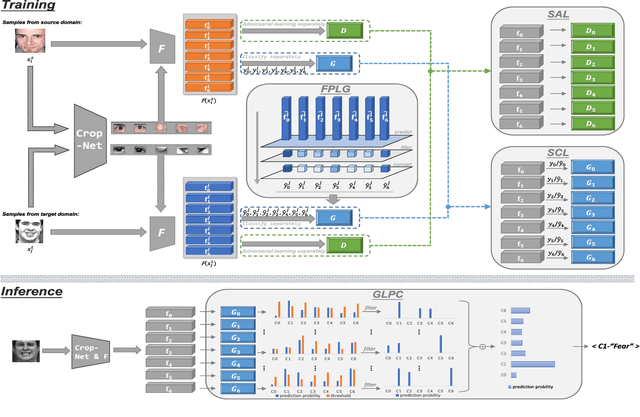
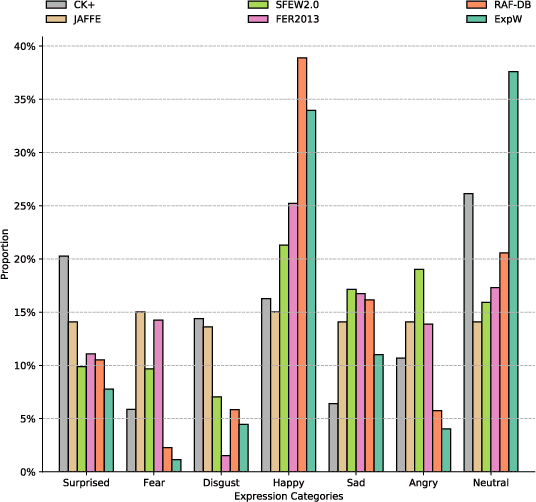
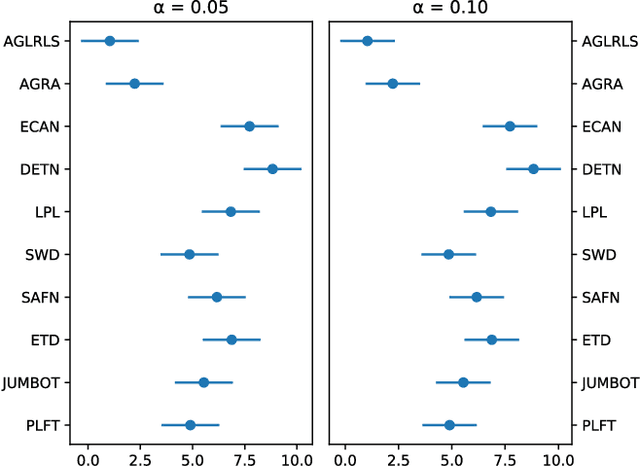
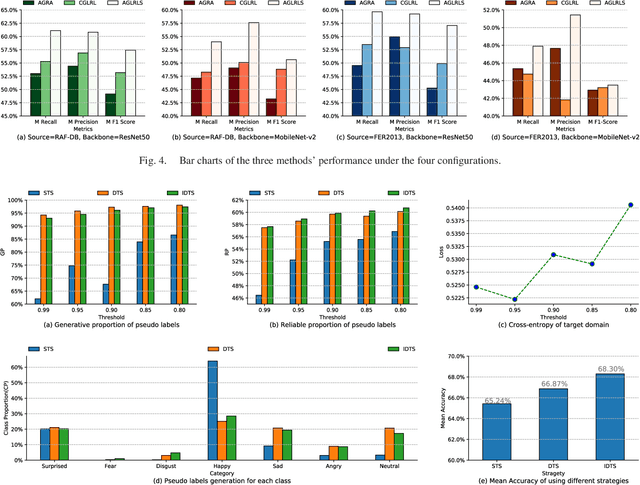
Domain shift poses a significant challenge in Cross-Domain Facial Expression Recognition (CD-FER) due to the distribution variation across different domains. Current works mainly focus on learning domain-invariant features through global feature adaptation, while neglecting the transferability of local features. Additionally, these methods lack discriminative supervision during training on target datasets, resulting in deteriorated feature representation in target domain. To address these limitations, we propose an Adaptive Global-Local Representation Learning and Selection (AGLRLS) framework. The framework incorporates global-local adversarial adaptation and semantic-aware pseudo label generation to enhance the learning of domain-invariant and discriminative feature during training. Meanwhile, a global-local prediction consistency learning is introduced to improve classification results during inference. Specifically, the framework consists of separate global-local adversarial learning modules that learn domain-invariant global and local features independently. We also design a semantic-aware pseudo label generation module, which computes semantic labels based on global and local features. Moreover, a novel dynamic threshold strategy is employed to learn the optimal thresholds by leveraging independent prediction of global and local features, ensuring filtering out the unreliable pseudo labels while retaining reliable ones. These labels are utilized for model optimization through the adversarial learning process in an end-to-end manner. During inference, a global-local prediction consistency module is developed to automatically learn an optimal result from multiple predictions. We conduct comprehensive experiments and analysis based on a fair evaluation benchmark. The results demonstrate that the proposed framework outperforms the current competing methods by a substantial margin.
Beyond Subspace Isolation: Many-to-Many Transformer for Light Field Image Super-resolution
Jan 01, 2024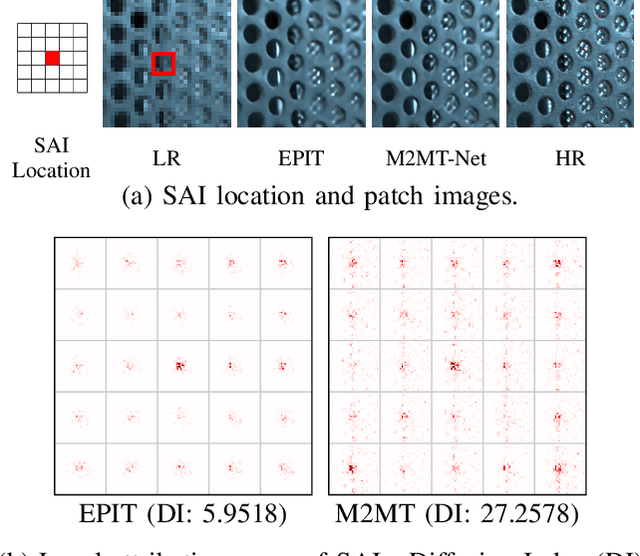
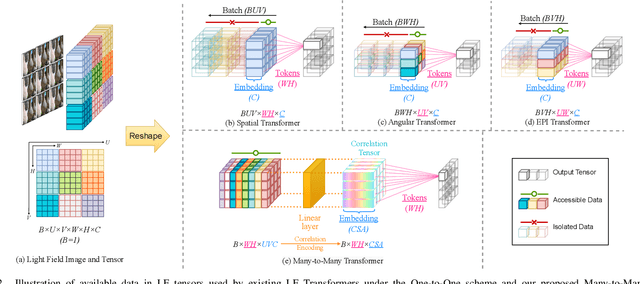
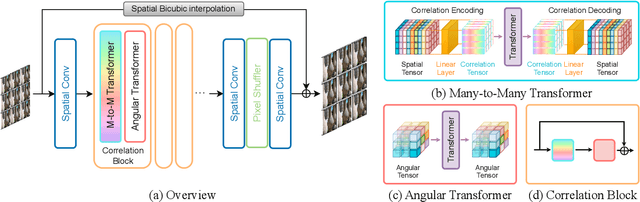
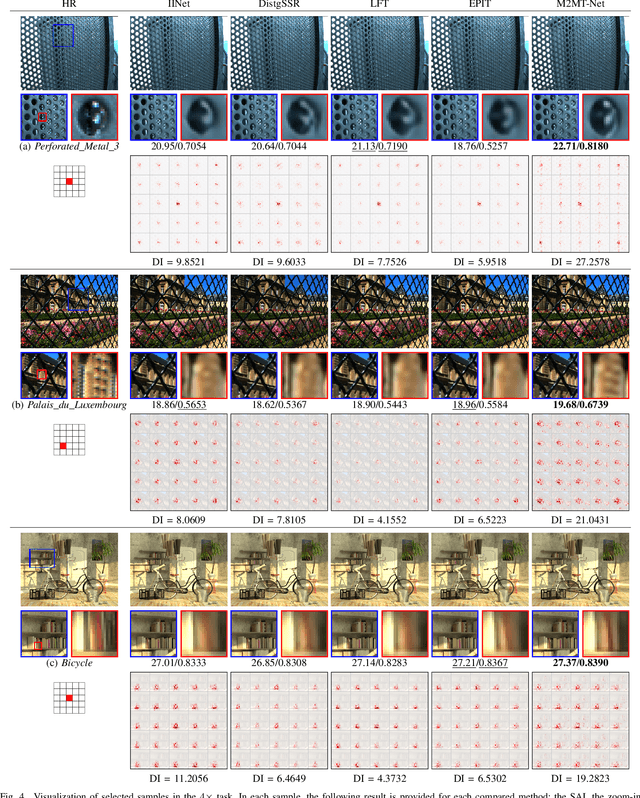
The effective extraction of spatial-angular features plays a crucial role in light field image super-resolution (LFSR) tasks, and the introduction of convolution and Transformers leads to significant improvement in this area. Nevertheless, due to the large 4D data volume of light field images, many existing methods opted to decompose the data into a number of lower-dimensional subspaces and perform Transformers in each sub-space individually. As a side effect, these methods inadvertently restrict the self-attention mechanisms to a One-to-One scheme accessing only a limited subset of LF data, explicitly preventing comprehensive optimization on all spatial and angular cues. In this paper, we identify this limitation as subspace isolation and introduce a novel Many-to-Many Transformer (M2MT) to address it. M2MT aggregates angular information in the spatial subspace before performing the self-attention mechanism. It enables complete access to all information across all sub-aperture images (SAIs) in a light field image. Consequently, M2MT is enabled to comprehensively capture long-range correlation dependencies. With M2MT as the pivotal component, we develop a simple yet effective M2MT network for LFSR. Our experimental results demonstrate that M2MT achieves state-of-the-art performance across various public datasets. We further conduct in-depth analysis using local attribution maps (LAM) to obtain visual interpretability, and the results validate that M2MT is empowered with a truly non-local context in both spatial and angular subspaces to mitigate subspace isolation and acquire effective spatial-angular representation.