 Add to Chrome
 Add to Firefox
 Add to Edge
MMR-AD: A Large-Scale Multimodal Dataset for Benchmarking General Anomaly Detection with Multimodal Large Language Models
Apr 13, 2026
In the progress of industrial anomaly detection, general anomaly detection (GAD) is an emerging trend and also the ultimate goal. Unlike the conventional single- and multi-class AD, general AD aims to train a general AD model that can directly detect anomalies in diverse novel classes without any retraining or fine-tuning on the target data. Recently, Multimodal Large Language Models (MLLMs) have shown great promise in achieving general anomaly detection due to their revolutionary visual understanding and language reasoning capabilities. However, MLLM's general AD ability remains underexplored due to: (1) MLLMs are pretrained on amounts of data sourced from the Web, these data still have significant gaps with the data in AD scenarios. Moreover, the image-text pairs during pretraining are also not specifically for AD tasks. (2) The current mainstream AD datasets are image-based and not yet suitable for post-training MLLMs. To facilitate MLLM-based general AD research, we present MMR-AD, which is a comprehensive benchmark for both training and evaluating MLLM-based AD models. With MMR-AD, we reveal that the AD performance of current SOTA generalist MLLMs still falls far behind the industrial requirements. Based on MMR-AD, we also propose a baseline model, Anomaly-R1, which is a reasoning-based AD model that learns from the CoT data in MMR-AD and is further enhanced by reinforcement learning. Extensive experiments show that our Anomaly-R1 achieves remarkable improvements over generalist MLLMs in both anomaly detection and localization.

ADPretrain: Advancing Industrial Anomaly Detection via Anomaly Representation Pretraining
Nov 07, 2025The current mainstream and state-of-the-art anomaly detection (AD) methods are substantially established on pretrained feature networks yielded by ImageNet pretraining. However, regardless of supervised or self-supervised pretraining, the pretraining process on ImageNet does not match the goal of anomaly detection (i.e., pretraining in natural images doesn't aim to distinguish between normal and abnormal). Moreover, natural images and industrial image data in AD scenarios typically have the distribution shift. The two issues can cause ImageNet-pretrained features to be suboptimal for AD tasks. To further promote the development of the AD field, pretrained representations specially for AD tasks are eager and very valuable. To this end, we propose a novel AD representation learning framework specially designed for learning robust and discriminative pretrained representations for industrial anomaly detection. Specifically, closely surrounding the goal of anomaly detection (i.e., focus on discrepancies between normals and anomalies), we propose angle- and norm-oriented contrastive losses to maximize the angle size and norm difference between normal and abnormal features simultaneously. To avoid the distribution shift from natural images to AD images, our pretraining is performed on a large-scale AD dataset, RealIAD. To further alleviate the potential shift between pretraining data and downstream AD datasets, we learn the pretrained AD representations based on the class-generalizable representation, residual features. For evaluation, based on five embedding-based AD methods, we simply replace their original features with our pretrained representations. Extensive experiments on five AD datasets and five backbones consistently show the superiority of our pretrained features. The code is available at https://github.com/xcyao00/ADPretrain.
Hierarchical Gaussian Mixture Normalizing Flow Modeling for Unified Anomaly Detection
Mar 20, 2024Unified anomaly detection (AD) is one of the most challenges for anomaly detection, where one unified model is trained with normal samples from multiple classes with the objective to detect anomalies in these classes. For such a challenging task, popular normalizing flow (NF) based AD methods may fall into a "homogeneous mapping" issue,where the NF-based AD models are biased to generate similar latent representations for both normal and abnormal features, and thereby lead to a high missing rate of anomalies. In this paper, we propose a novel Hierarchical Gaussian mixture normalizing flow modeling method for accomplishing unified Anomaly Detection, which we call HGAD. Our HGAD consists of two key components: inter-class Gaussian mixture modeling and intra-class mixed class centers learning. Compared to the previous NF-based AD methods, the hierarchical Gaussian mixture modeling approach can bring stronger representation capability to the latent space of normalizing flows, so that even complex multi-class distribution can be well represented and learned in the latent space. In this way, we can avoid mapping different class distributions into the same single Gaussian prior, thus effectively avoiding or mitigating the "homogeneous mapping" issue. We further indicate that the more distinguishable different class centers, the more conducive to avoiding the bias issue. Thus, we further propose a mutual information maximization loss for better structuring the latent feature space. We evaluate our method on four real-world AD benchmarks, where we can significantly improve the previous NF-based AD methods and also outperform the SOTA unified AD methods.
Focus the Discrepancy: Intra- and Inter-Correlation Learning for Image Anomaly Detection
Aug 06, 2023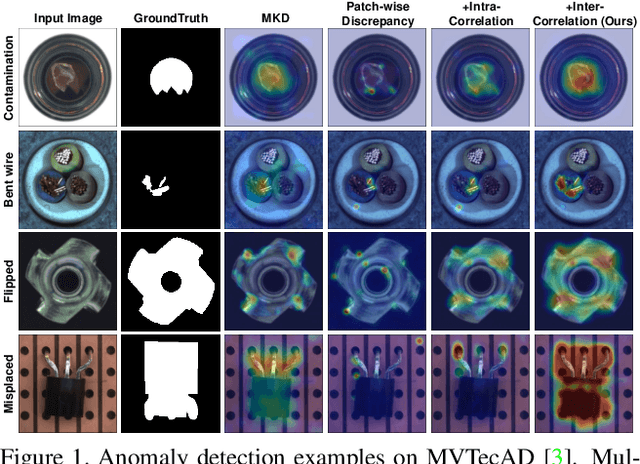


Humans recognize anomalies through two aspects: larger patch-wise representation discrepancies and weaker patch-to-normal-patch correlations. However, the previous AD methods didn't sufficiently combine the two complementary aspects to design AD models. To this end, we find that Transformer can ideally satisfy the two aspects as its great power in the unified modeling of patch-wise representations and patch-to-patch correlations. In this paper, we propose a novel AD framework: FOcus-the-Discrepancy (FOD), which can simultaneously spot the patch-wise, intra- and inter-discrepancies of anomalies. The major characteristic of our method is that we renovate the self-attention maps in transformers to Intra-Inter-Correlation (I2Correlation). The I2Correlation contains a two-branch structure to first explicitly establish intra- and inter-image correlations, and then fuses the features of two-branch to spotlight the abnormal patterns. To learn the intra- and inter-correlations adaptively, we propose the RBF-kernel-based target-correlations as learning targets for self-supervised learning. Besides, we introduce an entropy constraint strategy to solve the mode collapse issue in optimization and further amplify the normal-abnormal distinguishability. Extensive experiments on three unsupervised real-world AD benchmarks show the superior performance of our approach. Code will be available at https://github.com/xcyao00/FOD.