 Add to Chrome
 Add to Firefox
 Add to Edge
Temporal Structure Matters for Efficient Test-Time Adaptation in Wearable Human Activity Recognition
May 06, 2026
Wearable human activity recognition (WHAR) models often suffer from performance degradation under real-world cross-user distribution shifts. Test-time adaptation (TTA) mitigates this degradation by adapting models online using unlabeled test streams, yet existing methods largely inherit assumptions from vision tasks and underexploit the inherent inter-window temporal structure in WHAR streams. In this paper, we revisit such temporal structure as a feature-conditioned inference signal rather than merely an output-space smoothing prior. We derive the insight that temporal continuity and observation-induced feature deviations provide complementary cues for determining when to preserve or release temporal inertia and where to route prediction refinement during likely transitions. Building upon this insight, we propose SIGHT, a lightweight and backpropagation-free TTA framework for WHAR, enabling real-time edge deployment. SIGHT estimates predictive surprise by comparing the current feature with a prototype-based expected state, and then uses the resulting feature deviation to guide geometry-aware transition routing based on prototype alignment and stream-level marginal habit tracking. Evaluations on real-world datasets confirm that SIGHT outperforms existing TTA baselines while reducing computational and memory costs.

Analytic Personalized Federated Meta-Learning
Feb 10, 2025
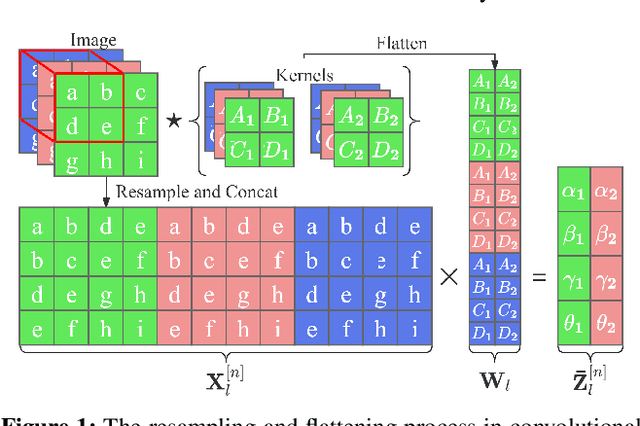
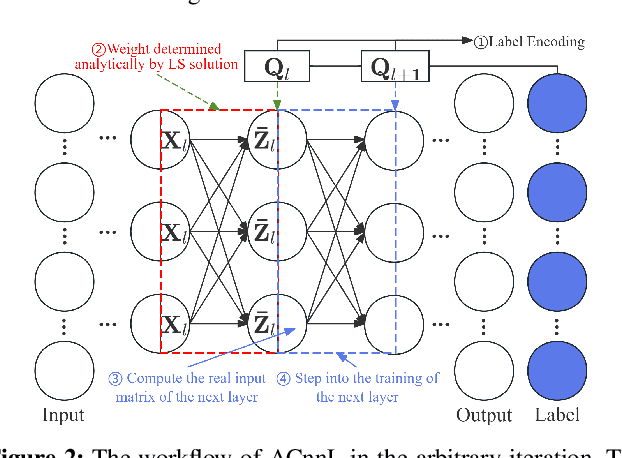

Analytic federated learning (AFL) which updates model weights only once by using closed-form least-square (LS) solutions can reduce abundant training time in gradient-free federated learning (FL). The current AFL framework cannot support deep neural network (DNN) training, which hinders its implementation on complex machine learning tasks. Meanwhile, it overlooks the heterogeneous data distribution problem that restricts the single global model from performing well on each client's task. To overcome the first challenge, we propose an AFL framework, namely FedACnnL, in which we resort to a novel local analytic learning method (ACnnL) and model the training of each layer as a distributed LS problem. For the second challenge, we propose an analytic personalized federated meta-learning framework, namely pFedACnnL, which is inherited from FedACnnL. In pFedACnnL, clients with similar data distribution share a common robust global model for fast adapting it to local tasks in an analytic manner. FedACnnL is theoretically proven to require significantly shorter training time than the conventional zeroth-order (i.e. gradient-free) FL frameworks on DNN training while the reduction ratio is $98\%$ in the experiment. Meanwhile, pFedACnnL achieves state-of-the-art (SOTA) model performance in most cases of convex and non-convex settings, compared with the previous SOTA frameworks.