 Add to Chrome
 Add to Firefox
 Add to Edge
Pretraining Language Models on Historical Text
Jun 02, 2026
We introduce TypewriterLM, a 7.24B History language model (LM) trained exclusively on English text predating 1913. Developing History LMs requires addressing challenges in data quality and availability, preventing temporal leakage, designing temporally consistent post-training pipelines, and constructing reliable evaluations. To address these issues, we construct TypewriterCorpus, a 54B-token historical corpus collected from diverse archival and linguistically annotated sources with extensive data cleaning and leakage mitigation procedures. Furthermore, we introduce lexically grounded instructing tuning, a post-training framework that constraints responses to remain directly grounded in historical source documents. Using this framework we construct two historical instruction tuning datasets: History-LIMA and History-SelfInstruct. To evaluate capability and temporal consistency, we introduce History-Event, a benchmark suite for evaluating competence, temporal grounding and data leakage. We release TypewriterLM and all associated resources to support future research on historical language models.

Procedural Pretraining: Warming Up Language Models with Abstract Data
Jan 29, 2026Pretraining directly on web-scale corpora is the de facto paradigm for building language models. We study an alternative setting where the model is initially exposed to abstract structured data, as a means to ease the subsequent acquisition of rich semantic knowledge, much like humans learn simple logic and mathematics before higher reasoning. We specifically focus on procedural data, generated by formal languages and other simple algorithms, as such abstract data. We first diagnose the algorithmic skills that different forms of procedural data can improve, often significantly. For example, on context recall (Needle-in-a-haystack), the accuracy jumps from 10 to 98% when pretraining on Dyck sequences (balanced brackets). Second, we study how these gains are reflected in pretraining larger models (up to 1.3B). We find that front-loading as little as 0.1% procedural data significantly outperforms standard pretraining on natural language, code, and informal mathematics (C4, CodeParrot, and DeepMind-Math datasets). Notably, this procedural pretraining enables the models to reach the same loss value with only 55, 67, 86% of the original data. Third, we explore the mechanisms behind and find that procedural pretraining instils non-trivial structure in both attention and MLP layers. The former is particularly important for structured domains (e.g. code), and the latter for language. Finally, we lay a path for combining multiple forms of procedural data. Our results show that procedural pretraining is a simple, lightweight means to improving performance and accelerating language model pretraining, ultimately suggesting the promise of disentangling knowledge acquisition from reasoning in LLMs.
Can You Learn to See Without Images? Procedural Warm-Up for Vision Transformers
Nov 17, 2025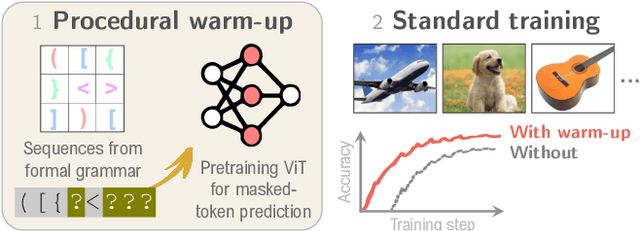


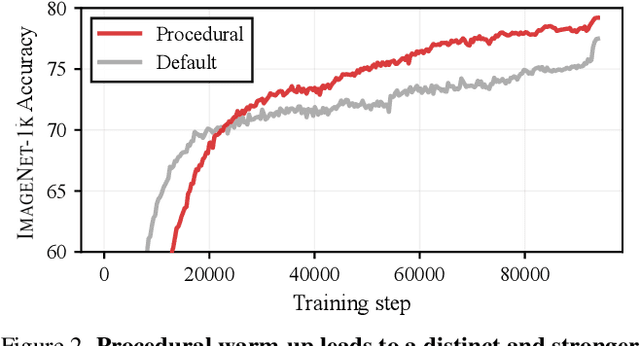
Transformers show remarkable versatility across domains, suggesting the existence of inductive biases beneficial across modalities. In this work, we explore a new way to instil such generic biases in vision transformers (ViTs) by pretraining on procedurally-generated data devoid of visual or semantic content. We generate this data with simple algorithms such as formal grammars, so the results bear no relationship to either natural or synthetic images. We use this procedurally-generated data to pretrain ViTs in a warm-up phase that bypasses their visual patch embedding mechanisms, thus encouraging the models to internalise abstract computational priors. When followed by standard image-based training, this warm-up significantly improves data efficiency, convergence speed, and downstream performance. On ImageNet-1k for example, allocating just 1% of the training budget to procedural data improves final accuracy by over 1.7%. In terms of its effect on performance, 1% procedurally generated data is thus equivalent to 28% of the ImageNet-1k data. These findings suggest a promising path toward new data-efficient and domain-agnostic pretraining strategies.
Transformers Pretrained on Procedural Data Contain Modular Structures for Algorithmic Reasoning
May 28, 2025Pretraining on large, semantically rich datasets is key for developing language models. Surprisingly, recent studies have shown that even synthetic data, generated procedurally through simple semantic-free algorithms, can yield some of the same benefits as natural language pretraining. It is unclear what specific capabilities such simple synthetic data instils in a model, where these capabilities reside in the architecture, and how they manifest within its weights. In this short paper, we identify several beneficial forms of procedural data, together with specific algorithmic reasoning skills that improve in small transformers. Our core finding is that different procedural rules instil distinct but complementary inductive structures in the model. With extensive ablations and partial-transfer experiments, we discover that these structures reside in different parts of the model. Attention layers often carry the most transferable information, but some pretraining rules impart useful structure to MLP blocks instead. Most interestingly, the structures induced by multiple rules can be composed to jointly reinforce multiple capabilities. These results suggest an exciting possibility of disentangling the acquisition of knowledge from reasoning in language models, with the goal of improving their robustness and data efficiency.