 Add to Chrome
 Add to Firefox
 Add to Edge
Evidence Triangulation for Multimodal Fact-Checking in the Wild
Jun 30, 2026
The proliferation of multimedia content on social platforms has fueled multimodal misinformation, where images are used to reinforce false claims. Consequently, Multimodal Fact-Checking (MFC) has emerged as an increasingly important research area. However, current progress is hindered by a reliance on synthetic training data and curated benchmarks that fail to capture the complexity of in-the-wild data. Furthermore, existing detection models rely on restricted intra-modality consistency or unconstrained all-to-all fusion, failing to capture nuanced relations between posts and external evidence. To address these limitations, we introduce X-POSE, a benchmark of real-world, community-annotated multimodal posts from X (formerly Twitter), augmented with full-length news articles retrieved via VLM-optimized search. Additionally, we propose TRENT, a novel MFC model that performs evidence triangulation using three parallel cross-attention streams alongside a relational fusion mechanism that explicitly models entailment and contradiction. Extensive evaluations demonstrate that TRENT consistently outperforms state-of-the-art specialized models and commercial VLMs. The code, prompt templates, and dataset are available at https://github.com/stevejpapad/evidence-triangulation

Credible, Unreliable or Leaked?: Evidence Verification for Enhanced Automated Fact-checking
Apr 29, 2024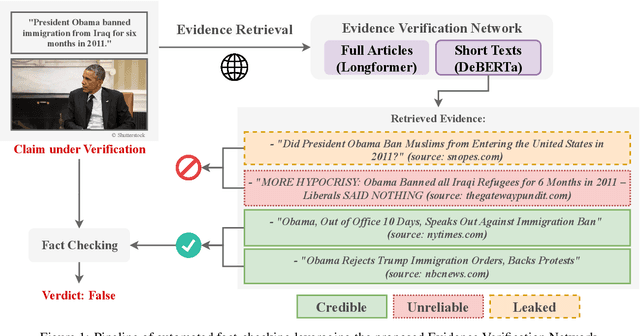
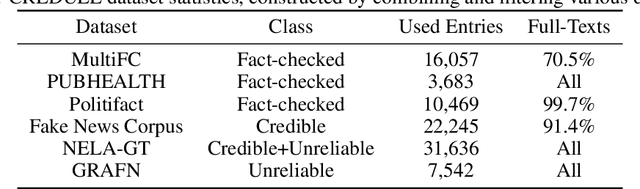
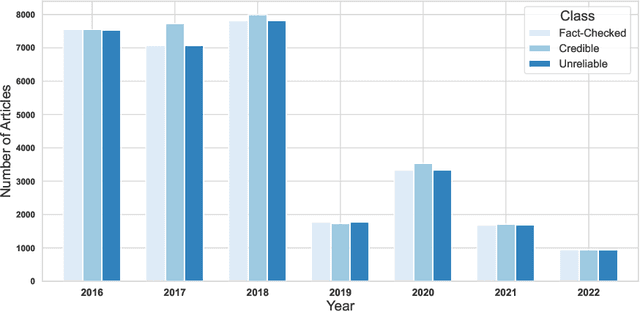
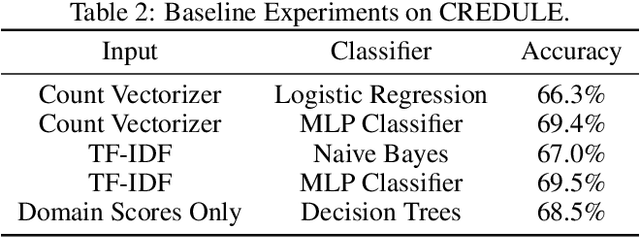
Automated fact-checking (AFC) is garnering increasing attention by researchers aiming to help fact-checkers combat the increasing spread of misinformation online. While many existing AFC methods incorporate external information from the Web to help examine the veracity of claims, they often overlook the importance of verifying the source and quality of collected "evidence". One overlooked challenge involves the reliance on "leaked evidence", information gathered directly from fact-checking websites and used to train AFC systems, resulting in an unrealistic setting for early misinformation detection. Similarly, the inclusion of information from unreliable sources can undermine the effectiveness of AFC systems. To address these challenges, we present a comprehensive approach to evidence verification and filtering. We create the "CREDible, Unreliable or LEaked" (CREDULE) dataset, which consists of 91,632 articles classified as Credible, Unreliable and Fact checked (Leaked). Additionally, we introduce the EVidence VERification Network (EVVER-Net), trained on CREDULE to detect leaked and unreliable evidence in both short and long texts. EVVER-Net can be used to filter evidence collected from the Web, thus enhancing the robustness of end-to-end AFC systems. We experiment with various language models and show that EVVER-Net can demonstrate impressive performance of up to 91.5% and 94.4% accuracy, while leveraging domain credibility scores along with short or long texts, respectively. Finally, we assess the evidence provided by widely-used fact-checking datasets including LIAR-PLUS, MOCHEG, FACTIFY, NewsCLIPpings+ and VERITE, some of which exhibit concerning rates of leaked and unreliable evidence.