 Add to Chrome
 Add to Firefox
 Add to Edge
M3SR: Multi-Scale Multi-Perceptual Mamba for Efficient Spectral Reconstruction
Jan 13, 2026
The Mamba architecture has been widely applied to various low-level vision tasks due to its exceptional adaptability and strong performance. Although the Mamba architecture has been adopted for spectral reconstruction, it still faces the following two challenges: (1) Single spatial perception limits the ability to fully understand and analyze hyperspectral images; (2) Single-scale feature extraction struggles to capture the complex structures and fine details present in hyperspectral images. To address these issues, we propose a multi-scale, multi-perceptual Mamba architecture for the spectral reconstruction task, called M3SR. Specifically, we design a multi-perceptual fusion block to enhance the ability of the model to comprehensively understand and analyze the input features. By integrating the multi-perceptual fusion block into a U-Net structure, M3SR can effectively extract and fuse global, intermediate, and local features, thereby enabling accurate reconstruction of hyperspectral images at multiple scales. Extensive quantitative and qualitative experiments demonstrate that the proposed M3SR outperforms existing state-of-the-art methods while incurring a lower computational cost.

Digging Deeper into CRNN Model in Chinese Text Images Recognition
Nov 17, 2020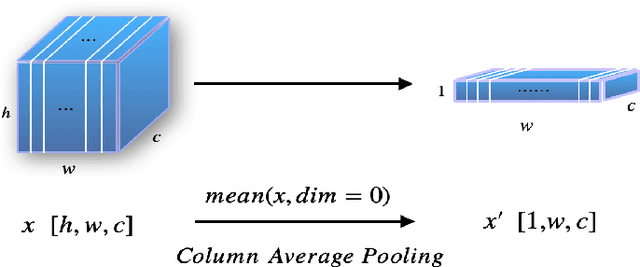

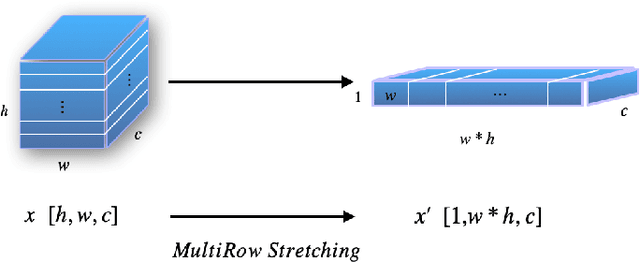
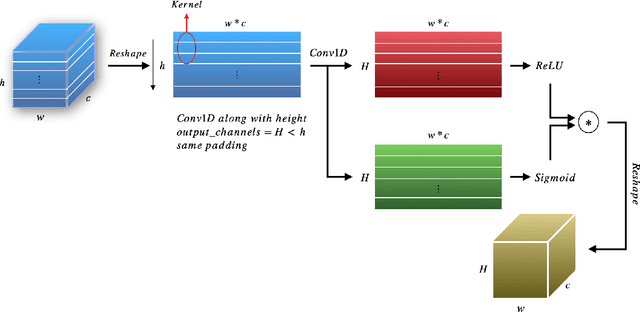
Automatic text image recognition is a prevalent application in computer vision field. One efficient way is use Convolutional Recurrent Neural Network(CRNN) to accomplish task in an end-to-end(End2End) fashion. However, CRNN notoriously fails to detect multi-row images and excel-like images. In this paper, we present one alternative to first recognize single-row images, then extend the same architecture to recognize multi-row images with proposed multiple methods. To recognize excel-like images containing box lines, we propose Line-Deep Denoising Convolutional AutoEncoder(Line-DDeCAE) to recover box lines. Finally, we present one Knowledge Distillation(KD) method to compress original CRNN model without loss of generality. To carry out experiments, we first generate artificial samples from one Chinese novel book, then conduct various experiments to verify our methods.