 Add to Chrome
 Add to Firefox
 Add to Edge
Lightweight User-Personalization Method for Closed Split Computing
Mar 16, 2026
Split Computing enables collaborative inference between edge devices and the cloud by partitioning a deep neural network into an edge-side head and a server-side tail, reducing latency and limiting exposure of raw input data. However, inference performance often degrades in practical deployments due to user-specific data distribution shifts, unreliable communication, and privacy-oriented perturbations, especially in closed environments where model architectures and parameters are inaccessible. To address this challenge, we propose SALT (Split-Adaptive Lightweight Tuning), a lightweight adaptation framework for closed Split Computing systems. SALT introduces a compact client-side adapter that refines intermediate representations produced by a frozen head network, enabling effective model adaptation without modifying the head or tail networks or increasing communication overhead. By modifying only the training conditions, SALT supports multiple adaptation objectives, including user personalization, communication robustness, and privacy-aware inference. Experiments using ResNet-18 on CIFAR-10 and CIFAR-100 show that SALT achieves higher accuracy than conventional retraining and fine-tuning while significantly reducing training cost. On CIFAR-10, SALT improves personalized accuracy from 88.1% to 93.8% while reducing training latency by more than 60%. SALT also maintains over 90% accuracy under 75% packet loss and preserves high accuracy (about 88% at sigma = 1.0) under noise injection. These results demonstrate that SALT provides an efficient and practical adaptation framework for real-world Split Computing systems.

SALT: A Lightweight Model Adaptation Method for Closed Split Computing Environments
Jun 09, 2025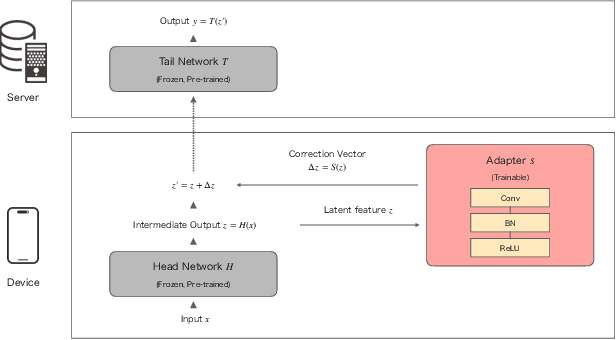
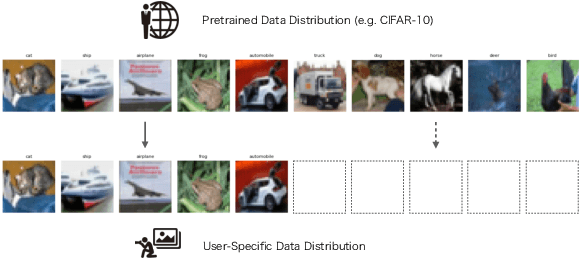
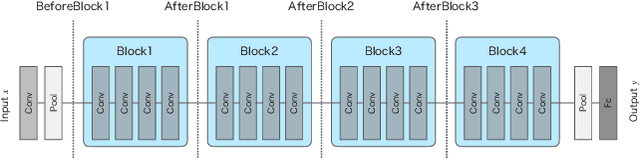
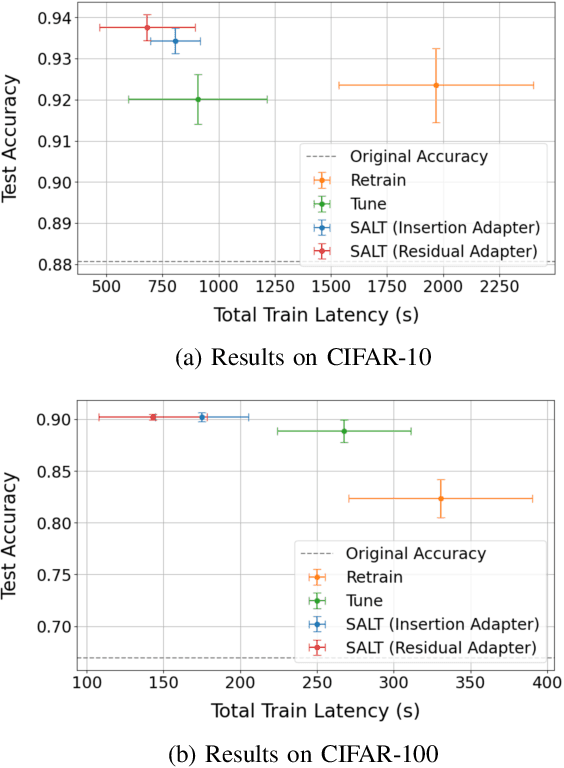
We propose SALT (Split-Adaptive Lightweight Tuning), a lightweight model adaptation framework for Split Computing under closed constraints, where the head and tail networks are proprietary and inaccessible to users. In such closed environments, conventional adaptation methods are infeasible since they require access to model parameters or architectures. SALT addresses this challenge by introducing a compact, trainable adapter on the client side to refine latent features from the head network, enabling user-specific adaptation without modifying the original models or increasing communication overhead. We evaluate SALT on user-specific classification tasks with CIFAR-10 and CIFAR-100, demonstrating improved accuracy with lower training latency compared to fine-tuning methods. Furthermore, SALT facilitates model adaptation for robust inference over lossy networks, a common challenge in edge-cloud environments. With minimal deployment overhead, SALT offers a practical solution for personalized inference in edge AI systems under strict system constraints.