 Add to Chrome
 Add to Firefox
 Add to Edge
Teaching Language Models to Check Grounded Claim Factuality with Human Test-Taking Strategies
May 28, 2026
Grounded claim factuality checking is important for large language model (LLM) applications such as retrieval-augmented generation, as it helps users assess the correctness of generated outputs. Existing metrics using entailment classifiers require dataset-specific threshold tuning, while LLM-based approaches often use direct prompting, which underutilises the reasoning capabilities of LLMs. We address this by formulating grounded claim factuality checking as a true/false reading comprehension task and prompting LLMs with explicit test-taking strategies for efficient reasoning. Our method reduces token usage by over 80% compared to unguided open-ended reasoning, and achieves competitive performance to more expensive alternatives across two factuality benchmarks, setting a new state of the art on one. To further reduce inference cost, we train small language models (SLMs) to replace LLMs in the checking pipeline. Using supervised fine-tuning (SFT) and a self-revision mechanism, the SLMs learn to improve their factuality judgements. Experimental results show that the resulting SLMs perform on par with strong baselines, combining low inference costs with generating supporting rationales to support interpretability. Code and datasets will be released upon acceptance.

Optimising Factual Consistency in Summarisation via Preference Learning from Multiple Imperfect Metrics
May 26, 2026Reinforcement learning with evaluation metrics as rewards is widely used to enhance specific capabilities of language models. However, for tasks such as factually consistent summarisation, existing metrics remain underdeveloped, limiting their effectiveness as signals for shaping model behaviour.While individual factuality metrics are unreliable, their combination can more effectively capture diverse factual errors. We leverage this insight to introduce an automated training pipeline that improves factual consistency in summaries by aggregating scores from different weak metrics. Our approach avoids the need for complex reward shaping by mapping scores to preferences and filtering out cases with high disagreement between metrics. For each source document, we generate lexically similar summary pairs by varying decoding strategies, enabling the model to learn from factual differences caused by subtle lexical differences. This approach constructs a high-quality preference dataset using only source documents.Experiments demonstrate consistent factuality gains across models, ranging from early encoder-decoder architectures to modern large language models, with smaller models reaching comparable factuality to larger ones.
Interactively Learning to Summarise Timelines by Reinforcement Learning
Nov 14, 2022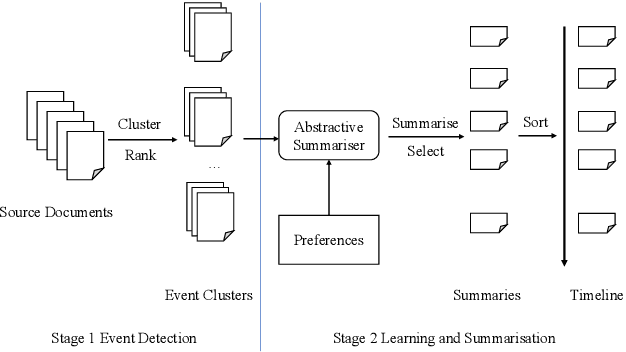

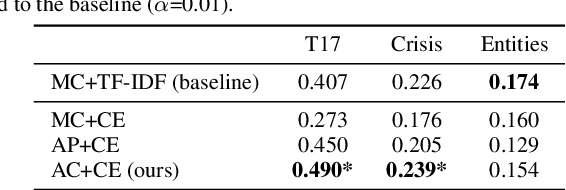
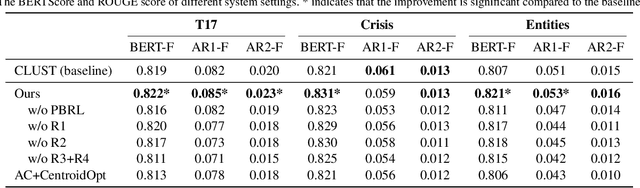
Timeline summarisation (TLS) aims to create a time-ordered summary list concisely describing a series of events with corresponding dates. This differs from general summarisation tasks because it requires the method to capture temporal information besides the main idea of the input documents. This paper proposes a TLS system which can interactively learn from the user's feedback via reinforcement learning and generate timelines satisfying the user's interests. We define a compound reward function that can update automatically according to the received feedback through interaction with the user. The system utilises the reward function to fine-tune an abstractive summarisation model via reinforcement learning to guarantee topical coherence, factual consistency and linguistic fluency of the generated summaries. The proposed system avoids the need of preference feedback from individual users. The experiments show that our system outperforms the baseline on the benchmark TLS dataset and can generate accurate and timeline precises that better satisfy real users.