 Add to Chrome
 Add to Firefox
 Add to Edge
Eddy-Resolving Global Ocean Forecasting with Multi-Scale Graph Neural Networks
Jan 19, 2026
Research on data-driven ocean models has progressed rapidly in recent years; however, the application of these models to global eddy-resolving ocean forecasting remains limited. The accurate representation of ocean dynamics across a wide range of spatial scales remains a major challenge in such applications. This study proposes a multi-scale graph neural network-based ocean model for 10-day global forecasting that improves short-term prediction skill and enhances the representation of multi-scale ocean variability. The model employs an encoder-processor-decoder architecture and uses two spherical meshes with different resolutions to better capture the multi-scale nature of ocean dynamics. In addition, the model incorporates surface atmospheric variables along with ocean state variables as node inputs to improve short-term prediction accuracy by representing atmospheric forcing. Evaluation using surface kinetic energy spectra and case studies shows that the model accurately represents a broad range of spatial scales, while root mean square error comparisons demonstrate improved skill in short-term predictions. These results indicate that the proposed model delivers more accurate short-term forecasts and improved representation of multi-scale ocean dynamics, thereby highlighting its potential to advance data-driven, eddy-resolving global ocean forecasting.

Data-driven Mesoscale Weather Forecasting Combining Swin-Unet and Diffusion Models
Mar 25, 2025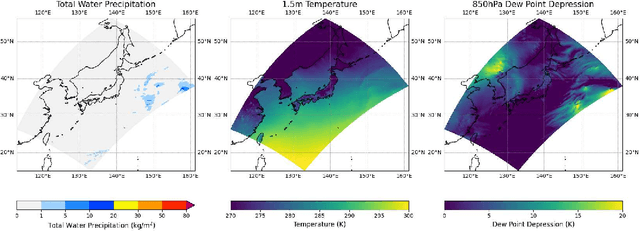
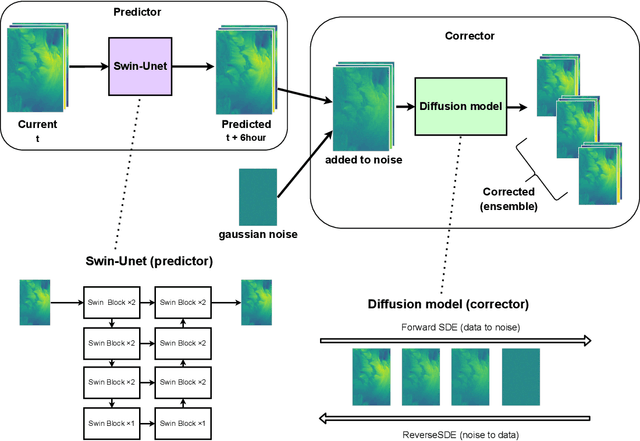
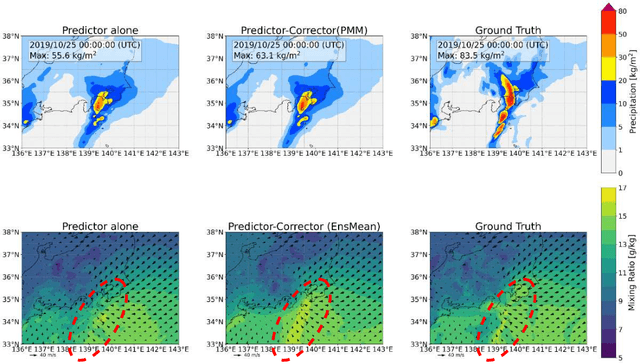
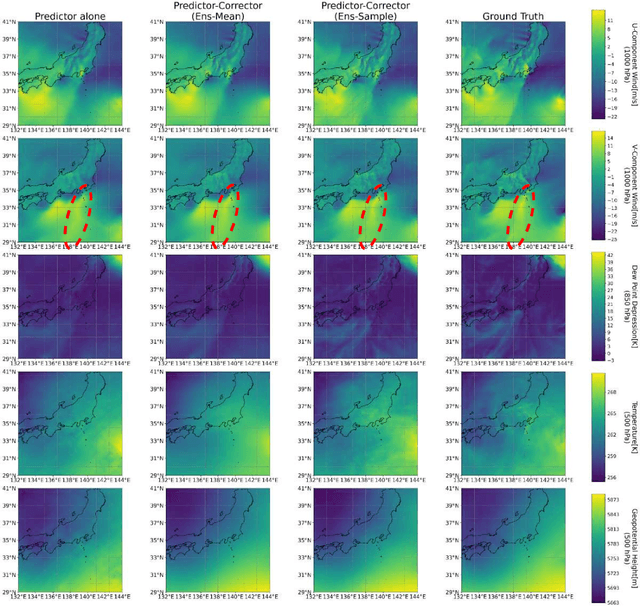
Data-driven weather prediction models exhibit promising performance and advance continuously. In particular, diffusion models represent fine-scale details without spatial smoothing, which is crucial for mesoscale predictions, such as heavy rainfall forecasting. However, the applications of diffusion models to mesoscale prediction remain limited. To address this gap, this study proposes an architecture that combines a diffusion model with Swin-Unet as a deterministic model, achieving mesoscale predictions while maintaining flexibility. The proposed architecture trains the two models independently, allowing the diffusion model to remain unchanged when the deterministic model is updated. Comparisons using the Fractions Skill Score and power spectral analysis demonstrate that incorporating the diffusion model leads to improved accuracy compared to predictions without it. These findings underscore the potential of the proposed architecture to enhance mesoscale predictions, particularly for strong rainfall events, while maintaining flexibility.