 Add to Chrome
 Add to Firefox
 Add to Edge
Tackling multiphysics problems via finite element-guided physics-informed operator learning
Mar 02, 2026
This work presents a finite element-guided physics-informed operator learning framework for multiphysics problems with coupled partial differential equations (PDEs) on arbitrary domains. Implemented with Folax, a JAX-based operator-learning platform, the proposed framework learns a mapping from the input parameter space to the solution space with a weighted residual formulation based on the finite element method, enabling discretization-independent prediction beyond the training resolution without relying on labaled simulation data. The present framework for multiphysics problems is verified on nonlinear thermo-mechanical problems. Two- and three-dimensional representative volume elements with varying heterogeneous microstructures, and a close-to-reality industrial casting example under varying boundary conditions are investigated as the example problems. We investigate the potential of several neural operator backbones, including Fourier neural operators (FNOs), deep operator networks (DeepONets), and a newly proposed implicit finite operator learning (iFOL) approach based on conditional neural fields. The results demonstrate that FNOs yield highly accurate solution operators on regular domains, where the global topology can be efficiently learned in the spectral domain, and iFOL offers efficient parametric operator learning capabilities for complex and irregular geometries. Furthermore, studies on training strategies, network decomposition, and training sample quality reveal that a monolithic training strategy using a single network is sufficient for accurate predictions, while training sample quality strongly influences performance. Overall, the present approach highlights the potential of physics-informed operator learning with a finite element-based loss as a unified and scalable approach for coupled multiphysics simulations.

Neural-Initialized Newton: Accelerating Nonlinear Finite Elements via Operator Learning
Nov 10, 2025We propose a Newton-based scheme, initialized by neural operator predictions, to accelerate the parametric solution of nonlinear problems in computational solid mechanics. First, a physics informed conditional neural field is trained to approximate the nonlinear parametric solutionof the governing equations. This establishes a continuous mapping between the parameter and solution spaces, which can then be evaluated for a given parameter at any spatial resolution. Second, since the neural approximation may not be exact, it is subsequently refined using a Newton-based correction initialized by the neural output. To evaluate the effectiveness of this hybrid approach, we compare three solution strategies: (i) the standard Newton-Raphson solver used in NFEM, which is robust and accurate but computationally demanding; (ii) physics-informed neural operators, which provide rapid inference but may lose accuracy outside the training distribution and resolution; and (iii) the neural-initialized Newton (NiN) strategy, which combines the efficiency of neural operators with the robustness of NFEM. The results demonstrate that the proposed hybrid approach reduces computational cost while preserving accuracy, highlighting its potential to accelerate large-scale nonlinear simulations.
A Physics-Informed Meta-Learning Framework for the Continuous Solution of Parametric PDEs on Arbitrary Geometries
Apr 03, 2025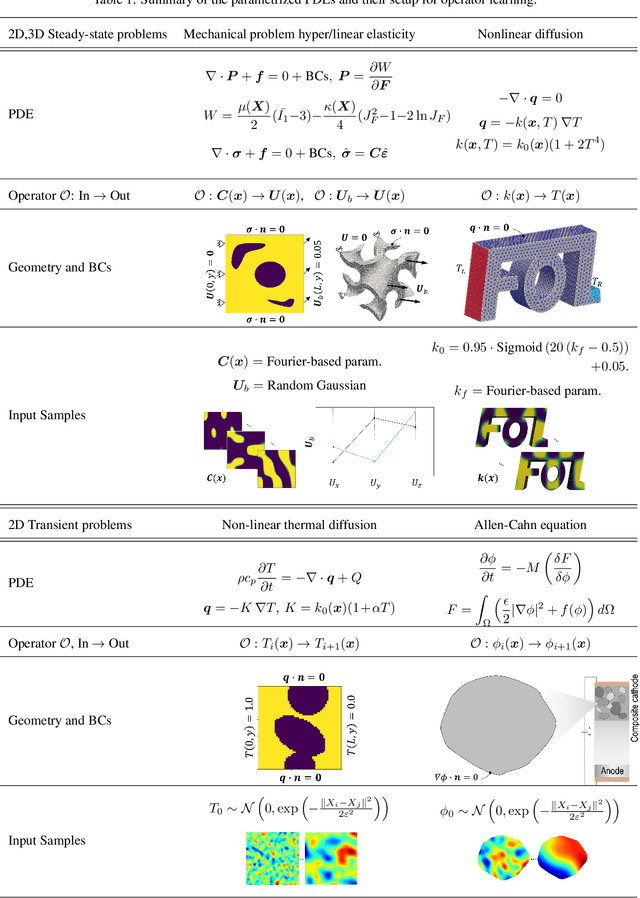
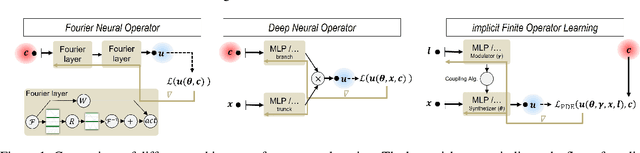
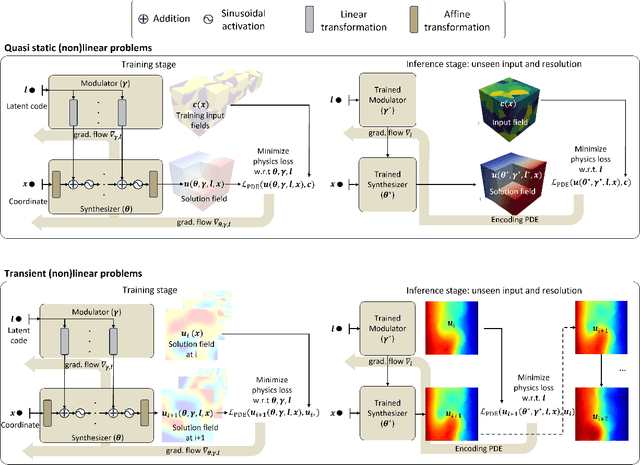

In this work, we introduce implicit Finite Operator Learning (iFOL) for the continuous and parametric solution of partial differential equations (PDEs) on arbitrary geometries. We propose a physics-informed encoder-decoder network to establish the mapping between continuous parameter and solution spaces. The decoder constructs the parametric solution field by leveraging an implicit neural field network conditioned on a latent or feature code. Instance-specific codes are derived through a PDE encoding process based on the second-order meta-learning technique. In training and inference, a physics-informed loss function is minimized during the PDE encoding and decoding. iFOL expresses the loss function in an energy or weighted residual form and evaluates it using discrete residuals derived from standard numerical PDE methods. This approach results in the backpropagation of discrete residuals during both training and inference. iFOL features several key properties: (1) its unique loss formulation eliminates the need for the conventional encode-process-decode pipeline previously used in operator learning with conditional neural fields for PDEs; (2) it not only provides accurate parametric and continuous fields but also delivers solution-to-parameter gradients without requiring additional loss terms or sensitivity analysis; (3) it can effectively capture sharp discontinuities in the solution; and (4) it removes constraints on the geometry and mesh, making it applicable to arbitrary geometries and spatial sampling (zero-shot super-resolution capability). We critically assess these features and analyze the network's ability to generalize to unseen samples across both stationary and transient PDEs. The overall performance of the proposed method is promising, demonstrating its applicability to a range of challenging problems in computational mechanics.
A finite element-based physics-informed operator learning framework for spatiotemporal partial differential equations on arbitrary domains
May 22, 2024We propose a novel finite element-based physics-informed operator learning framework that allows for predicting spatiotemporal dynamics governed by partial differential equations (PDEs). The proposed framework employs a loss function inspired by the finite element method (FEM) with the implicit Euler time integration scheme. A transient thermal conduction problem is considered to benchmark the performance. The proposed operator learning framework takes a temperature field at the current time step as input and predicts a temperature field at the next time step. The Galerkin discretized weak formulation of the heat equation is employed to incorporate physics into the loss function, which is coined finite operator learning (FOL). Upon training, the networks successfully predict the temperature evolution over time for any initial temperature field at high accuracy compared to the FEM solution. The framework is also confirmed to be applicable to a heterogeneous thermal conductivity and arbitrary geometry. The advantages of FOL can be summarized as follows: First, the training is performed in an unsupervised manner, avoiding the need for a large data set prepared from costly simulations or experiments. Instead, random temperature patterns generated by the Gaussian random process and the Fourier series, combined with constant temperature fields, are used as training data to cover possible temperature cases. Second, shape functions and backward difference approximation are exploited for the domain discretization, resulting in a purely algebraic equation. This enhances training efficiency, as one avoids time-consuming automatic differentiation when optimizing weights and biases while accepting possible discretization errors. Finally, thanks to the interpolation power of FEM, any arbitrary geometry can be handled with FOL, which is crucial to addressing various engineering application scenarios.