 Add to Chrome
 Add to Firefox
 Add to Edge
Tackling multiphysics problems via finite element-guided physics-informed operator learning
Mar 02, 2026
This work presents a finite element-guided physics-informed operator learning framework for multiphysics problems with coupled partial differential equations (PDEs) on arbitrary domains. Implemented with Folax, a JAX-based operator-learning platform, the proposed framework learns a mapping from the input parameter space to the solution space with a weighted residual formulation based on the finite element method, enabling discretization-independent prediction beyond the training resolution without relying on labaled simulation data. The present framework for multiphysics problems is verified on nonlinear thermo-mechanical problems. Two- and three-dimensional representative volume elements with varying heterogeneous microstructures, and a close-to-reality industrial casting example under varying boundary conditions are investigated as the example problems. We investigate the potential of several neural operator backbones, including Fourier neural operators (FNOs), deep operator networks (DeepONets), and a newly proposed implicit finite operator learning (iFOL) approach based on conditional neural fields. The results demonstrate that FNOs yield highly accurate solution operators on regular domains, where the global topology can be efficiently learned in the spectral domain, and iFOL offers efficient parametric operator learning capabilities for complex and irregular geometries. Furthermore, studies on training strategies, network decomposition, and training sample quality reveal that a monolithic training strategy using a single network is sufficient for accurate predictions, while training sample quality strongly influences performance. Overall, the present approach highlights the potential of physics-informed operator learning with a finite element-based loss as a unified and scalable approach for coupled multiphysics simulations.

Neural-Initialized Newton: Accelerating Nonlinear Finite Elements via Operator Learning
Nov 10, 2025We propose a Newton-based scheme, initialized by neural operator predictions, to accelerate the parametric solution of nonlinear problems in computational solid mechanics. First, a physics informed conditional neural field is trained to approximate the nonlinear parametric solutionof the governing equations. This establishes a continuous mapping between the parameter and solution spaces, which can then be evaluated for a given parameter at any spatial resolution. Second, since the neural approximation may not be exact, it is subsequently refined using a Newton-based correction initialized by the neural output. To evaluate the effectiveness of this hybrid approach, we compare three solution strategies: (i) the standard Newton-Raphson solver used in NFEM, which is robust and accurate but computationally demanding; (ii) physics-informed neural operators, which provide rapid inference but may lose accuracy outside the training distribution and resolution; and (iii) the neural-initialized Newton (NiN) strategy, which combines the efficiency of neural operators with the robustness of NFEM. The results demonstrate that the proposed hybrid approach reduces computational cost while preserving accuracy, highlighting its potential to accelerate large-scale nonlinear simulations.
A Physics-Informed Meta-Learning Framework for the Continuous Solution of Parametric PDEs on Arbitrary Geometries
Apr 03, 2025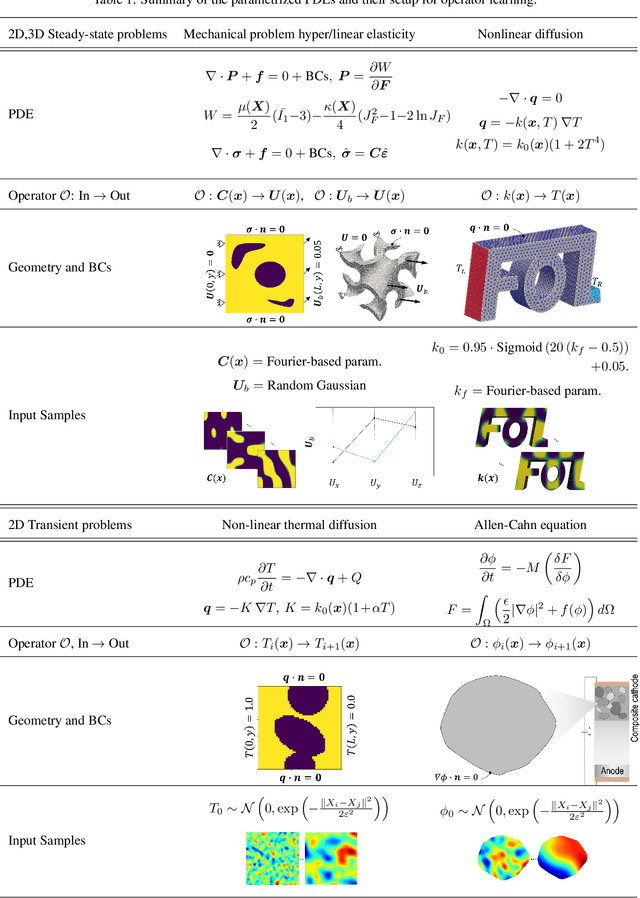
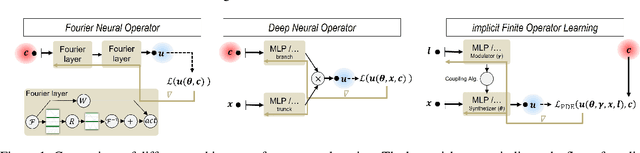
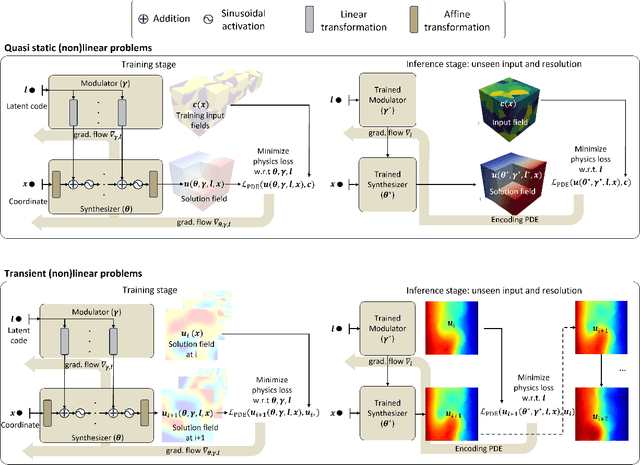

In this work, we introduce implicit Finite Operator Learning (iFOL) for the continuous and parametric solution of partial differential equations (PDEs) on arbitrary geometries. We propose a physics-informed encoder-decoder network to establish the mapping between continuous parameter and solution spaces. The decoder constructs the parametric solution field by leveraging an implicit neural field network conditioned on a latent or feature code. Instance-specific codes are derived through a PDE encoding process based on the second-order meta-learning technique. In training and inference, a physics-informed loss function is minimized during the PDE encoding and decoding. iFOL expresses the loss function in an energy or weighted residual form and evaluates it using discrete residuals derived from standard numerical PDE methods. This approach results in the backpropagation of discrete residuals during both training and inference. iFOL features several key properties: (1) its unique loss formulation eliminates the need for the conventional encode-process-decode pipeline previously used in operator learning with conditional neural fields for PDEs; (2) it not only provides accurate parametric and continuous fields but also delivers solution-to-parameter gradients without requiring additional loss terms or sensitivity analysis; (3) it can effectively capture sharp discontinuities in the solution; and (4) it removes constraints on the geometry and mesh, making it applicable to arbitrary geometries and spatial sampling (zero-shot super-resolution capability). We critically assess these features and analyze the network's ability to generalize to unseen samples across both stationary and transient PDEs. The overall performance of the proposed method is promising, demonstrating its applicability to a range of challenging problems in computational mechanics.
Finite Operator Learning: Bridging Neural Operators and Numerical Methods for Efficient Parametric Solution and Optimization of PDEs
Jul 04, 2024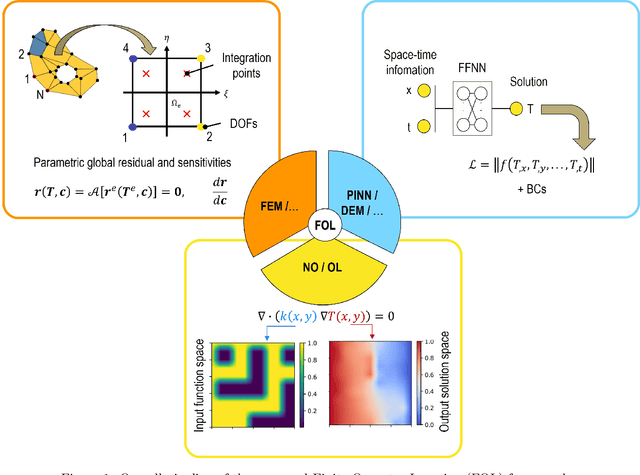

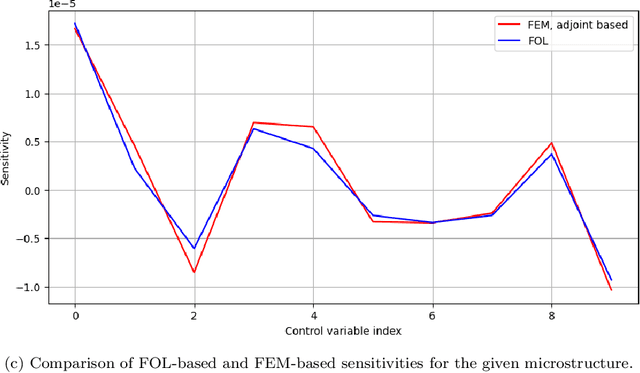
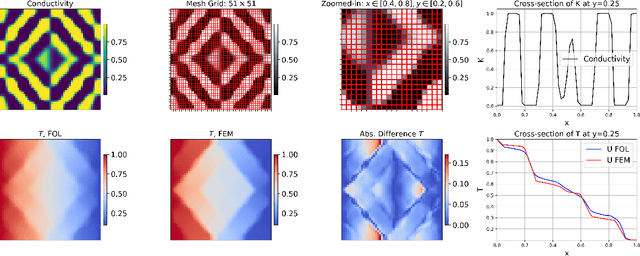
We introduce a method that combines neural operators, physics-informed machine learning, and standard numerical methods for solving PDEs. The proposed approach extends each of the aforementioned methods and unifies them within a single framework. We can parametrically solve partial differential equations in a data-free manner and provide accurate sensitivities, meaning the derivatives of the solution space with respect to the design space. These capabilities enable gradient-based optimization without the typical sensitivity analysis costs, unlike adjoint methods that scale directly with the number of response functions. Our Finite Operator Learning (FOL) approach uses an uncomplicated feed-forward neural network model to directly map the discrete design space (i.e. parametric input space) to the discrete solution space (i.e. finite number of sensor points in the arbitrary shape domain) ensuring compliance with physical laws by designing them into loss functions. The discretized governing equations, as well as the design and solution spaces, can be derived from any well-established numerical techniques. In this work, we employ the Finite Element Method (FEM) to approximate fields and their spatial derivatives. Subsequently, we conduct Sobolev training to minimize a multi-objective loss function, which includes the discretized weak form of the energy functional, boundary conditions violations, and the stationarity of the residuals with respect to the design variables. Our study focuses on the steady-state heat equation within heterogeneous materials that exhibits significant phase contrast and possibly temperature-dependent conductivity. The network's tangent matrix is directly used for gradient-based optimization to improve the microstructure's heat transfer characteristics. ...