 Add to Chrome
 Add to Firefox
 Add to Edge
OrdinalBench: A Benchmark Dataset for Diagnosing Generalization Limits in Ordinal Number Understanding of Vision-Language Models
Mar 08, 2026
Vision-Language Models (VLMs) have advanced across multimodal benchmarks but still show clear gaps in ordinal number understanding, i.e., the ability to track relative positions and generalize to large indices. We present OrdinalBench, a diagnostic benchmark that standardizes ordinal number understanding as an evaluation task for VLMs. The core task is N-th object identification, defined by a starting reference and traversal rule. Task difficulty is controlled along three axes: (i) ordinal magnitude, from small numbers to extreme cases up to 300; (ii) arrangement complexity, from single loops to maze-like paths; and (iii) object count. The benchmark provides 39,000 question-answer pairs, each annotated with a ground-truth reasoning trajectory and balanced across difficulty levels for controlled large-scale testing. Beyond answer-only evaluation, our framework requires models to generate structured stepwise traces of the counting process and provides an open evaluation toolkit that measures both final accuracy and step-level path consistency. Zero-shot evaluations of GPT-5, Gemini 2.5 Flash Lite, Qwen2.5-VL, InternVL3.5, and Molmo reveal sharp degradation under large-ordinal and complex-path conditions, highlighting weak generalization despite strong scores on standard multimodal tasks. By framing ordinal number understanding as a core target, OrdinalBench provides a reproducible benchmark and diagnostic framework for developing VLMs with stronger sequential reasoning. All data and code are available at https://ordinalbench.github.io/

Can Visual Encoder Learn to See Arrows?
May 26, 2025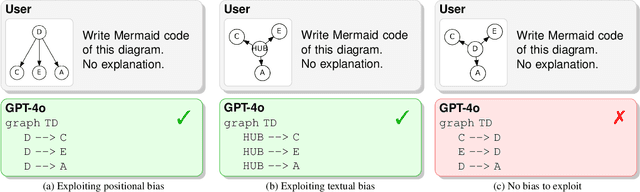
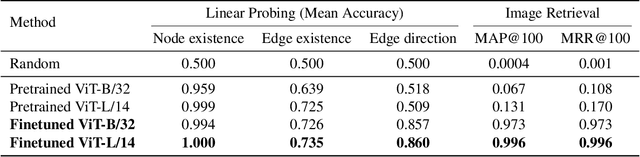
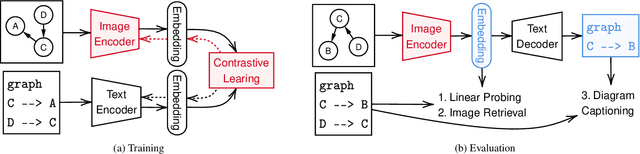
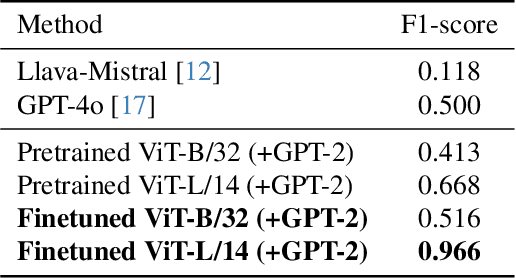
The diagram is a visual representation of a relationship illustrated with edges (lines or arrows), which is widely used in industrial and scientific communication. Although recognizing diagrams is essential for vision language models (VLMs) to comprehend domain-specific knowledge, recent studies reveal that many VLMs fail to identify edges in images. We hypothesize that these failures stem from an over-reliance on textual and positional biases, preventing VLMs from learning explicit edge features. Based on this idea, we empirically investigate whether the image encoder in VLMs can learn edge representation through training on a diagram dataset in which edges are biased neither by textual nor positional information. To this end, we conduct contrastive learning on an artificially generated diagram--caption dataset to train an image encoder and evaluate its diagram-related features on three tasks: probing, image retrieval, and captioning. Our results show that the finetuned model outperforms pretrained CLIP in all tasks and surpasses zero-shot GPT-4o and LLaVA-Mistral in the captioning task. These findings confirm that eliminating textual and positional biases fosters accurate edge recognition in VLMs, offering a promising path for advancing diagram understanding.