 Add to Chrome
 Add to Firefox
 Add to Edge
Breaking the Capability Ceiling of LLM Post-Training by Reintroducing Markov States
Mar 20, 2026
Reinforcement learning (RL) has become a standard paradigm for post-training and aligning Large Language Models (LLMs), yet recent evidence suggests it faces a persistent "capability ceiling": unlike classical RL systems that discover novel strategies, RL for LLMs often acts as a mere refiner of patterns already latent in pre-trained weights. In this work, we identify a fundamental structural bottleneck: while classical RL relies on compact, informative Markov states, current LLM post-training formulations are tethered to an ever-expanding history of actions. We revisit a classical principle long central to RL yet absent from LLM post-training: explicit Markov states. Theoretically, we provide rigorous guarantees demonstrating that leveraging estimated Markov states can significantly reduce sample complexity. Empirically, we show that introducing Markov states consistently breaks the performance boundaries of standard RL post-training across a suite of complex logic puzzles. Our findings suggest that moving beyond "history-as-state" modeling in favor of structured Markovian representations is essential for unlocking open-ended discovery and genuinely new reasoning capabilities in Generative AI.

Reinforce LLM Reasoning through Multi-Agent Reflection
Jun 10, 2025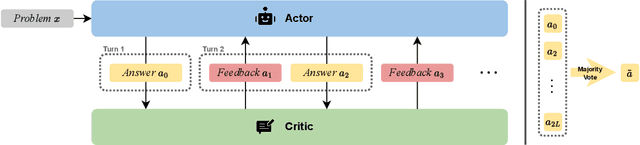
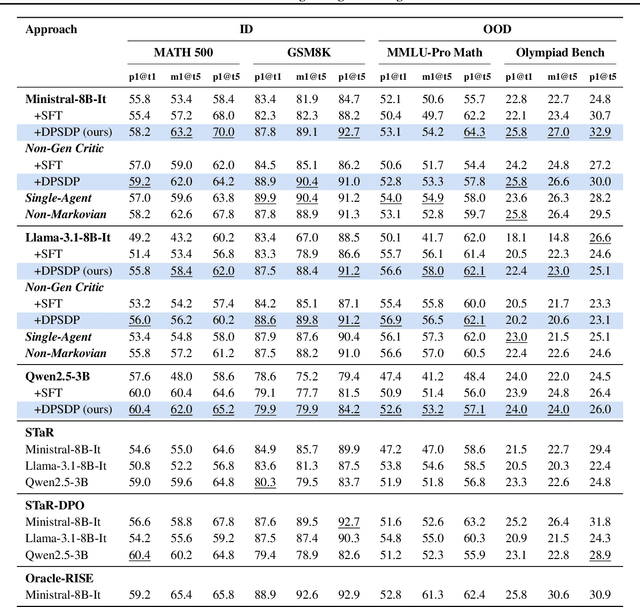
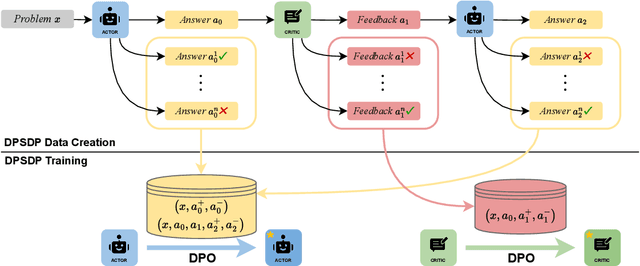
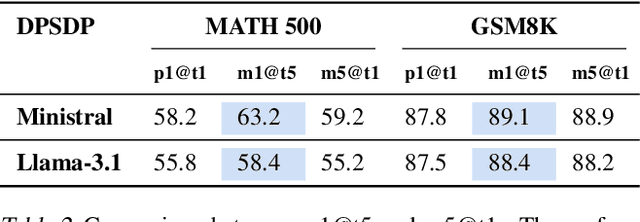
Leveraging more test-time computation has proven to be an effective way to boost the reasoning capabilities of large language models (LLMs). Among various methods, the verify-and-improve paradigm stands out for enabling dynamic solution exploration and feedback incorporation. However, existing approaches often suffer from restricted feedback spaces and lack of coordinated training of different parties, leading to suboptimal performance. To address this, we model this multi-turn refinement process as a Markov Decision Process and introduce DPSDP (Direct Policy Search by Dynamic Programming), a reinforcement learning algorithm that trains an actor-critic LLM system to iteratively refine answers via direct preference learning on self-generated data. Theoretically, DPSDP can match the performance of any policy within the training distribution. Empirically, we instantiate DPSDP with various base models and show improvements on both in- and out-of-distribution benchmarks. For example, on benchmark MATH 500, majority voting over five refinement steps increases first-turn accuracy from 58.2% to 63.2% with Ministral-based models. An ablation study further confirms the benefits of multi-agent collaboration and out-of-distribution generalization.
Trajectory Bellman Residual Minimization: A Simple Value-Based Method for LLM Reasoning
May 21, 2025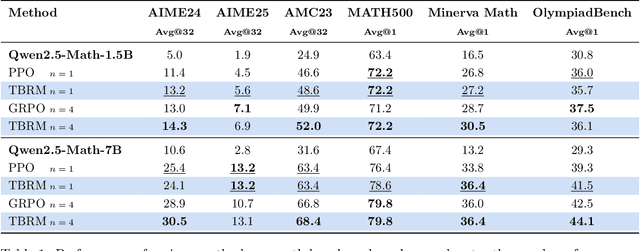
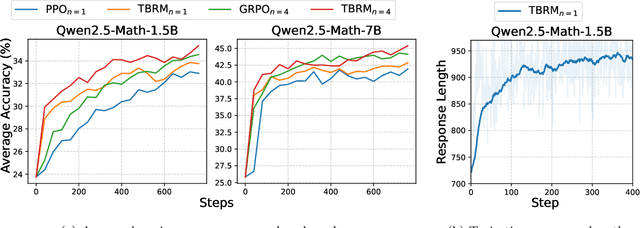
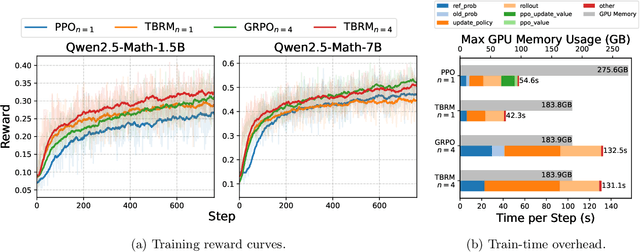

Policy-based methods currently dominate reinforcement learning (RL) pipelines for large language model (LLM) reasoning, leaving value-based approaches largely unexplored. We revisit the classical paradigm of Bellman Residual Minimization and introduce Trajectory Bellman Residual Minimization (TBRM), an algorithm that naturally adapts this idea to LLMs, yielding a simple yet effective off-policy algorithm that optimizes a single trajectory-level Bellman objective using the model's own logits as $Q$-values. TBRM removes the need for critics, importance-sampling ratios, or clipping, and operates with only one rollout per prompt. We prove convergence to the near-optimal KL-regularized policy from arbitrary off-policy data via an improved change-of-trajectory-measure analysis. Experiments on standard mathematical-reasoning benchmarks show that TBRM consistently outperforms policy-based baselines, like PPO and GRPO, with comparable or lower computational and memory overhead. Our results indicate that value-based RL might be a principled and efficient alternative for enhancing reasoning capabilities in LLMs.