 Add to Chrome
 Add to Firefox
 Add to Edge
IoT-Enabled Autonomous Maritime Navigation in Smart Ports: A Curriculum-Guided Shared Policy Learning Framework
Aug 12, 2026
As smart port infrastructures increasingly rely on autonomous maritime devices enabled by the Internet of Things (IoT), ensuring reliable onboard navigation intelligence has become a critical challenge for safe and scalable operations in congested waterways. This paper investigates onboard autonomous navigation for such IoT devices under partial observability and dense traffic conditions. A curriculum-guided reinforcement learning framework with a shared recurrent policy is developed to enhance temporal reasoning, deployment scalability, and robustness of edge-level decision-making. Centralized training is adopted as an offline design-time strategy, while all navigation actions are executed fully onboard, consistent with IoT edge intelligence paradigms. Extensive simulations in multiple realistic port environments demonstrate that the proposed approach improves navigation reliability, collision avoidance, and training stability compared with standard baseline methods, and generalizes effectively to previously unseen high-density scenarios. The results indicate that curriculum-guided shared learning provides a practical solution for scalable deployment of IoT-enabled autonomous maritime devices in smart port operations.

Modality Dominance-Aware Optimization for Embodied RGB-Infrared Perception
Jan 02, 2026RGB-Infrared (RGB-IR) multimodal perception is fundamental to embodied multimedia systems operating in complex physical environments. Although recent cross-modal fusion methods have advanced RGB-IR detection, the optimization dynamics caused by asymmetric modality characteristics remain underexplored. In practice, disparities in information density and feature quality introduce persistent optimization bias, leading training to overemphasize a dominant modality and hindering effective fusion. To quantify this phenomenon, we propose the Modality Dominance Index (MDI), which measures modality dominance by jointly modeling feature entropy and gradient contribution. Based on MDI, we develop a Modality Dominance-Aware Cross-modal Learning (MDACL) framework that regulates cross-modal optimization. MDACL incorporates Hierarchical Cross-modal Guidance (HCG) to enhance feature alignment and Adversarial Equilibrium Regularization (AER) to balance optimization dynamics during fusion. Extensive experiments on three RGB-IR benchmarks demonstrate that MDACL effectively mitigates optimization bias and achieves SOTA performance.
Malicious Web Domain Identification using Online Credibility and Performance Data by Considering the Class Imbalance Issue
Oct 19, 2018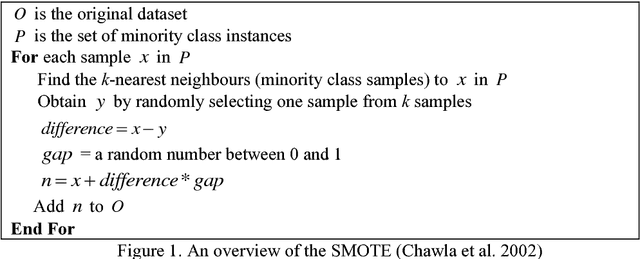

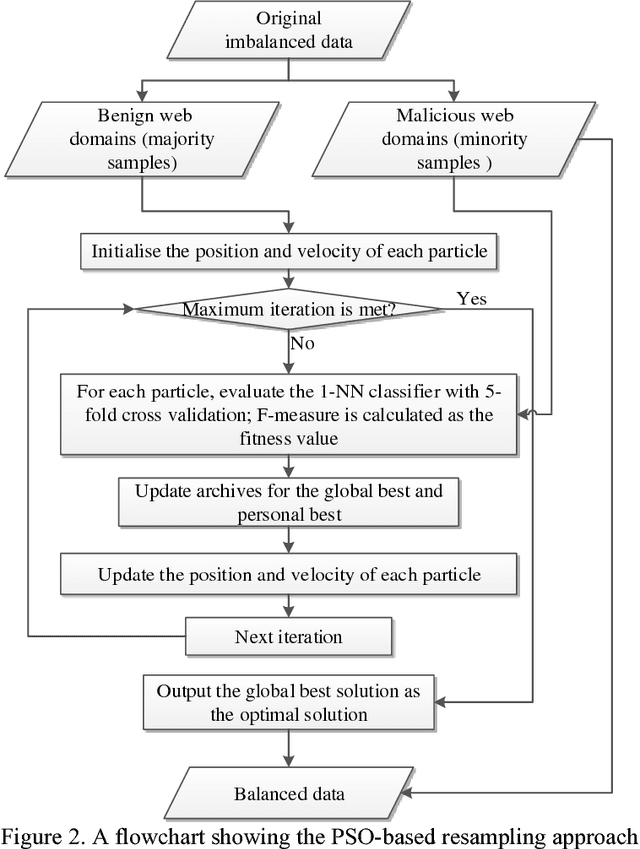
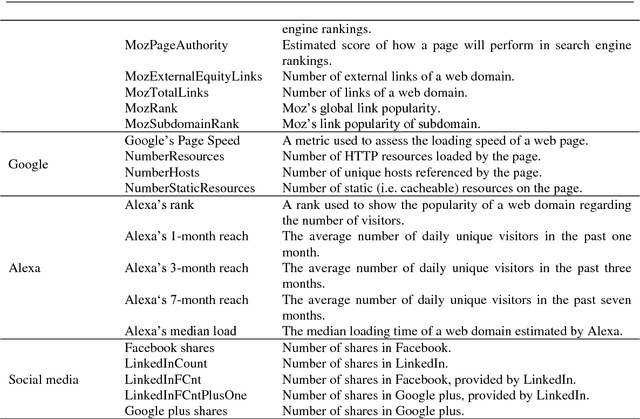
Purpose: Malicious web domain identification is of significant importance to the security protection of Internet users. With online credibility and performance data, this paper aims to investigate the use of machine learning tech-niques for malicious web domain identification by considering the class imbalance issue (i.e., there are more benign web domains than malicious ones). Design/methodology/approach: We propose an integrated resampling approach to handle class imbalance by combining the Synthetic Minority Over-sampling TEchnique (SMOTE) and Particle Swarm Optimisation (PSO), a population-based meta-heuristic algorithm. We use the SMOTE for over-sampling and PSO for under-sampling. Findings: By applying eight well-known machine learning classifiers, the proposed integrated resampling approach is comprehensively examined using several imbalanced web domain datasets with different imbalance ratios. Com-pared to five other well-known resampling approaches, experimental results confirm that the proposed approach is highly effective. Practical implications: This study not only inspires the practical use of online credibility and performance data for identifying malicious web domains, but also provides an effective resampling approach for handling the class imbal-ance issue in the area of malicious web domain identification. Originality/value: Online credibility and performance data is applied to build malicious web domain identification models using machine learning techniques. An integrated resampling approach is proposed to address the class im-balance issue. The performance of the proposed approach is confirmed based on real-world datasets with different imbalance ratios.
* 20 pages