 Add to Chrome
 Add to Firefox
 Add to Edge
Joint Optimization of Memory and Computing Frequency for Energy-Efficient DNN Inference
Aug 14, 2026
Deep neural network (DNN) inference on mobile devices often incurs high latency and energy consumption due to limited computing and memory resources. To enable energy-efficient DNN inference, most existing studies focus on dynamic voltage and frequency scaling (DVFS) for adjusting the computing frequency, while the impact of memory frequency on the inference performance has been greatly overlooked. In this paper, we consider the impact of memory frequency and computing frequency on DNN inference time, and jointly optimize these two frequencies together with communication resources for energy-efficient DNN inference. Based on a realistic inference time model, we formulate an optimization problem to minimize the energy consumption of all mobile devices under the deadline constraint. For local inference, we derive a near-optimal closed-form solution via convex optimization, while an optimal closed-form solution for transmission power is obtained for edge inference with the given bandwidth. Furthermore, we propose a low-complexity heuristic algorithm to effectively solve the overall problem with polynomial time complexity. Simulation results based on measured data show that the proposed near-optimal solution for local inference can achieve optimal performance under strict deadline constraints, with a performance gap of up to 2.5% compared with the optimal solution. Meanwhile, our proposed algorithm significantly reduces the energy consumption of devices by up to 10.4% compared to other methods.

Robust DNN Partitioning and Resource Allocation Under Uncertain Inference Time
Mar 27, 2025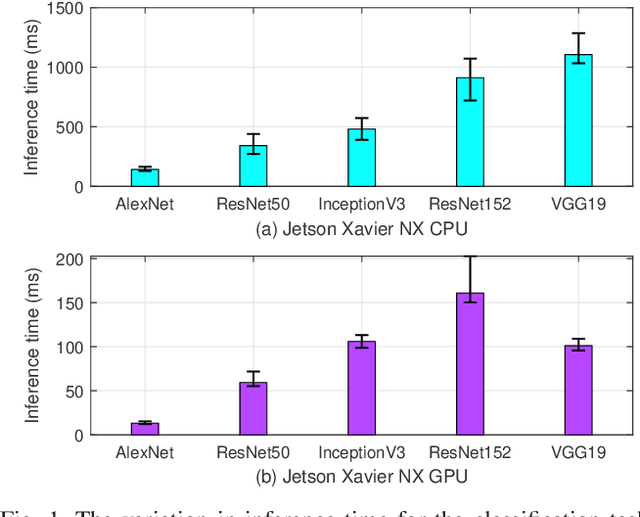
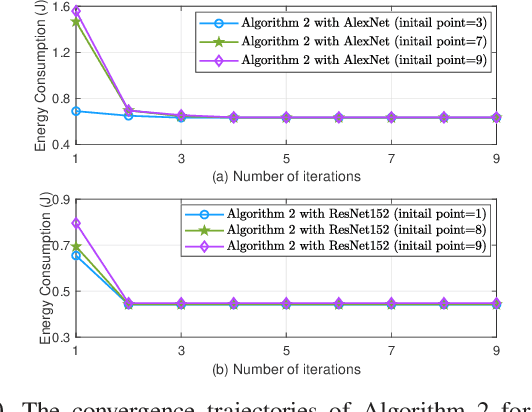
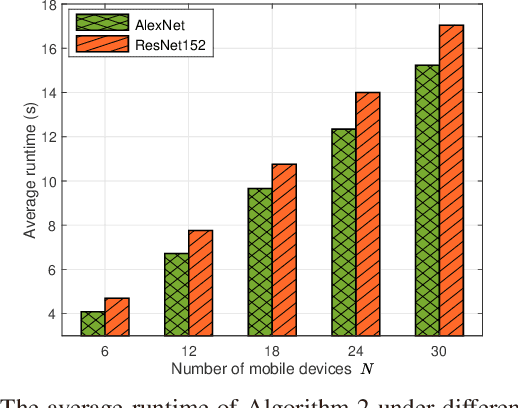
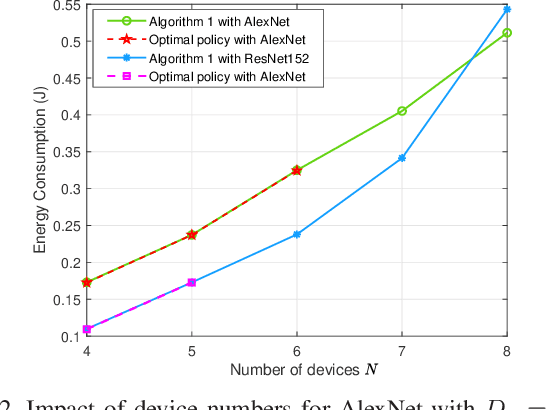
In edge intelligence systems, deep neural network (DNN) partitioning and data offloading can provide real-time task inference for resource-constrained mobile devices. However, the inference time of DNNs is typically uncertain and cannot be precisely determined in advance, presenting significant challenges in ensuring timely task processing within deadlines. To address the uncertain inference time, we propose a robust optimization scheme to minimize the total energy consumption of mobile devices while meeting task probabilistic deadlines. The scheme only requires the mean and variance information of the inference time, without any prediction methods or distribution functions. The problem is formulated as a mixed-integer nonlinear programming (MINLP) that involves jointly optimizing the DNN model partitioning and the allocation of local CPU/GPU frequencies and uplink bandwidth. To tackle the problem, we first decompose the original problem into two subproblems: resource allocation and DNN model partitioning. Subsequently, the two subproblems with probability constraints are equivalently transformed into deterministic optimization problems using the chance-constrained programming (CCP) method. Finally, the convex optimization technique and the penalty convex-concave procedure (PCCP) technique are employed to obtain the optimal solution of the resource allocation subproblem and a stationary point of the DNN model partitioning subproblem, respectively. The proposed algorithm leverages real-world data from popular hardware platforms and is evaluated on widely used DNN models. Extensive simulations show that our proposed algorithm effectively addresses the inference time uncertainty with probabilistic deadline guarantees while minimizing the energy consumption of mobile devices.
DVFS-Aware DNN Inference on GPUs: Latency Modeling and Performance Analysis
Feb 10, 2025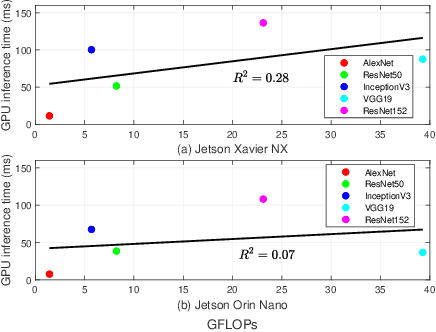
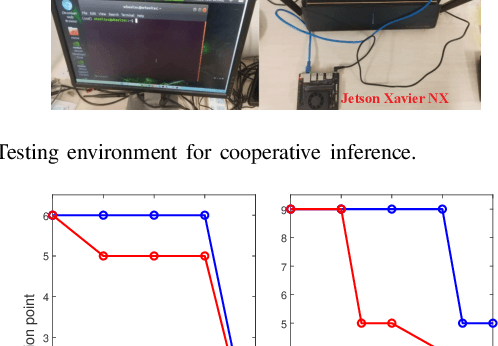
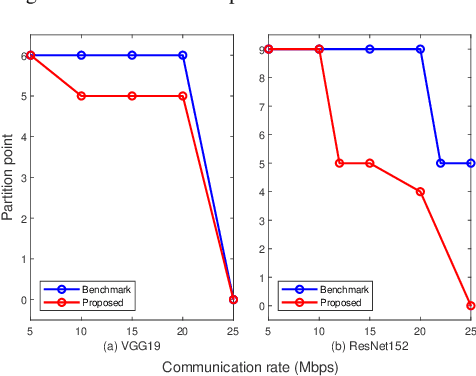
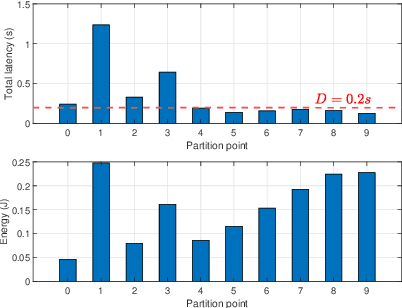
The rapid development of deep neural networks (DNNs) is inherently accompanied by the problem of high computational costs. To tackle this challenge, dynamic voltage frequency scaling (DVFS) is emerging as a promising technology for balancing the latency and energy consumption of DNN inference by adjusting the computing frequency of processors. However, most existing models of DNN inference time are based on the CPU-DVFS technique, and directly applying the CPU-DVFS model to DNN inference on GPUs will lead to significant errors in optimizing latency and energy consumption. In this paper, we propose a DVFS-aware latency model to precisely characterize DNN inference time on GPUs. We first formulate the DNN inference time based on extensive experiment results for different devices and analyze the impact of fitting parameters. Then by dividing DNNs into multiple blocks and obtaining the actual inference time, the proposed model is further verified. Finally, we compare our proposed model with the CPU-DVFS model in two specific cases. Evaluation results demonstrate that local inference optimization with our proposed model achieves a reduction of no less than 66% and 69% in inference time and energy consumption respectively. In addition, cooperative inference with our proposed model can improve the partition policy and reduce the energy consumption compared to the CPU-DVFS model.