 Add to Chrome
 Add to Firefox
 Add to Edge
PQFA: Parallel Quantum Feature Augmentation of Fused Representations for Multimodal Classification
Jul 15, 2026
Most multimodal learning methods improve how heterogeneous representations are aligned and fused, while post-fusion enhancement remains less explored. We propose Parallel Quantum Feature Augmentation (PQFA), a hybrid quantum-classical framework that applies multiple shallow variational quantum circuits to fused multimodal features. Text and image representations extracted by frozen RoBERTa and ViT encoders are processed through bidirectional cross-attention, attentive pooling, and adaptive gated fusion. The fused feature is then amplitude-encoded into parallel quantum circuits, whose measurement readouts are concatenated with the classical representation for prediction. We evaluate PQFA on MM-IMDb and N24News through controlled comparisons using the same encoders, fusion backbone, data splits, projection dimension, and augmentation output width. PQFA consistently outperforms both the fusion backbone without quantum augmentation and a width-matched MLP augmentation baseline, while using approximately 2.2K augmentation parameters compared with 24.0K for the MLP branch. Missing-modality experiments further show improved robustness when textual or visual inputs are incomplete, with particularly clear gains when the more informative textual modality is severely degraded. Controlled ablations and feature-space analyses indicate that the improvement cannot be reproduced by random feature mappings, increased classical width, or untrained quantum transformations. Quantum-state diagnostics additionally show stable predictive performance across the tested simulated noise levels and distinct branch-specific transformations of the encoded states. These results establish PQFA as an effective and parameter-efficient strategy for post-fusion augmentation in hybrid quantum-classical multimodal learning.

Density peak clustering using tensor network
Feb 01, 2023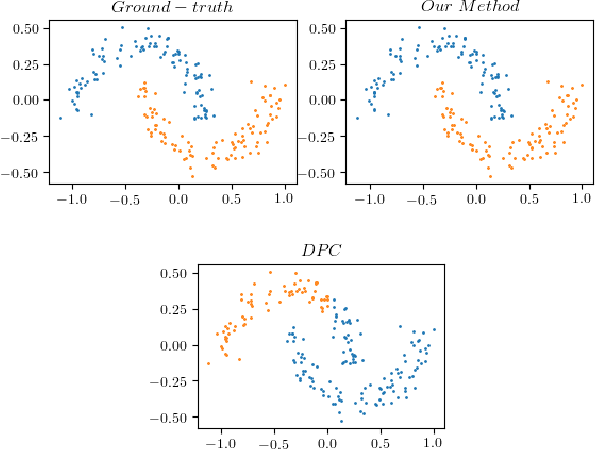
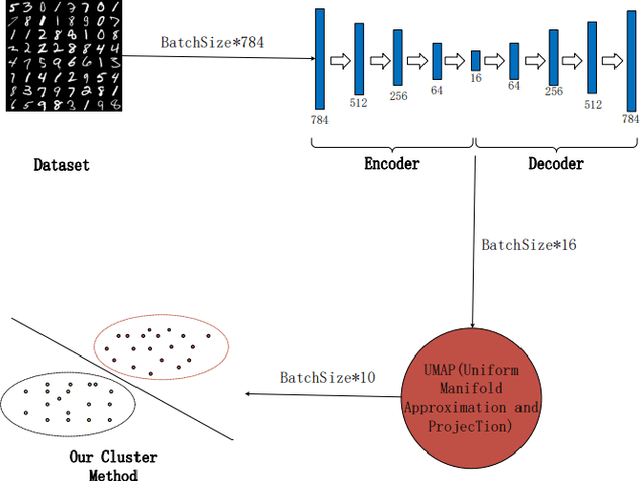
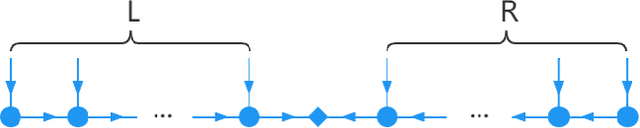
Tensor networks, which have been traditionally used to simulate many-body physics, have recently gained significant attention in the field of machine learning due to their powerful representation capabilities. In this work, we propose a density-based clustering algorithm inspired by tensor networks. We encode classical data into tensor network states on an extended Hilbert space and train the tensor network states to capture the features of the clusters. Here, we define density and related concepts in terms of fidelity, rather than using a classical distance measure. We evaluate the performance of our algorithm on six synthetic data sets, four real world data sets, and three commonly used computer vision data sets. The results demonstrate that our method provides state-of-the-art performance on several synthetic data sets and real world data sets, even when the number of clusters is unknown. Additionally, our algorithm performs competitively with state-of-the-art algorithms on the MNIST, USPS, and Fashion-MNIST image data sets. These findings reveal the great potential of tensor networks for machine learning applications.