 Add to Chrome
 Add to Firefox
 Add to Edge
Connectivity-Aware Representations for Constrained Motion Planning via Multi-Scale Contrastive Learning
Mar 26, 2026
The objective of constrained motion planning is to connect start and goal configurations while satisfying task-specific constraints. Motion planning becomes inefficient or infeasible when the configurations lie in disconnected regions, known as essentially mutually disconnected (EMD) components. Constraints further restrict feasible space to a lower-dimensional submanifold, while redundancy introduces additional complexity because a single end-effector pose admits infinitely many inverse kinematic solutions that may form discrete self-motion manifolds. This paper addresses these challenges by learning a connectivity-aware representation for selecting start and goal configurations prior to planning. Joint configurations are embedded into a latent space through multi-scale manifold learning across neighborhood ranges from local to global, and clustering generates pseudo-labels that supervise a contrastive learning framework. The proposed framework provides a connectivity-aware measure that biases the selection of start and goal configurations in connected regions, avoiding EMDs and yielding higher success rates with reduced planning time. Experiments on various manipulation tasks showed that our method achieves 1.9 times higher success rates and reduces the planning time by a factor of 0.43 compared to baselines.

SCOB: Universal Text Understanding via Character-wise Supervised Contrastive Learning with Online Text Rendering for Bridging Domain Gap
Sep 21, 2023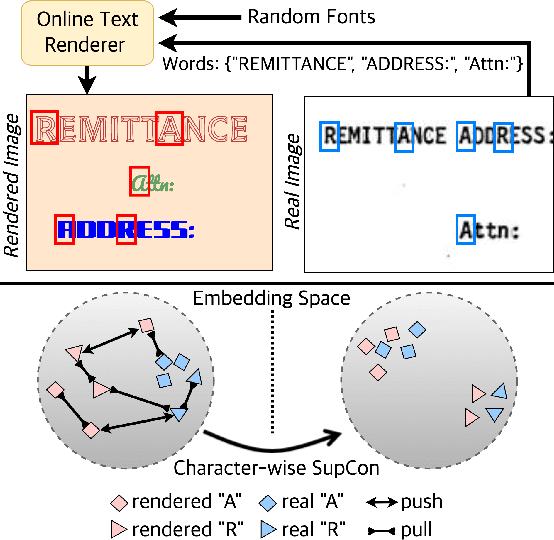
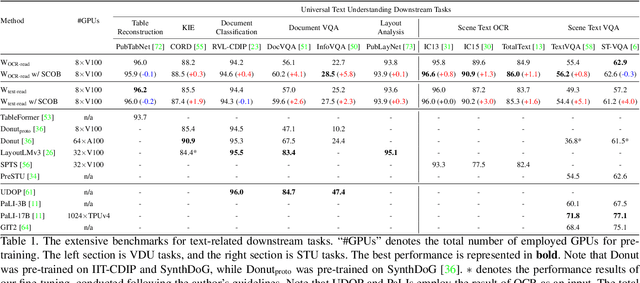

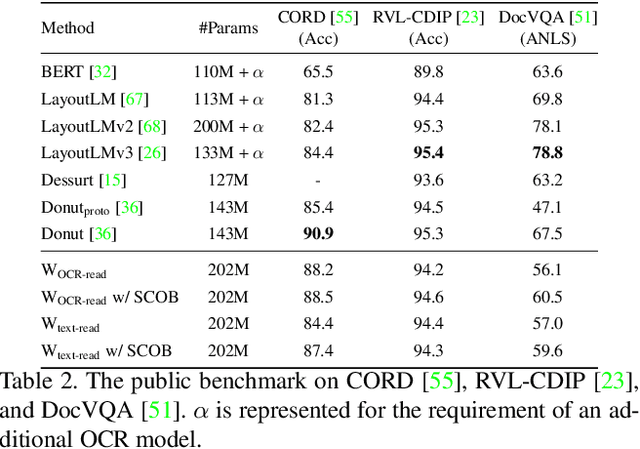
Inspired by the great success of language model (LM)-based pre-training, recent studies in visual document understanding have explored LM-based pre-training methods for modeling text within document images. Among them, pre-training that reads all text from an image has shown promise, but often exhibits instability and even fails when applied to broader domains, such as those involving both visual documents and scene text images. This is a substantial limitation for real-world scenarios, where the processing of text image inputs in diverse domains is essential. In this paper, we investigate effective pre-training tasks in the broader domains and also propose a novel pre-training method called SCOB that leverages character-wise supervised contrastive learning with online text rendering to effectively pre-train document and scene text domains by bridging the domain gap. Moreover, SCOB enables weakly supervised learning, significantly reducing annotation costs. Extensive benchmarks demonstrate that SCOB generally improves vanilla pre-training methods and achieves comparable performance to state-of-the-art methods. Our findings suggest that SCOB can be served generally and effectively for read-type pre-training methods. The code will be available at https://github.com/naver-ai/scob.