 Add to Chrome
 Add to Firefox
 Add to Edge
Alignment of Similarity-Transformed Images Based on Fourier--Mellin Transform Using Auxiliary Function Method
Aug 12, 2026
This paper proposes an algorithm for estimating the similarity transformation, namely translation, scale, and rotation, between two images with subpixel accuracy. Image registration is a fundamental technique for aligning images acquired under different viewpoints and imaging conditions, and a representative approach based on maximizing discrete cross-correlation is the Fourier--Mellin registration. However, the Fourier--Mellin approach often fails to achieve sufficient alignment accuracy when subpixel-level estimation is required. The proposed method integrates (i) scale-and-rotation estimation from the Fourier magnitude spectrum in a log-polar representation and (ii) maximization of phase-only correlation based on the auxiliary function method. This integration enables a two-stage estimation procedure: it first estimates scale and rotation without being affected by translation, and then estimates translation with subpixel precision in the spatial domain using the corrected image pair. A simulation experiment on image pairs subjected to random similarity transformations demonstrates that the proposed method reduces estimation errors in scale, rotation, and translation compared with Fourier--Mellin-based registration methods using discrete cross-correlation.

Boundary-Continuous Cross-Camera RGB Mapping via Hue-Split Model Trees
Aug 12, 2026We propose a hue-split model-tree method for boundary-continuous cross-camera RGB mapping. Cross-camera RGB mapping aims to produce consistent color representations across cameras whose recorded RGB values differ due to sensor spectral sensitivities and image-signal processing pipelines. A common chart-based remedy is to estimate a single global affine color correction matrix (CCM), but such a global model cannot capture hue-specific discrepancies between cameras. To capture that behavior, we recursively partitions the source-camera color space along a scalar hue coordinate and builds an model tree that stores an affine CCM at every node. For fitting the node CCMs, we utilize a log-domain error objective. To prevent false contours that arise from hard hue splits, we further introduce a boundary-continuous formulation in which the prediction is obtained by blending the log-domain outputs of all node CCMs along the root-to-leaf path. The path-wise blending weights are optimized under a simplex constraint using both a chart-pair fitting loss and an explicit continuity regularizer defined on deterministic boundary prototype pairs placed just on either side of each learned hue threshold. We conducted an experiment on a Canon EOS-1Ds Mark II to Canon EOS 20D mapping using the Middlebury Registered Color Checker dataset. The results show that hue splitting substantially reduces log-RMSE over a single global affine CCM and that the proposed path blending with boundary prototype regularization simultaneously improves accuracy and suppresses chromaticity gaps at the learned hue thresholds across two illuminants and multiple exposure conditions.
Pre-training Autoencoder for Acoustic Event Classification via Blinky
Sep 18, 2025In the acoustic event classification (AEC) framework that employs Blinkies, audio signals are converted into LED light emissions and subsequently captured by a single video camera. However, the 30 fps optical transmission channel conveys only about 0.2% of the normal audio bandwidth and is highly susceptible to noise. We propose a novel sound-to-light conversion method that leverages the encoder of a pre-trained autoencoder (AE) to distill compact, discriminative features from the recorded audio. To pre-train the AE, we adopt a noise-robust learning strategy in which artificial noise is injected into the encoder's latent representations during training, thereby enhancing the model's robustness against channel noise. The encoder architecture is specifically designed for the memory footprint of contemporary edge devices such as the Raspberry Pi 4. In a simulation experiment on the ESC-50 dataset under a stringent 15 Hz bandwidth constraint, the proposed method achieved higher macro-F1 scores than conventional sound-to-light conversion approaches.
Template matching with white balance adjustment under multiple illuminants
Aug 03, 2022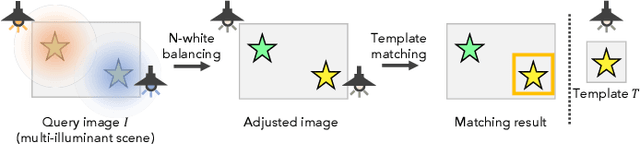
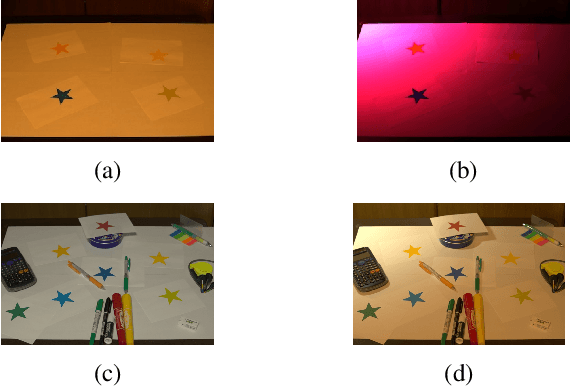

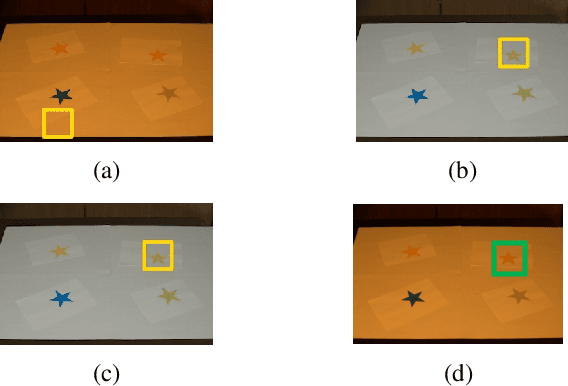
In this paper, we propose a novel template matching method with a white balancing adjustment, called N-white balancing, which was proposed for multi-illuminant scenes. To reduce the influence of lighting effects, N-white balancing is applied to images for multi-illumination color constancy, and then a template matching method is carried out by using adjusted images. In experiments, the effectiveness of the proposed method is demonstrated to be effective in object detection tasks under various illumination conditions.
Image and Model Transformation with Secret Key for Vision Transformer
Jul 12, 2022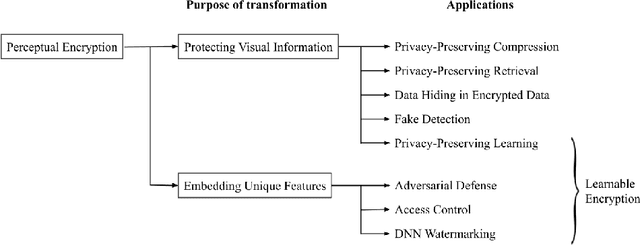
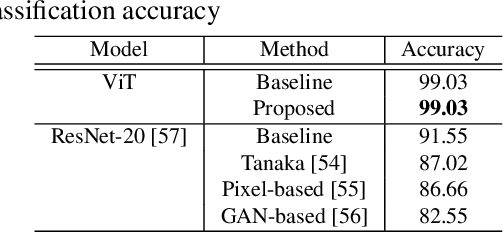
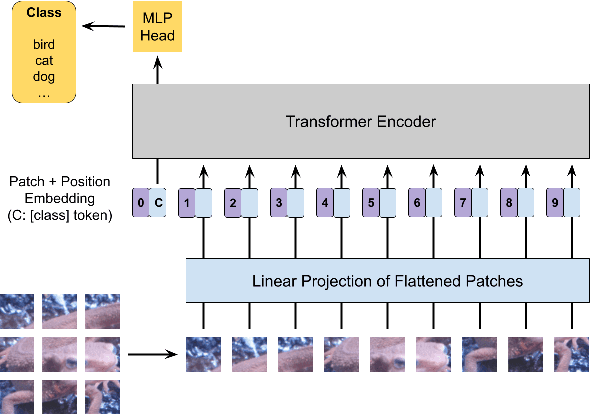
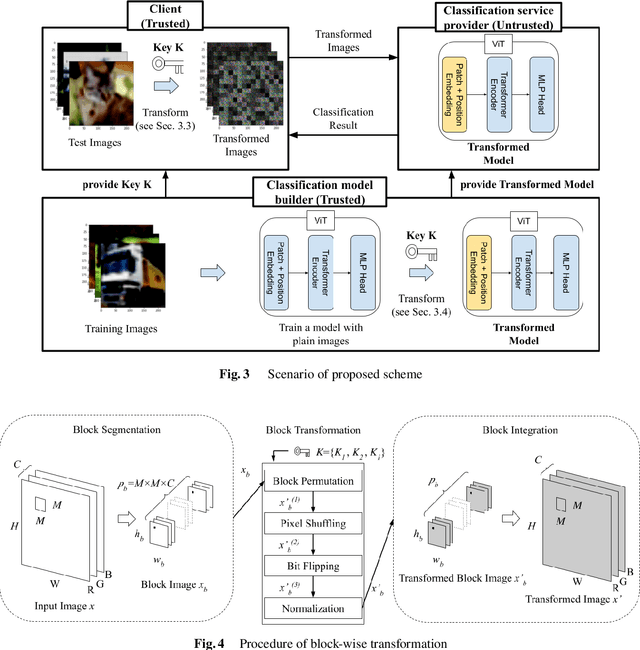
In this paper, we propose a combined use of transformed images and vision transformer (ViT) models transformed with a secret key. We show for the first time that models trained with plain images can be directly transformed to models trained with encrypted images on the basis of the ViT architecture, and the performance of the transformed models is the same as models trained with plain images when using test images encrypted with the key. In addition, the proposed scheme does not require any specially prepared data for training models or network modification, so it also allows us to easily update the secret key. In an experiment, the effectiveness of the proposed scheme is evaluated in terms of performance degradation and model protection performance in an image classification task on the CIFAR-10 dataset.
Privacy-Preserving Image Classification Using Vision Transformer
May 24, 2022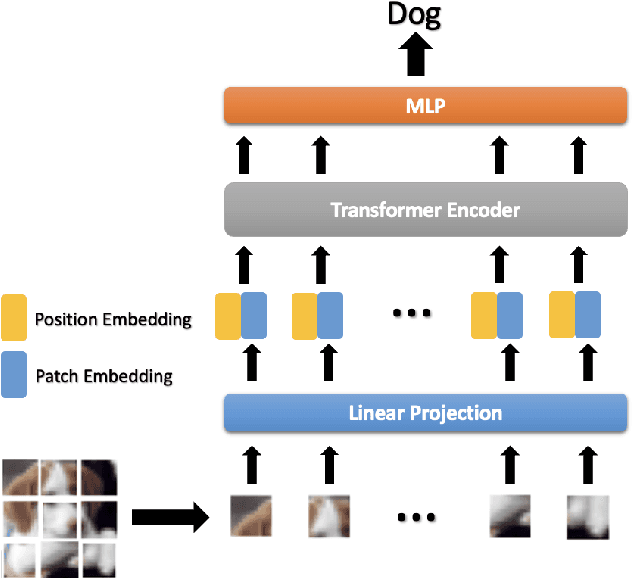
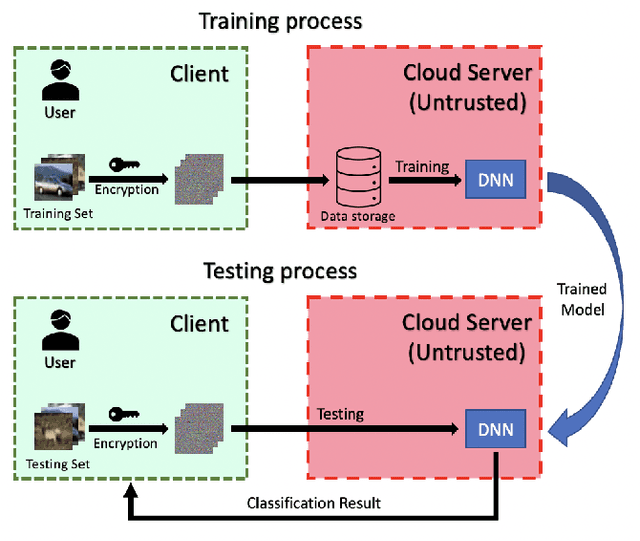
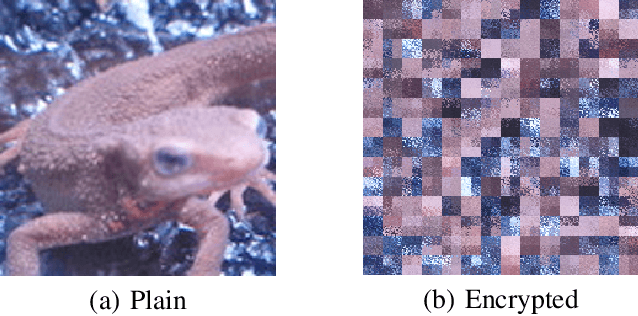
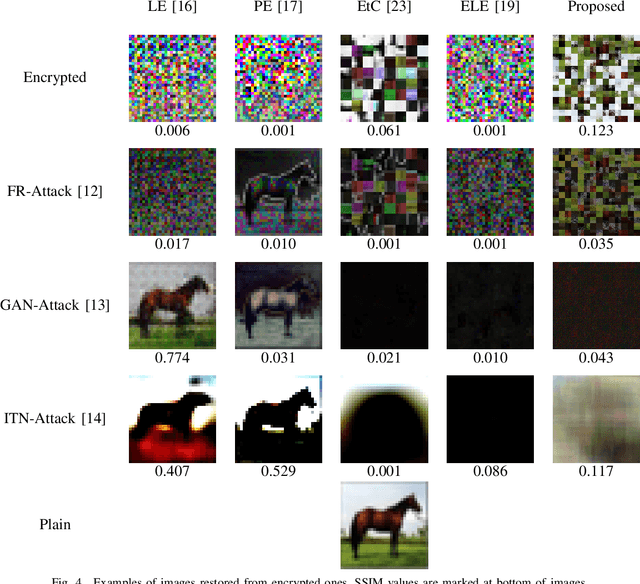
In this paper, we propose a privacy-preserving image classification method that is based on the combined use of encrypted images and the vision transformer (ViT). The proposed method allows us not only to apply images without visual information to ViT models for both training and testing but to also maintain a high classification accuracy. ViT utilizes patch embedding and position embedding for image patches, so this architecture is shown to reduce the influence of block-wise image transformation. In an experiment, the proposed method for privacy-preserving image classification is demonstrated to outperform state-of-the-art methods in terms of classification accuracy and robustness against various attacks.
An Overview of Compressible and Learnable Image Transformation with Secret Key and Its Applications
Jan 26, 2022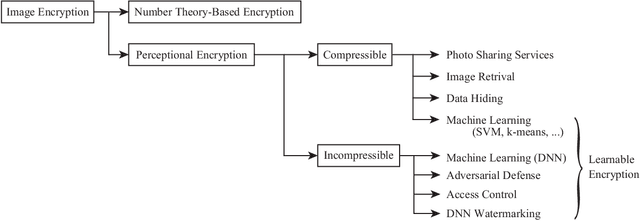
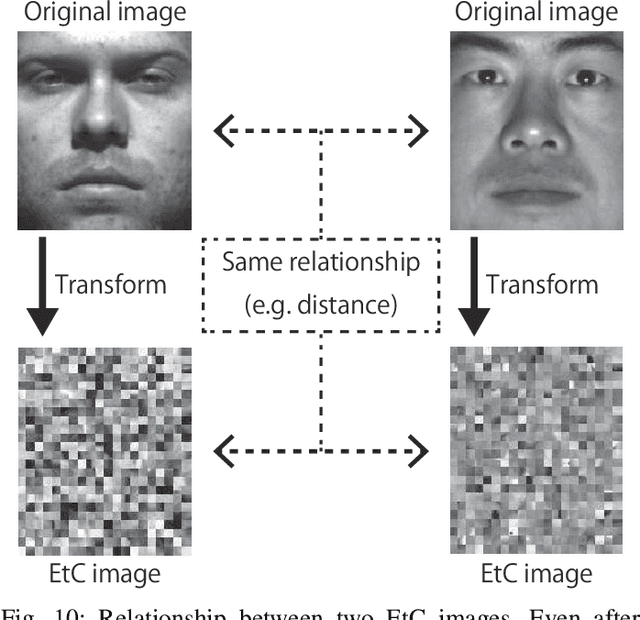
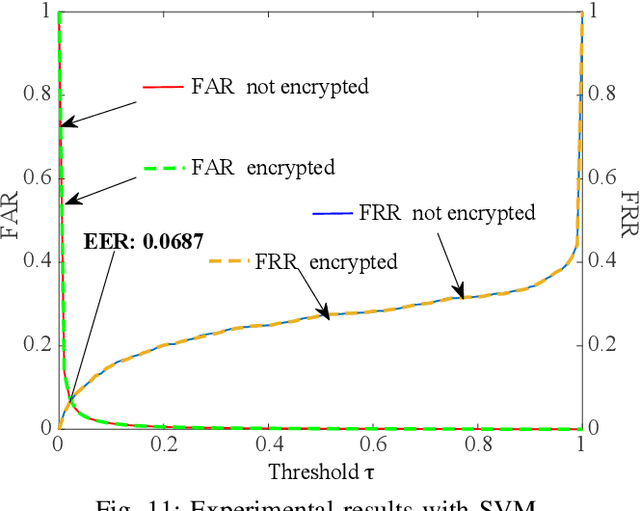
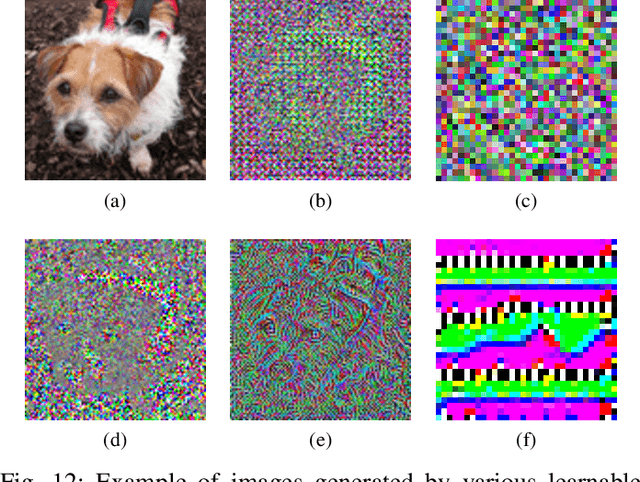
This article presents an overview of image transformation with a secret key and its applications. Image transformation with a secret key enables us not only to protect visual information on plain images but also to embed unique features controlled with a key into images. In addition, numerous encryption methods can generate encrypted images that are compressible and learnable for machine learning. Various applications of such transformation have been developed by using these properties. In this paper, we focus on a class of image transformation referred to as learnable image encryption, which is applicable to privacy-preserving machine learning and adversarially robust defense. Detailed descriptions of both transformation algorithms and performances are provided. Moreover, we discuss robustness against various attacks.
Self-Supervised Intrinsic Image Decomposition Network Considering Reflectance Consistency
Nov 05, 2021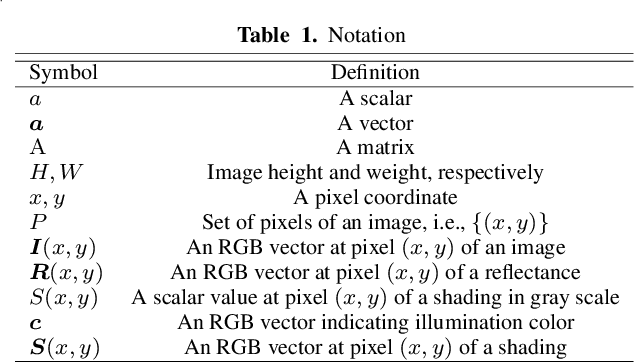
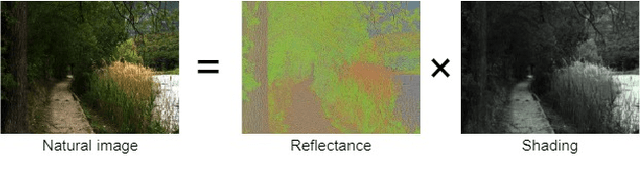
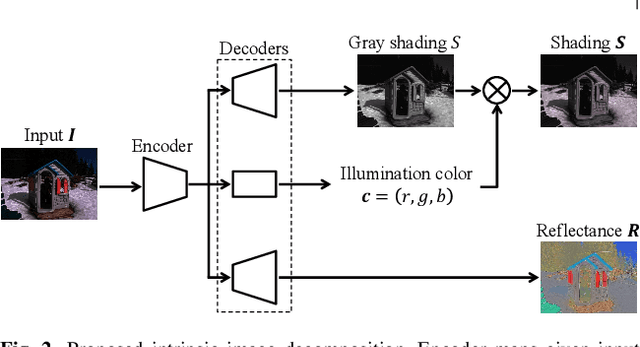
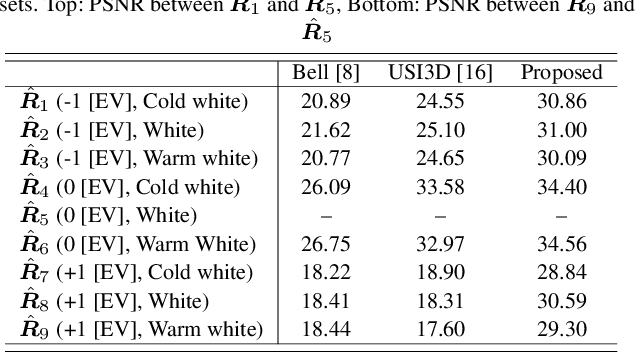
We propose a novel intrinsic image decomposition network considering reflectance consistency. Intrinsic image decomposition aims to decompose an image into illumination-invariant and illumination-variant components, referred to as ``reflectance'' and ``shading,'' respectively. Although there are three consistencies that the reflectance and shading should satisfy, most conventional work does not sufficiently account for consistency with respect to reflectance, owing to the use of a white-illuminant decomposition model and the lack of training images capturing the same objects under various illumination-brightness and -color conditions. For this reason, the three consistencies are considered in the proposed network by using a color-illuminant model and training the network with losses calculated from images taken under various illumination conditions. In addition, the proposed network can be trained in a self-supervised manner because various illumination conditions can easily be simulated. Experimental results show that our network can decompose images into reflectance and shading components.
Spatially varying white balancing for mixed and non-uniform illuminants
Sep 03, 2021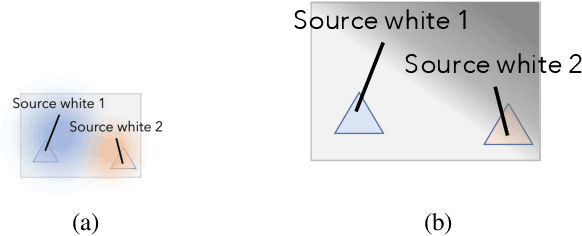
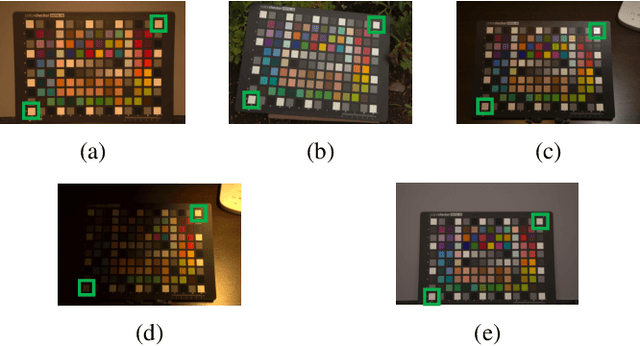
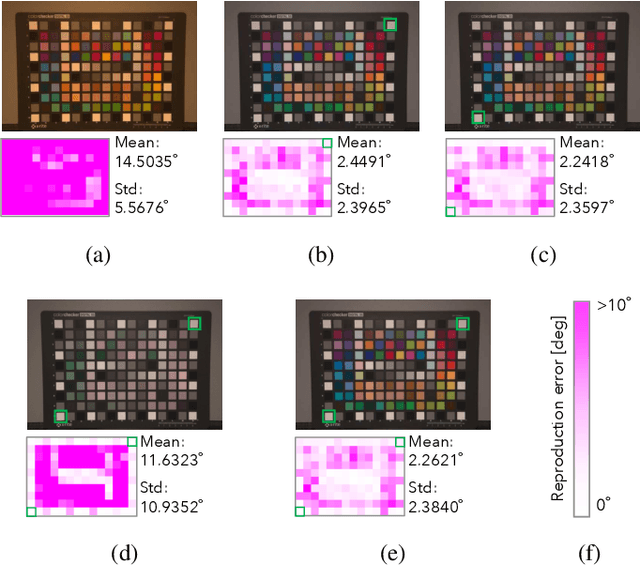
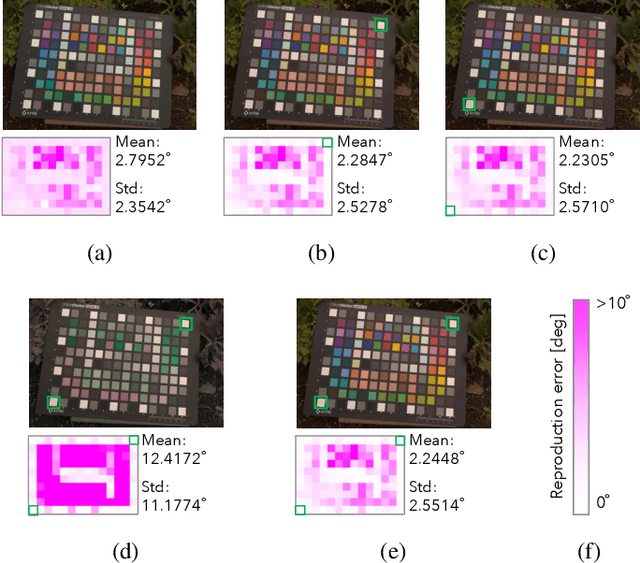
In this paper, we propose a novel white balance adjustment, called "spatially varying white balancing," for single, mixed, and non-uniform illuminants. By using n diagonal matrices along with a weight, the proposed method can reduce lighting effects on all spatially varying colors in an image under such illumination conditions. In contrast, conventional white balance adjustments do not consider the correcting of all colors except under a single illuminant. Also, multi-color balance adjustments can map multiple colors into corresponding ground truth colors, although they may cause the rank deficiency problem to occur as a non-diagonal matrix is used, unlike white balancing. In an experiment, the effectiveness of the proposed method is shown under mixed and non-uniform illuminants, compared with conventional white and multi-color balancing. Moreover, under a single illuminant, the proposed method has almost the same performance as the conventional white balancing.
Separated-Spectral-Distribution Estimation Based on Bayesian Inference with Single RGB Camera
Jun 01, 2021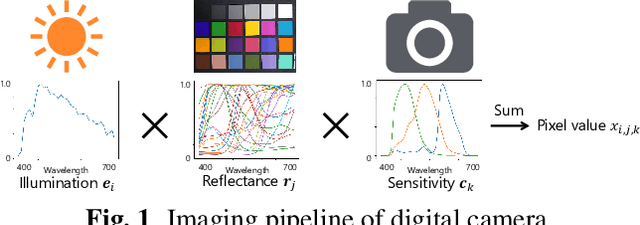
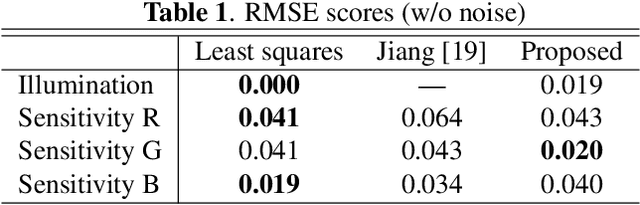
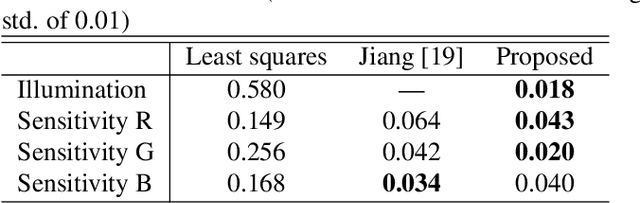
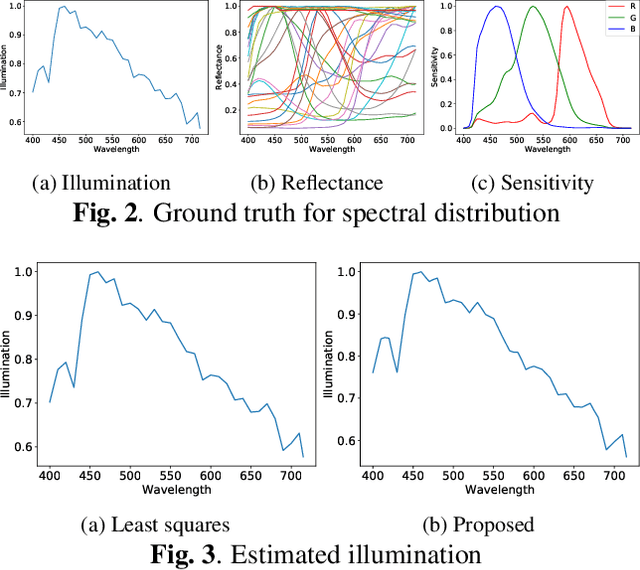
In this paper, we propose a novel method for separately estimating spectral distributions from images captured by a typical RGB camera. The proposed method allows us to separately estimate a spectral distribution of illumination, reflectance, or camera sensitivity, while recent hyperspectral cameras are limited to capturing a joint spectral distribution from a scene. In addition, the use of Bayesian inference makes it possible to take into account prior information of both spectral distributions and image noise as probability distributions. As a result, the proposed method can estimate spectral distributions in a unified way, and it can enhance the robustness of the estimation against noise, which conventional spectral-distribution estimation methods cannot. The use of Bayesian inference also enables us to obtain the confidence of estimation results. In an experiment, the proposed method is shown not only to outperform conventional estimation methods in terms of RMSE but also to be robust against noise.