 Add to Chrome
 Add to Firefox
 Add to Edge
Boundary-Continuous Cross-Camera RGB Mapping via Hue-Split Model Trees
Aug 12, 2026
We propose a hue-split model-tree method for boundary-continuous cross-camera RGB mapping. Cross-camera RGB mapping aims to produce consistent color representations across cameras whose recorded RGB values differ due to sensor spectral sensitivities and image-signal processing pipelines. A common chart-based remedy is to estimate a single global affine color correction matrix (CCM), but such a global model cannot capture hue-specific discrepancies between cameras. To capture that behavior, we recursively partitions the source-camera color space along a scalar hue coordinate and builds an model tree that stores an affine CCM at every node. For fitting the node CCMs, we utilize a log-domain error objective. To prevent false contours that arise from hard hue splits, we further introduce a boundary-continuous formulation in which the prediction is obtained by blending the log-domain outputs of all node CCMs along the root-to-leaf path. The path-wise blending weights are optimized under a simplex constraint using both a chart-pair fitting loss and an explicit continuity regularizer defined on deterministic boundary prototype pairs placed just on either side of each learned hue threshold. We conducted an experiment on a Canon EOS-1Ds Mark II to Canon EOS 20D mapping using the Middlebury Registered Color Checker dataset. The results show that hue splitting substantially reduces log-RMSE over a single global affine CCM and that the proposed path blending with boundary prototype regularization simultaneously improves accuracy and suppresses chromaticity gaps at the learned hue thresholds across two illuminants and multiple exposure conditions.

Alignment of Similarity-Transformed Images Based on Fourier--Mellin Transform Using Auxiliary Function Method
Aug 12, 2026This paper proposes an algorithm for estimating the similarity transformation, namely translation, scale, and rotation, between two images with subpixel accuracy. Image registration is a fundamental technique for aligning images acquired under different viewpoints and imaging conditions, and a representative approach based on maximizing discrete cross-correlation is the Fourier--Mellin registration. However, the Fourier--Mellin approach often fails to achieve sufficient alignment accuracy when subpixel-level estimation is required. The proposed method integrates (i) scale-and-rotation estimation from the Fourier magnitude spectrum in a log-polar representation and (ii) maximization of phase-only correlation based on the auxiliary function method. This integration enables a two-stage estimation procedure: it first estimates scale and rotation without being affected by translation, and then estimates translation with subpixel precision in the spatial domain using the corrected image pair. A simulation experiment on image pairs subjected to random similarity transformations demonstrates that the proposed method reduces estimation errors in scale, rotation, and translation compared with Fourier--Mellin-based registration methods using discrete cross-correlation.
CFE-PPAR: Compression-friendly encryption for privacy-preserving action recognition leveraging video transformers
May 07, 2026Privacy-preserving action recognition (PPAR) enables machines to understand human activities in videos without revealing sensitive visual content. Among the various strategies for PPAR, encryption-based methods achieve strong privacy protection while maintaining high recognition performance. However, these methods lead to a catastrophic decrease in recognition performance and visual quality when the encrypted videos are compressed. That is, the previous methods are not compression-friendly. To address these issues, in this paper, we propose the first compression-friendly encryption method for PPAR, called CFE-PPAR. In CFE-PPAR, videos encrypted with secret keys can be directly recognized by a video transformer, which uses parameters transformed by the same keys as those used for video encryption. In experiments, it is verified that CFE-PPAR outperforms previous methods on the UCF101 and HMDB51 datasets under Motion-JPEG and H.264 compression.
Effective Fine-Tuning of Vision Transformers with Low-Rank Adaptation for Privacy-Preserving Image Classification
Jul 16, 2025We propose a low-rank adaptation method for training privacy-preserving vision transformer (ViT) models that efficiently freezes pre-trained ViT model weights. In the proposed method, trainable rank decomposition matrices are injected into each layer of the ViT architecture, and moreover, the patch embedding layer is not frozen, unlike in the case of the conventional low-rank adaptation methods. The proposed method allows us not only to reduce the number of trainable parameters but to also maintain almost the same accuracy as that of full-time tuning.
Privacy-Preserving Vision Transformer Using Images Encrypted with Restricted Random Permutation Matrices
Aug 16, 2024
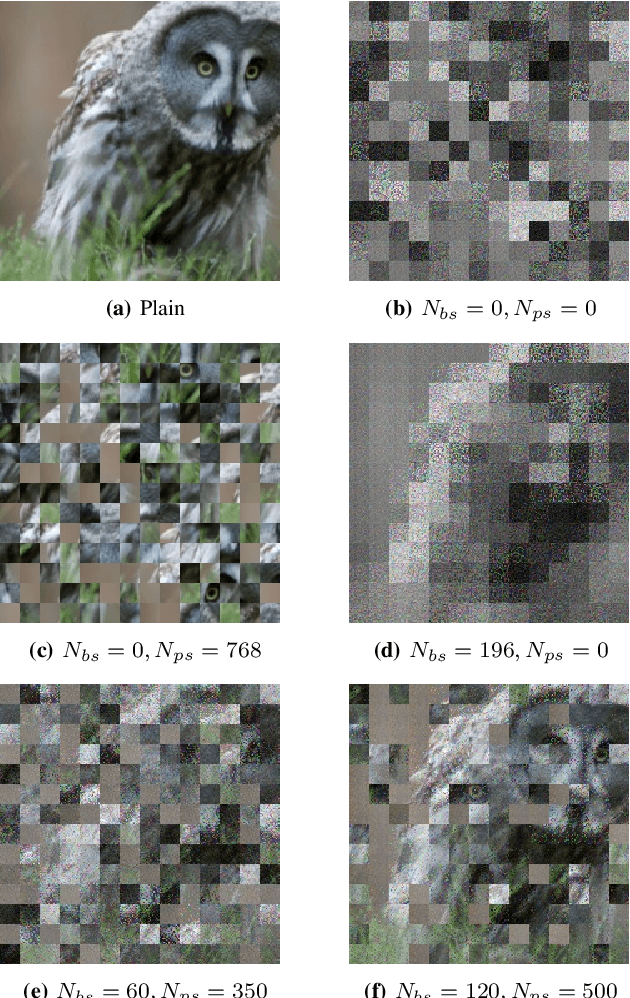

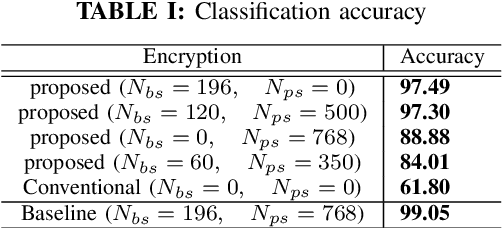
We propose a novel method for privacy-preserving fine-tuning vision transformers (ViTs) with encrypted images. Conventional methods using encrypted images degrade model performance compared with that of using plain images due to the influence of image encryption. In contrast, the proposed encryption method using restricted random permutation matrices can provide a higher performance than the conventional ones.
Speech privacy-preserving methods using secret key for convolutional neural network models and their robustness evaluation
Aug 07, 2024In this paper, we propose privacy-preserving methods with a secret key for convolutional neural network (CNN)-based models in speech processing tasks. In environments where untrusted third parties, like cloud servers, provide CNN-based systems, ensuring the privacy of speech queries becomes essential. This paper proposes encryption methods for speech queries using secret keys and a model structure that allows for encrypted queries to be accepted without decryption. Our approach introduces three types of secret keys: Shuffling, Flipping, and random orthogonal matrix (ROM). In experiments, we demonstrate that when the proposed methods are used with the correct key, identification performance did not degrade. Conversely, when an incorrect key is used, the performance significantly decreased. Particularly, with the use of ROM, we show that even with a relatively small key space, high privacy-preserving performance can be maintained many speech processing tasks. Furthermore, we also demonstrate the difficulty of recovering original speech from encrypted queries in various robustness evaluations.
Fine-Tuning Text-To-Image Diffusion Models for Class-Wise Spurious Feature Generation
Feb 13, 2024We propose a method for generating spurious features by leveraging large-scale text-to-image diffusion models. Although the previous work detects spurious features in a large-scale dataset like ImageNet and introduces Spurious ImageNet, we found that not all spurious images are spurious across different classifiers. Although spurious images help measure the reliance of a classifier, filtering many images from the Internet to find more spurious features is time-consuming. To this end, we utilize an existing approach of personalizing large-scale text-to-image diffusion models with available discovered spurious images and propose a new spurious feature similarity loss based on neural features of an adversarially robust model. Precisely, we fine-tune Stable Diffusion with several reference images from Spurious ImageNet with a modified objective incorporating the proposed spurious-feature similarity loss. Experiment results show that our method can generate spurious images that are consistently spurious across different classifiers. Moreover, the generated spurious images are visually similar to reference images from Spurious ImageNet.
A Random Ensemble of Encrypted Vision Transformers for Adversarially Robust Defense
Feb 11, 2024Deep neural networks (DNNs) are well known to be vulnerable to adversarial examples (AEs). In previous studies, the use of models encrypted with a secret key was demonstrated to be robust against white-box attacks, but not against black-box ones. In this paper, we propose a novel method using the vision transformer (ViT) that is a random ensemble of encrypted models for enhancing robustness against both white-box and black-box attacks. In addition, a benchmark attack method, called AutoAttack, is applied to models to test adversarial robustness objectively. In experiments, the method was demonstrated to be robust against not only white-box attacks but also black-box ones in an image classification task on the CIFAR-10 and ImageNet datasets. The method was also compared with the state-of-the-art in a standardized benchmark for adversarial robustness, RobustBench, and it was verified to outperform conventional defenses in terms of clean accuracy and robust accuracy.
Efficient Fine-Tuning with Domain Adaptation for Privacy-Preserving Vision Transformer
Jan 10, 2024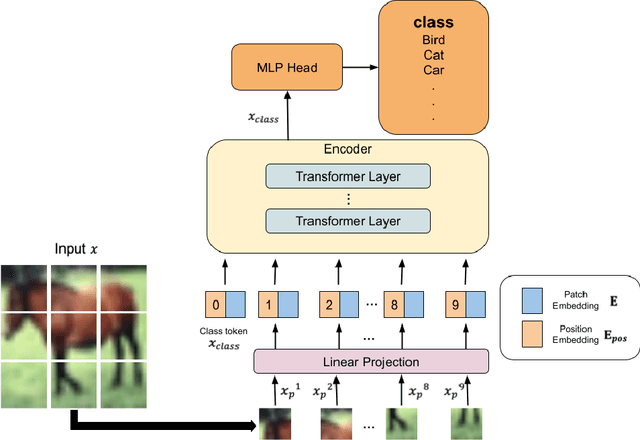
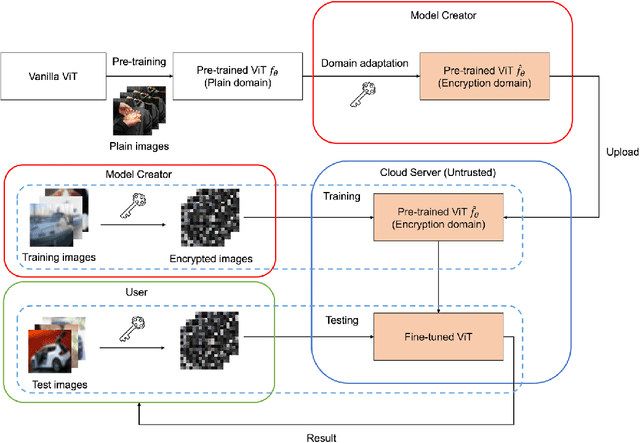
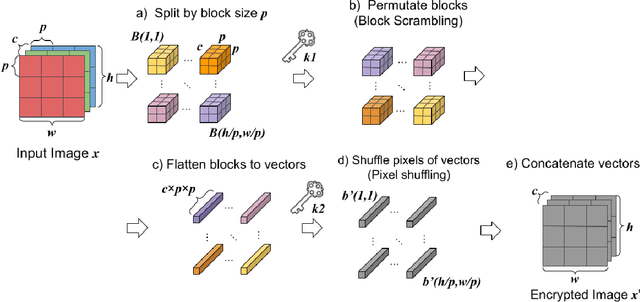
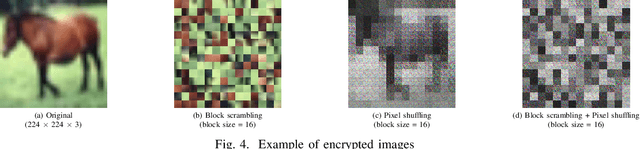
We propose a novel method for privacy-preserving deep neural networks (DNNs) with the Vision Transformer (ViT). The method allows us not only to train models and test with visually protected images but to also avoid the performance degradation caused from the use of encrypted images, whereas conventional methods cannot avoid the influence of image encryption. A domain adaptation method is used to efficiently fine-tune ViT with encrypted images. In experiments, the method is demonstrated to outperform conventional methods in an image classification task on the CIFAR-10 and ImageNet datasets in terms of classification accuracy.
A Random Ensemble of Encrypted models for Enhancing Robustness against Adversarial Examples
Jan 05, 2024Deep neural networks (DNNs) are well known to be vulnerable to adversarial examples (AEs). In addition, AEs have adversarial transferability, which means AEs generated for a source model can fool another black-box model (target model) with a non-trivial probability. In previous studies, it was confirmed that the vision transformer (ViT) is more robust against the property of adversarial transferability than convolutional neural network (CNN) models such as ConvMixer, and moreover encrypted ViT is more robust than ViT without any encryption. In this article, we propose a random ensemble of encrypted ViT models to achieve much more robust models. In experiments, the proposed scheme is verified to be more robust against not only black-box attacks but also white-box ones than convention methods.