 Add to Chrome
 Add to Firefox
 Add to Edge
Robust Multi-View Classification under Noisy Supervision via Global Anchor Consensus
Jul 20, 2026
In recent years, multi-view learning has attracted increasing attention, as it integrates the complementary information of heterogeneous views. Most existing multi-view classification methods rely on accurate annotations to guarantee performance. However, noisy labels are ubiquitous in practice due to imperfect annotation, and the refinement signals that existing methods derive from models trained on such noisy supervision can gradually lose their reliability. To deal with this problem, we propose a novel Global Anchor-based Label Auditing method (GALA) for multi-view classification to resist the negative impact of noisy labels. Specifically, we construct a global anchor for each class in every view, which aggregates the samples of the whole class and thus offers a stable reference insensitive to individual predictions. Then, each view measures how close an instance is to the anchor of its observed label relative to the nearest competing anchor, and the per-view evaluations are fused with the classifier confidence into a cross-view audit score. Based on the audit scores, suspicious samples are assigned small weights, and an adaptive correction strategy rewrites a label only when the anchor-based candidate agrees with the classifier prediction. Finally, the corrected labels in turn refine the anchors and supervise noise-robust representation learning. Extensive experiments on six datasets demonstrate that GALA outperforms eight state-of-the-art methods, especially under high noise rates.

Robust and sparse support vector machine via hybrid truncated loss for supervised classification
Jun 04, 2026The support vector machine (SVM) is a widely used classifier, but choosing an appropriate loss function remains difficult. Convex losses such as the hinge loss and least-squares loss are sensitive to outliers, while bounded non-convex losses often lead to high computational cost. To address this, we propose a hybrid truncated loss function ($L_{\mathrm{ht}}$) that is both sparse and bounded, and build the $L_{\mathrm{ht}}$-SVM model for single-view classification. We introduce the P-stationary point and use it to establish the first-order necessary and sufficient optimality conditions. Based on these conditions, we design an alternating direction method of multipliers with a working-set strategy that reduces computational cost and achieves global convergence. We further extend $L_{\mathrm{ht}}$-SVM to multi-view learning by adding structural information and view weights, resulting in Mv$L_{\mathrm{ht}}$-SVM, which follows both the consensus and complementarity principles. Experiments on synthetic, real-world, and image datasets show that $L_{\mathrm{ht}}$-SVM achieves higher accuracy with fewer support vectors and better noise robustness than five single-view methods, while Mv$L_{\mathrm{ht}}$-SVM outperforms six multi-view methods in accuracy, precision, recall, and F1-score.
WISE-TTT:Worldwide Information Segmentation Enhancement
Apr 01, 2025Video multi-target segmentation remains a major challenge in long sequences, mainly due to the inherent limitations of existing architectures in capturing global temporal dependencies. We introduce WISE-TTT, a synergistic architecture integrating Test-Time Training (TTT) mechanisms with the Transformer architecture through co-design. The TTT layer systematically compresses historical temporal data to generate hidden states containing worldwide information(Lossless memory to maintain long contextual integrity), while achieving multi-stage contextual aggregation through splicing. Crucially, our framework provides the first empirical validation that implementing worldwide information across multiple network layers is essential for optimal dependency utilization.Ablation studies show TTT modules at high-level features boost global modeling. This translates to 3.1% accuracy improvement(J&F metric) on Davis2017 long-term benchmarks -- the first proof of hierarchical context superiority in video segmentation. We provide the first systematic evidence that worldwide information critically impacts segmentation performance.
MC-MLP:Multiple Coordinate Frames in all-MLP Architecture for Vision
Apr 08, 2023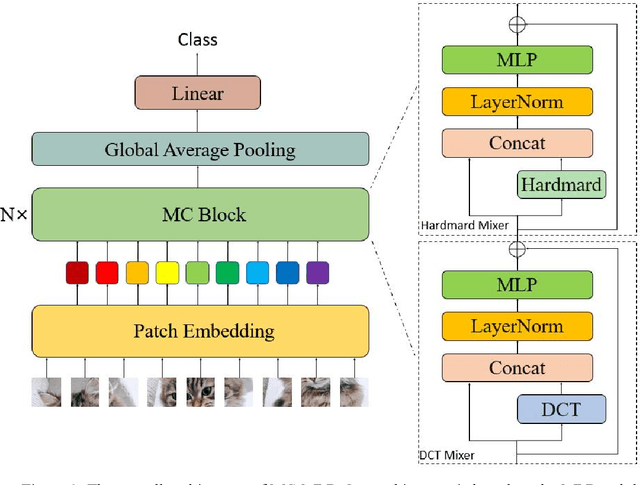
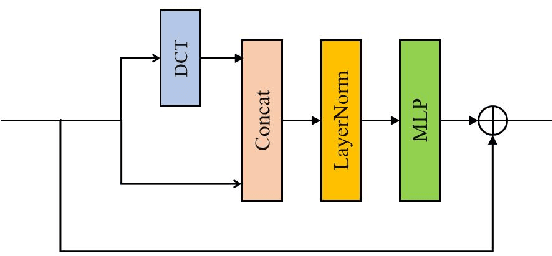
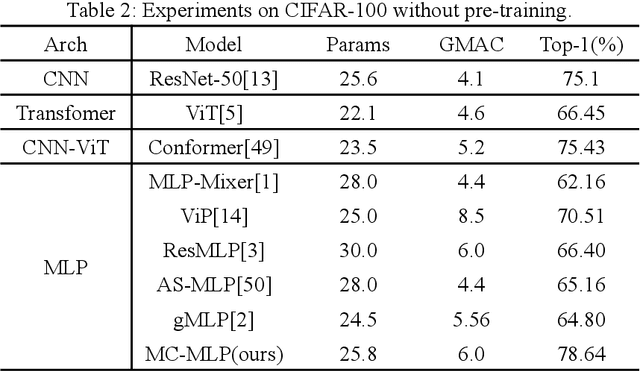
In deep learning, Multi-Layer Perceptrons (MLPs) have once again garnered attention from researchers. This paper introduces MC-MLP, a general MLP-like backbone for computer vision that is composed of a series of fully-connected (FC) layers. In MC-MLP, we propose that the same semantic information has varying levels of difficulty in learning, depending on the coordinate frame of features. To address this, we perform an orthogonal transform on the feature information, equivalent to changing the coordinate frame of features. Through this design, MC-MLP is equipped with multi-coordinate frame receptive fields and the ability to learn information across different coordinate frames. Experiments demonstrate that MC-MLP outperforms most MLPs in image classification tasks, achieving better performance at the same parameter level. The code will be available at: https://github.com/ZZM11/MC-MLP.