 Add to Chrome
 Add to Firefox
 Add to Edge
Benchmarking Quantum Kernels Across Diverse and Complex Data
Nov 13, 2025
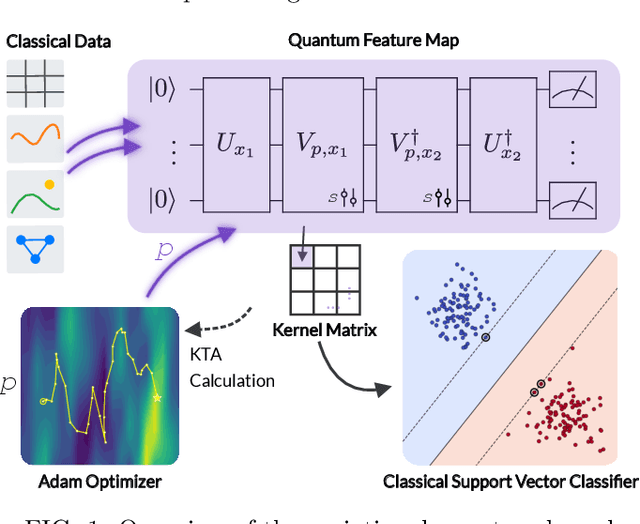
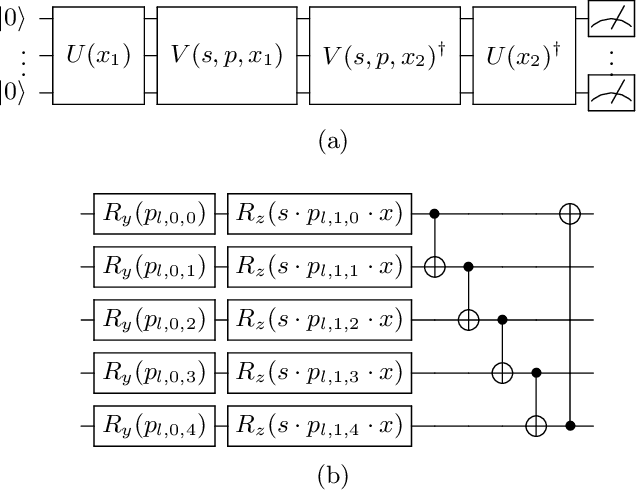
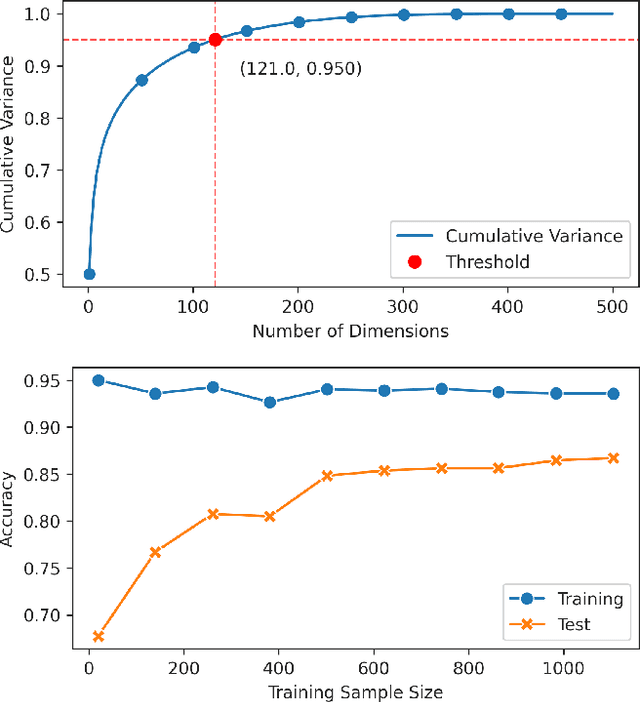
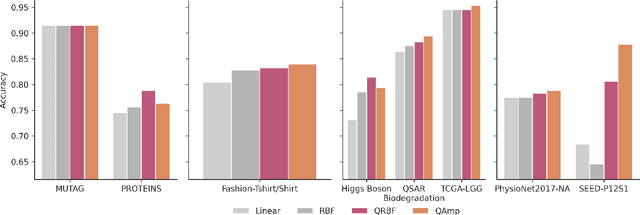
Quantum kernel methods are a promising branch of quantum machine learning, yet their practical advantage on diverse, high-dimensional, real-world data remains unverified. Current research has largely been limited to low-dimensional or synthetic datasets, preventing a thorough evaluation of their potential. To address this gap, we developed a variational quantum kernel framework utilizing resource-efficient ansätze for complex classification tasks and introduced a parameter scaling technique to accelerate convergence. We conducted a comprehensive benchmark of this framework on eight challenging, real world and high-dimensional datasets covering tabular, image, time series, and graph data. Our classically simulated results show that the proposed quantum kernel demonstrated a clear performance advantage over standard classical kernels, such as the radial basis function (RBF) kernel. This work demonstrates that properly designed quantum kernels can function as versatile, high-performance tools, laying a foundation for quantum-enhanced applications in real-world machine learning. Further research is needed to fully assess the practical quantum advantage.

Securing FC-RIS and UAV Empowered Multiuser Communications Against a Randomly Flying Eavesdropper
Aug 26, 2024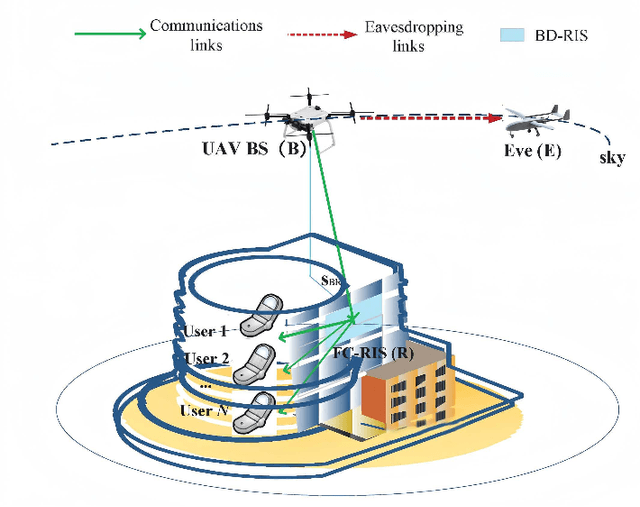
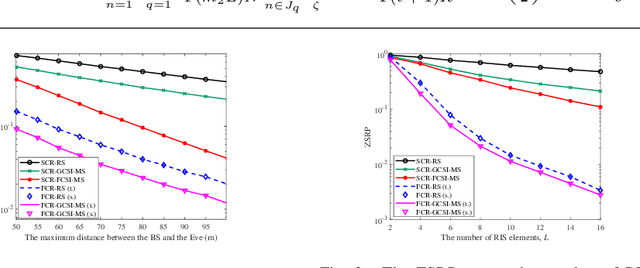
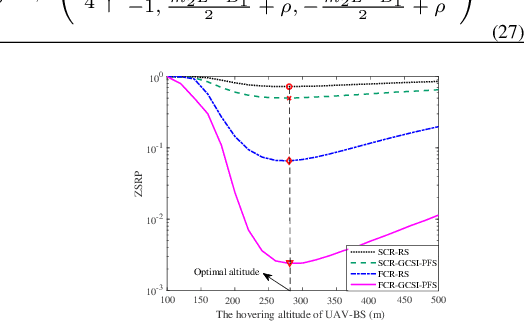
This paper investigates a wireless network consisting of an unmanned aerial vehicle (UAV) base station (BS), a fully-connected reconfigurable intelligent surface (FC-RIS), and multiple users, where the downlink signal can simultaneously be captured by an aerial eavesdropper at a random location. To improve the physical-layer security (PLS) of the considered downlink multiuser communications, we propose the fully-connected reconfigurable intelligent surface aided round-robin scheduling (FCR-RS) and the FC-RIS and ground channel state information (CSI) aided proportional fair scheduling (FCR-GCSI-PFS) schemes. Thereafter, we derive closed-form expressions of the zero secrecy rate probability (ZSRP). Numerical results not only validate the closed-form ZSRP analysis, but also verify that the proposed GCSI-PFS scheme obtains the same performance gain as the full-CSI-aided PFS in FC-RIS-aided communications. Furthermore, optimizing the hovering altitude remarkably enhances the PLS of the FC-RIS and UAV empowered multiuser communications.