 Add to Chrome
 Add to Firefox
 Add to Edge
COG: Confidence-aware Optimal Geometric Correspondence for Unsupervised Single-reference Novel Object Pose Estimation
Feb 28, 2026
Estimating the 6DoF pose of a novel object with a single reference view is challenging due to occlusions, view-point changes, and outliers. A core difficulty lies in finding robust cross-view correspondences, as existing methods often rely on discrete one-to-one matching that is non-differentiable and tends to collapse onto sparse key-points. We propose Confidence-aware Optimal Geometric Correspondence (COG), an unsupervised framework that formulates correspondence estimation as a confidence-aware optimal transport problem. COG produces balanced soft correspondences by predicting point-wise confidences and injecting them as optimal transport marginals, suppressing non-overlapping regions. Semantic priors from vision foundation models further regularize the correspondences, leading to stable pose estimation. This design integrates confidence into the correspondence finding and pose estimation pipeline, enabling unsupervised learning. Experiments show unsupervised COG achieves comparable performance to supervised methods, and supervised COG outperforms them.

OP-Align: Object-level and Part-level Alignment for Self-supervised Category-level Articulated Object Pose Estimation
Aug 29, 2024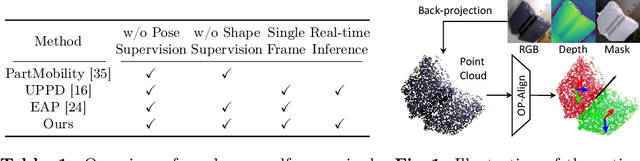
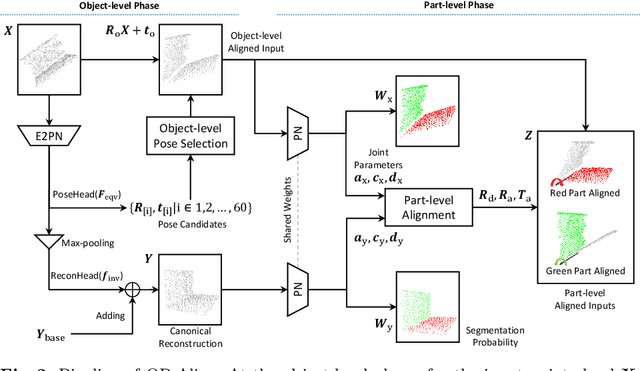
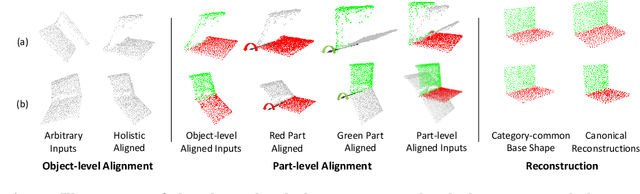
Category-level articulated object pose estimation focuses on the pose estimation of unknown articulated objects within known categories. Despite its significance, this task remains challenging due to the varying shapes and poses of objects, expensive dataset annotation costs, and complex real-world environments. In this paper, we propose a novel self-supervised approach that leverages a single-frame point cloud to solve this task. Our model consistently generates reconstruction with a canonical pose and joint state for the entire input object, and it estimates object-level poses that reduce overall pose variance and part-level poses that align each part of the input with its corresponding part of the reconstruction. Experimental results demonstrate that our approach significantly outperforms previous self-supervised methods and is comparable to the state-of-the-art supervised methods. To assess the performance of our model in real-world scenarios, we also introduce a new real-world articulated object benchmark dataset.