 Add to Chrome
 Add to Firefox
 Add to Edge
A Formative Study of Brief Affective Text as a Complement to Wearable Sensing for Longitudinal Student Health Monitoring
May 14, 2026
Wearable devices capture physiological and behavioral data with increasing fidelity, but the psychological context shaping these outcomes is difficult to recover from sensor data alone, limiting passive sensing utility for digital health. We examined whether ultra-brief naturalistic concern text could serve as a scalable complement to passive sensing. In a year-long study of 458 university students (3,610 person-waves) tracked with Oura rings, participants responded bimonthly to an open-ended prompt about what concerned them most; responses had a median length of three words. We compared dictionary-based, general pretrained, and domain-adapted NLP approaches using within-person mixed-effects models across nine sleep and physical activity outcomes. Weeks dominated by academic concern framing were associated with lower physical activity; weeks characterized by emotional exhaustion language were associated with poorer sleep quality and lower heart rate variability. General pretrained embeddings outperformed domain-adapted models for most outcomes, with domain adaptation showing relative advantage for autonomic outcomes. Zero-shot classification of concern topics produced no significant associations, while affective dimensions across all three methods were consistently associated with outcomes, indicating emotional register rather than topical content carries the signal. These findings offer design guidance: ultra-brief affective prompts enrich the psychological interpretability of passive physiological data at minimal burden.

Beyond Fixed Psychological Personas: State Beats Trait, but Language Models are State-Blind
Jan 21, 2026User interactions with language models vary due to static properties of the user (trait) and the specific context of the interaction (state). However, existing persona datasets (like PersonaChat, PANDORA etc.) capture only trait, and ignore the impact of state. We introduce Chameleon, a dataset of 5,001 contextual psychological profiles from 1,667 Reddit users, each measured across multiple contexts. Using the Chameleon dataset, we present three key findings. First, inspired by Latent State-Trait theory, we decompose variance and find that 74\% is within-person(state) while only 26\% is between-person (trait). Second, we find that LLMs are state-blind: they focus on trait only, and produce similar responses regardless of state. Third, we find that reward models react to user state, but inconsistently: different models favor or penalize the same users in opposite directions. We release Chameleon to support research on affective computing, personalized dialogue, and RLHF alignment.
Uniform-in-Time Weak Error Analysis for Stochastic Gradient Descent Algorithms via Diffusion Approximation
Feb 02, 2019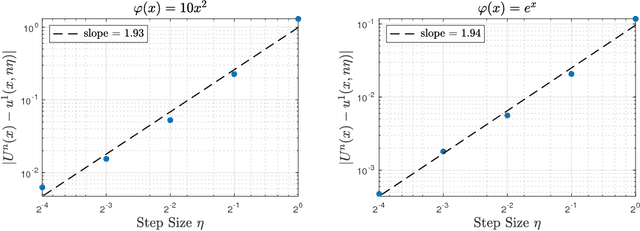
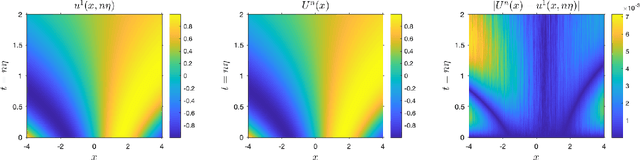
Diffusion approximation provides weak approximation for stochastic gradient descent algorithms in a finite time horizon. In this paper, we introduce new tools motivated by the backward error analysis of numerical stochastic differential equations into the theoretical framework of diffusion approximation, extending the validity of the weak approximation from finite to infinite time horizon. The new techniques developed in this paper enable us to characterize the asymptotic behavior of constant-step-size SGD algorithms for strongly convex objective functions, a goal previously unreachable within the diffusion approximation framework. Our analysis builds upon a truncated formal power expansion of the solution of a stochastic modified equation arising from diffusion approximation, where the main technical ingredient is a uniform-in-time weak error bound controlling the long-term behavior of the expansion coefficient functions near the global minimum. We expect these new techniques to greatly expand the range of applicability of diffusion approximation to cover wider and deeper aspects of stochastic optimization algorithms in data science.