 Add to Chrome
 Add to Firefox
 Add to Edge
Surface impedance inference via neural fields and sparse acoustic data obtained by a compact array
Feb 11, 2026
Standardized laboratory characterizations for absorbing materials rely on idealized sound field assumptions, which deviate largely from real-life conditions. Consequently, \emph{in-situ} acoustic characterization has become essential for accurate diagnosis and virtual prototyping. We propose a physics-informed neural field that reconstructs local, near-surface broadband sound fields from sparse pressure samples to directly infer complex surface impedance. A parallel, multi-frequency architecture enables a broadband impedance retrieval within runtimes on the order of seconds to minutes. To validate the method, we developed a compact microphone array with low hardware complexity. Numerical verifications and laboratory experiments demonstrate accurate impedance retrieval with a small number of sensors under realistic conditions. We further showcase the approach in a vehicle cabin to provide practical guidance on measurement locations that avoid strong interference. Here, we show that this approach offers a robust means of characterizing \emph{in-situ} boundary conditions for architectural and automotive acoustics.

Evaluation of acoustic Green's function in rectangular rooms with general surface impedance walls
Feb 10, 2026Acoustic room modes and the Green's function mode expansion are well-known for rectangular rooms with perfectly reflecting walls. First-order approximations also exist for nearly rigid boundaries; however, current analytical methods fail to accommodate more general boundary conditions, e.g., when wall absorption is significant. In this work, we present a comprehensive analysis that extends previous studies by including additional first-order asymptotics that account for soft-wall boundaries. In addition, we introduce a semi-analytical, efficient, and reliable method for computing the Green's function in rectangular rooms, which is described and validated through numerical tests. With a sufficiently large truncation order, the resulting error becomes negligible, making the method suitable as a benchmark for numerical simulations. Additional aspects regarding the spectral basis orthogonality and completeness are also addressed, providing a general framework for the validity of the proposed approach.
Room dimensions and absorption inference from room transfer function via machine learning
Apr 25, 2023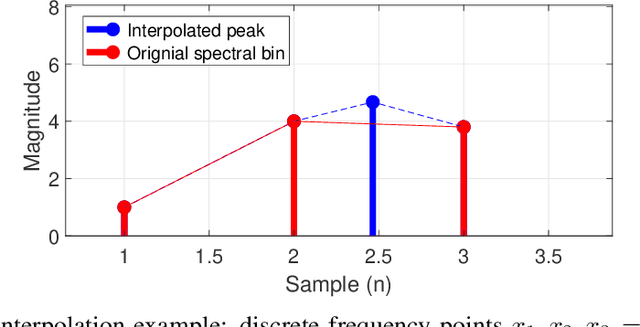
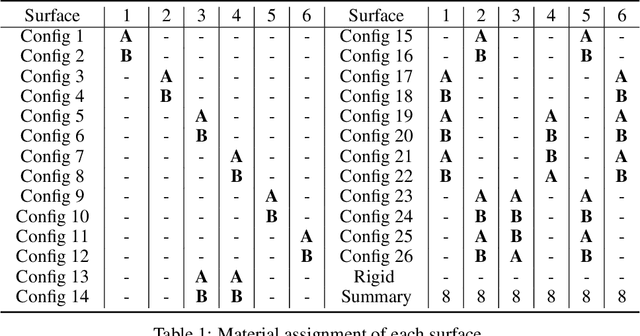
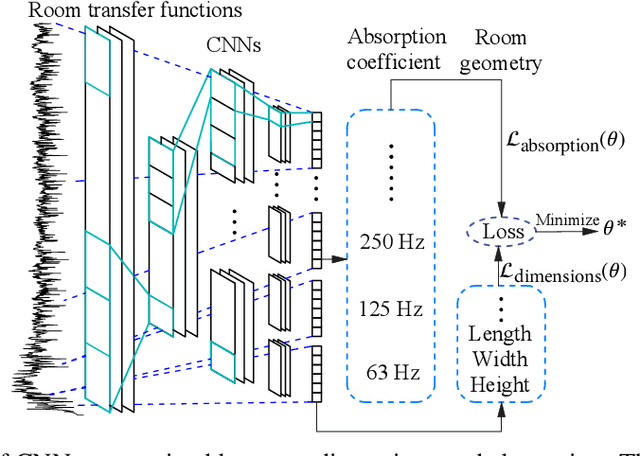
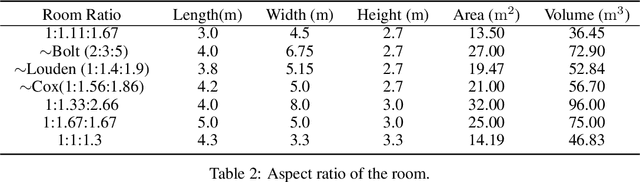
The inference of the absorption configuration of an existing room solely using acoustic signals can be challenging. This research presents two methods for estimating the room dimensions and frequency-dependent absorption coefficients using room transfer functions. The first method, a knowledge-based approach, calculates the room dimensions through damped resonant frequencies of the room. The second method, a machine learning approach, employs multi-task convolutional neural networks for inferring the room dimensions and frequency-dependent absorption coefficients of each surface. The study shows that accurate wave-based simulation data can be used to train neural networks for real-world measurements and demonstrates a potential for this algorithm to be used to estimate the boundary input data for room acoustic simulations. The proposed methods can be a valuable tool for room acoustic simulations during acoustic renovation or intervention projects, as they enable to infer the room geometry and absorption conditions with reasonably small data requirements.