 Add to Chrome
 Add to Firefox
 Add to Edge
MeGAS: Thermomechanical Dynamic Gaussian Splatting for Thermophysical Scene Editing
Jun 22, 2026
Recent advances integrate physically grounded Newtonian dynamics with neural rendering frameworks, narrowing the gap between photorealistic scene reconstruction and physics-based animation. However, existing approaches focus on mechanically driven dynamics while neglecting temperature, a fundamental yet invisible physical factor underlying phenomena such as melting, solidification, and other thermomechanical processes. In this paper, we propose MeGAS, a novel framework that incorporates thermomechanical phase-change dynamics into 3D Gaussian Splatting (3DGS). Specifically, we propose a new thermomechanical dynamic Gaussian Splatting representation that augments 3DGS with temperature attributes and employs a heat advection-diffusion solver with MPM dynamics incorporating phase transitions, enabling physically plausible and visually realistic synthesis of thermophysical phenomena. Furthermore, a new topology-adaptive Gaussian rendering strategy is proposed to mitigate cracking and floaters under extreme deformation. Extensive experiments demonstrate that MeGAS produces physically consistent thermomechanical behavior while maintaining high-fidelity photorealistic rendering, advancing toward physics-integrated world models.

PhysSkin: Real-Time and Generalizable Physics-Based Animation via Self-Supervised Neural Skinning
Mar 24, 2026Achieving real-time physics-based animation that generalizes across diverse 3D shapes and discretizations remains a fundamental challenge. We introduce PhysSkin, a physics-informed framework that addresses this challenge. In the spirit of Linear Blend Skinning, we learn continuous skinning fields as basis functions lifting motion subspace coordinates to full-space deformation, with subspace defined by handle transformations. To generate mesh-free, discretization-agnostic, and physically consistent skinning fields that generalize well across diverse 3D shapes, PhysSkin employs a new neural skinning fields autoencoder which consists of a transformer-based encoder and a cross-attention decoder. Furthermore, we also develop a novel physics-informed self-supervised learning strategy that incorporates on-the-fly skinning-field normalization and conflict-aware gradient correction, enabling effective balancing of energy minimization, spatial smoothness, and orthogonality constraints. PhysSkin shows outstanding performance on generalizable neural skinning and enables real-time physics-based animation.
DiffWind: Physics-Informed Differentiable Modeling of Wind-Driven Object Dynamics
Mar 10, 2026Modeling wind-driven object dynamics from video observations is highly challenging due to the invisibility and spatio-temporal variability of wind, as well as the complex deformations of objects. We present DiffWind, a physics-informed differentiable framework that unifies wind-object interaction modeling, video-based reconstruction, and forward simulation. Specifically, we represent wind as a grid-based physical field and objects as particle systems derived from 3D Gaussian Splatting, with their interaction modeled by the Material Point Method (MPM). To recover wind-driven object dynamics, we introduce a reconstruction framework that jointly optimizes the spatio-temporal wind force field and object motion through differentiable rendering and simulation. To ensure physical validity, we incorporate the Lattice Boltzmann Method (LBM) as a physics-informed constraint, enforcing compliance with fluid dynamics laws. Beyond reconstruction, our method naturally supports forward simulation under novel wind conditions and enables new applications such as wind retargeting. We further introduce WD-Objects, a dataset of synthetic and real-world wind-driven scenes. Extensive experiments demonstrate that our method significantly outperforms prior dynamic scene modeling approaches in both reconstruction accuracy and simulation fidelity, opening a new avenue for video-based wind-object interaction modeling.
GAPrompt: Geometry-Aware Point Cloud Prompt for 3D Vision Model
May 07, 2025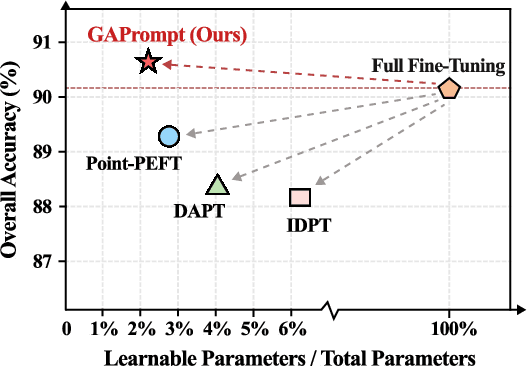
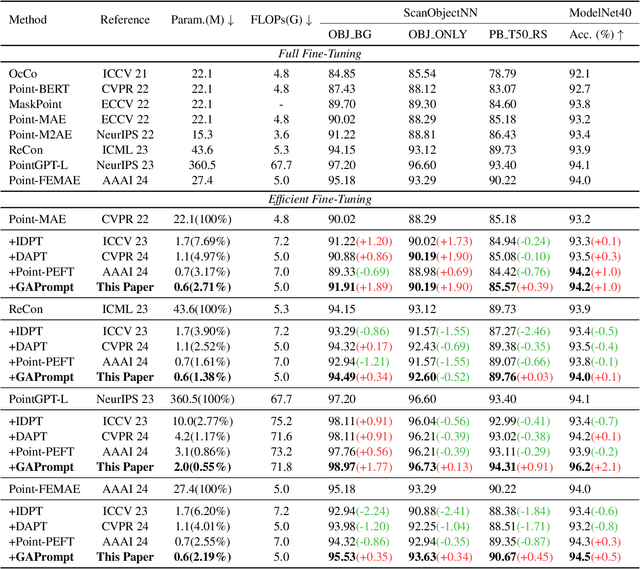
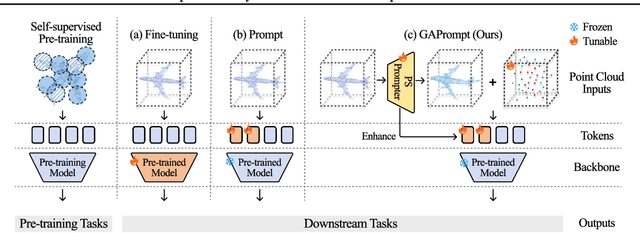
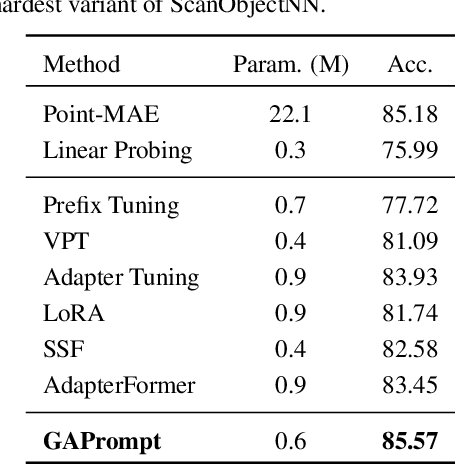
Pre-trained 3D vision models have gained significant attention for their promising performance on point cloud data. However, fully fine-tuning these models for downstream tasks is computationally expensive and storage-intensive. Existing parameter-efficient fine-tuning (PEFT) approaches, which focus primarily on input token prompting, struggle to achieve competitive performance due to their limited ability to capture the geometric information inherent in point clouds. To address this challenge, we propose a novel Geometry-Aware Point Cloud Prompt (GAPrompt) that leverages geometric cues to enhance the adaptability of 3D vision models. First, we introduce a Point Prompt that serves as an auxiliary input alongside the original point cloud, explicitly guiding the model to capture fine-grained geometric details. Additionally, we present a Point Shift Prompter designed to extract global shape information from the point cloud, enabling instance-specific geometric adjustments at the input level. Moreover, our proposed Prompt Propagation mechanism incorporates the shape information into the model's feature extraction process, further strengthening its ability to capture essential geometric characteristics. Extensive experiments demonstrate that GAPrompt significantly outperforms state-of-the-art PEFT methods and achieves competitive results compared to full fine-tuning on various benchmarks, while utilizing only 2.19% of trainable parameters. Our code is available at https://github.com/zhoujiahuan1991/ICML2025-VGP.