 Add to Chrome
 Add to Firefox
 Add to Edge
RobustVisRAG: Causality-Aware Vision-Based Retrieval-Augmented Generation under Visual Degradations
Feb 25, 2026
Vision-based Retrieval-Augmented Generation (VisRAG) leverages vision-language models (VLMs) to jointly retrieve relevant visual documents and generate grounded answers based on multimodal evidence. However, existing VisRAG models degrade in performance when visual inputs suffer from distortions such as blur, noise, low light, or shadow, where semantic and degradation factors become entangled within pretrained visual encoders, leading to errors in both retrieval and generation stages. To address this limitation, we introduce RobustVisRAG, a causality-guided dual-path framework that improves VisRAG robustness while preserving efficiency and zero-shot generalization. RobustVisRAG uses a non-causal path to capture degradation signals through unidirectional attention and a causal path to learn purified semantics guided by these signals. Together with the proposed Non-Causal Distortion Modeling and Causal Semantic Alignment objectives, the framework enforces a clear separation between semantics and degradations, enabling stable retrieval and generation under challenging visual conditions. To evaluate robustness under realistic conditions, we introduce the Distortion-VisRAG dataset, a large-scale benchmark containing both synthetic and real-world degraded documents across seven domains, with 12 synthetic and 5 real distortion types that comprehensively reflect practical visual degradations. Experimental results show that RobustVisRAG improves retrieval, generation, and end-to-end performance by 7.35%, 6.35%, and 12.40%, respectively, on real-world degradations, while maintaining comparable accuracy on clean inputs.

Improving Point-based Crowd Counting and Localization Based on Auxiliary Point Guidance
May 17, 2024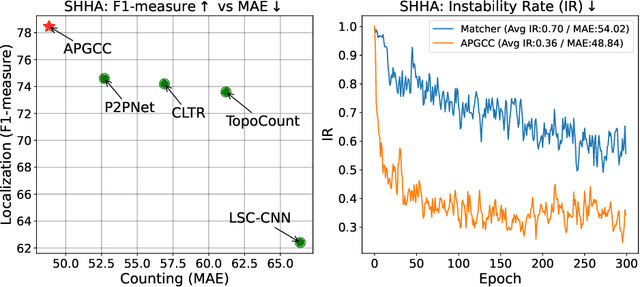
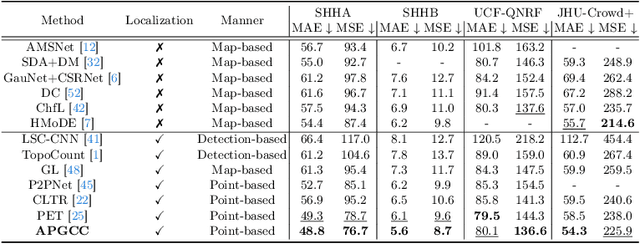
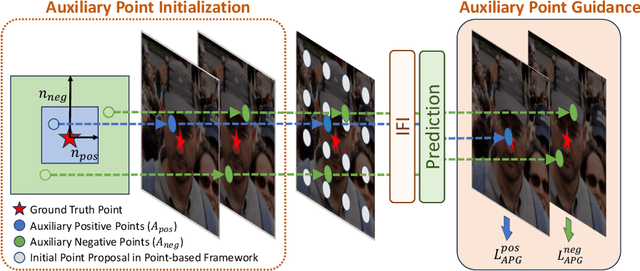
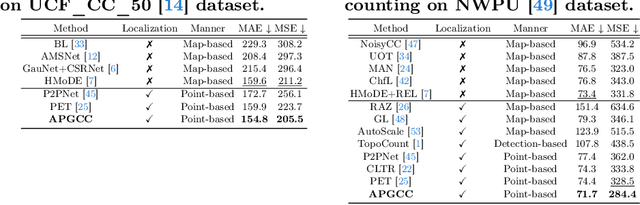
Crowd counting and localization have become increasingly important in computer vision due to their wide-ranging applications. While point-based strategies have been widely used in crowd counting methods, they face a significant challenge, i.e., the lack of an effective learning strategy to guide the matching process. This deficiency leads to instability in matching point proposals to target points, adversely affecting overall performance. To address this issue, we introduce an effective approach to stabilize the proposal-target matching in point-based methods. We propose Auxiliary Point Guidance (APG) to provide clear and effective guidance for proposal selection and optimization, addressing the core issue of matching uncertainty. Additionally, we develop Implicit Feature Interpolation (IFI) to enable adaptive feature extraction in diverse crowd scenarios, further enhancing the model's robustness and accuracy. Extensive experiments demonstrate the effectiveness of our approach, showing significant improvements in crowd counting and localization performance, particularly under challenging conditions. The source codes and trained models will be made publicly available.