 Add to Chrome
 Add to Firefox
 Add to Edge
DeCode: Decoupling Content and Delivery for Medical QA
Jan 05, 2026
Large language models (LLMs) exhibit strong medical knowledge and can generate factually accurate responses. However, existing models often fail to account for individual patient contexts, producing answers that are clinically correct yet poorly aligned with patients' needs. In this work, we introduce DeCode, a training-free, model-agnostic framework that adapts existing LLMs to produce contextualized answers in clinical settings. We evaluate DeCode on OpenAI HealthBench, a comprehensive and challenging benchmark designed to assess clinical relevance and validity of LLM responses. DeCode improves the previous state of the art from $28.4\%$ to $49.8\%$, corresponding to a $75\%$ relative improvement. Experimental results suggest the effectiveness of DeCode in improving clinical question answering of LLMs.

RANSAC-NN: Unsupervised Image Outlier Detection using RANSAC
Jul 23, 2023Image outlier detection (OD) is crucial for ensuring the quality and accuracy of image datasets used in computer vision tasks. The majority of OD algorithms, however, have not been targeted toward image data. Consequently, the results of applying such algorithms to images are often suboptimal. In this work, we propose RANSAC-NN, a novel unsupervised OD algorithm specifically designed for images. By comparing images in a RANSAC-based approach, our algorithm automatically predicts the outlier score of each image without additional training or label information. We evaluate RANSAC-NN against state-of-the-art OD algorithms on 15 diverse datasets. Without any hyperparameter tuning, RANSAC-NN consistently performs favorably in contrast to other algorithms in almost every dataset category. Furthermore, we provide a detailed analysis to understand each RANSAC-NN component, and we demonstrate its potential applications in image mislabeled detection. Code for RANSAC-NN is provided at https://github.com/mxtsai/ransac-nn
Multi-Task Lung Nodule Detection in Chest Radiographs with a Dual Head Network
Jul 07, 2022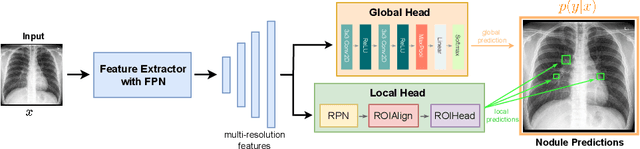
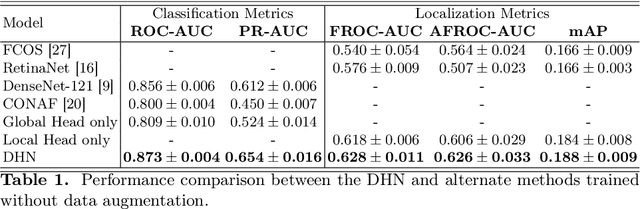
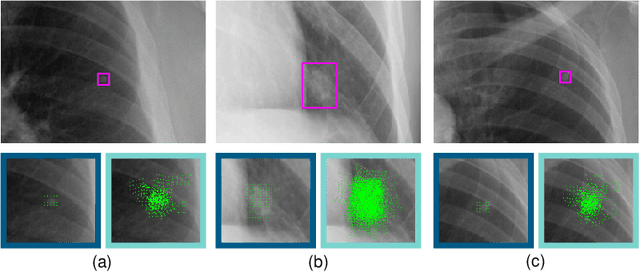
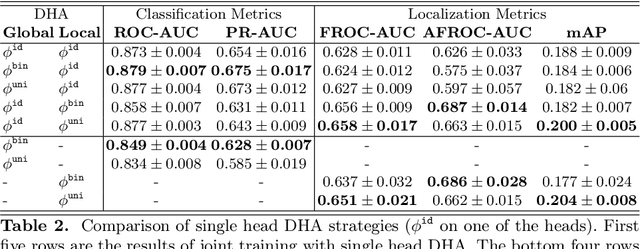
Lung nodules can be an alarming precursor to potential lung cancer. Missed nodule detections during chest radiograph analysis remains a common challenge among thoracic radiologists. In this work, we present a multi-task lung nodule detection algorithm for chest radiograph analysis. Unlike past approaches, our algorithm predicts a global-level label indicating nodule presence along with local-level labels predicting nodule locations using a Dual Head Network (DHN). We demonstrate the favorable nodule detection performance that our multi-task formulation yields in comparison to conventional methods. In addition, we introduce a novel Dual Head Augmentation (DHA) strategy tailored for DHN, and we demonstrate its significance in further enhancing global and local nodule predictions.
Effective Medical Test Suggestions Using Deep Reinforcement Learning
May 31, 2019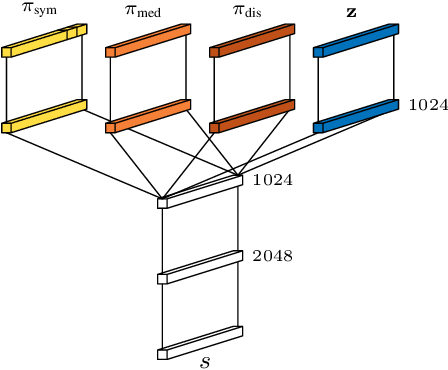
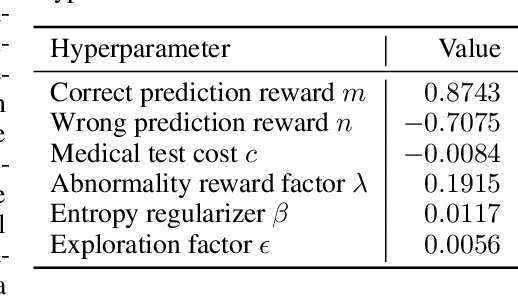
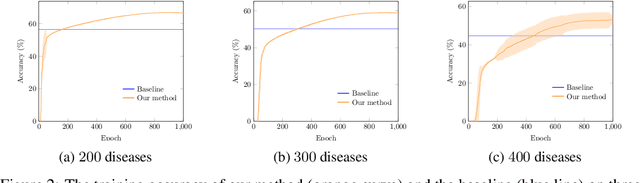
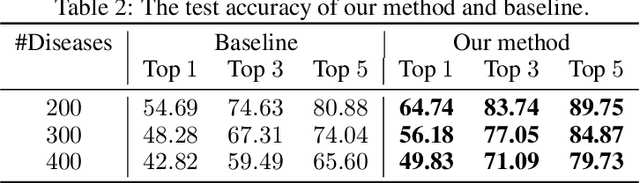
Effective medical test suggestions benefit both patients and physicians to conserve time and improve diagnosis accuracy. In this work, we show that an agent can learn to suggest effective medical tests. We formulate the problem as a stage-wise Markov decision process and propose a reinforcement learning method to train the agent. We introduce a new representation of multiple action policy along with the training method of the proposed representation. Furthermore, a new exploration scheme is proposed to accelerate the learning of disease distributions. Our experimental results demonstrate that the accuracy of disease diagnosis can be significantly improved with good medical test suggestions.