 Add to Chrome
 Add to Firefox
 Add to Edge
Designing to Forget: Deep Semi-parametric Models for Unlearning
Mar 24, 2026
Recent advances in machine unlearning have focused on developing algorithms to remove specific training samples from a trained model. In contrast, we observe that not all models are equally easy to unlearn. Hence, we introduce a family of deep semi-parametric models (SPMs) that exhibit non-parametric behavior during unlearning. SPMs use a fusion module that aggregates information from each training sample, enabling explicit test-time deletion of selected samples without altering model parameters. Empirically, we demonstrate that SPMs achieve competitive task performance to parametric models in image classification and generation, while being significantly more efficient for unlearning. Notably, on ImageNet classification, SPMs reduce the prediction gap relative to a retrained (oracle) baseline by $11\%$ and achieve over $10\times$ faster unlearning compared to existing approaches on parametric models. The code is available at https://github.com/amberyzheng/spm_unlearning.

Efficient Coarse-to-Fine Diffusion Models with Time Step Sequence Redistribution
Mar 22, 2026Recently, diffusion models (DMs) have made significant strides in high-quality image generation. However, the multi-step denoising process often results in considerable computational overhead, impeding deployment on resource-constrained edge devices. Existing methods mitigate this issue by compressing models and adjusting the time step sequence. However, they overlook input redundancy and require lengthy search times. In this paper, we propose Coarse-to-Fine Diffusion Models with Time Step Sequence Redistribution. Recognizing indistinguishable early-stage generated images, we introduce Coarse-to-Fine Denoising (C2F) to reduce computation during coarse feature generation. Furthermore, we design Time Step Sequence Redistribution (TRD) for efficient sampling trajectory adjustment, requiring less than 10 minutes for search. Experimental results demonstrate that the proposed methods achieve near-lossless performance with an 80% to 90% reduction in computation on CIFAR10 and LSUN-Church.
MPTQ-ViT: Mixed-Precision Post-Training Quantization for Vision Transformer
Feb 01, 2024
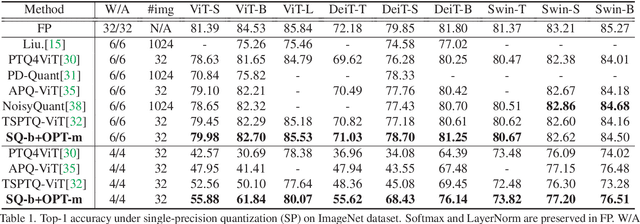
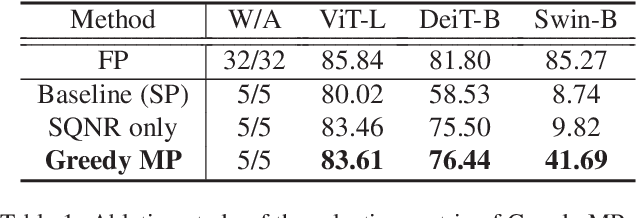

While vision transformers (ViTs) have shown great potential in computer vision tasks, their intense computation and memory requirements pose challenges for practical applications. Existing post-training quantization methods leverage value redistribution or specialized quantizers to address the non-normal distribution in ViTs. However, without considering the asymmetry in activations and relying on hand-crafted settings, these methods often struggle to maintain performance under low-bit quantization. To overcome these challenges, we introduce SmoothQuant with bias term (SQ-b) to alleviate the asymmetry issue and reduce the clamping loss. We also introduce optimal scaling factor ratio search (OPT-m) to determine quantization parameters by a data-dependent mechanism automatically. To further enhance the compressibility, we incorporate the above-mentioned techniques and propose a mixed-precision post-training quantization framework for vision transformers (MPTQ-ViT). We develop greedy mixed-precision quantization (Greedy MP) to allocate layer-wise bit-width considering both model performance and compressibility. Our experiments on ViT, DeiT, and Swin demonstrate significant accuracy improvements compared with SOTA on the ImageNet dataset. Specifically, our proposed methods achieve accuracy improvements ranging from 0.90% to 23.35% on 4-bit ViTs with single-precision and from 3.82% to 78.14% on 5-bit fully quantized ViTs with mixed-precision.
TSPTQ-ViT: Two-scaled post-training quantization for vision transformer
May 22, 2023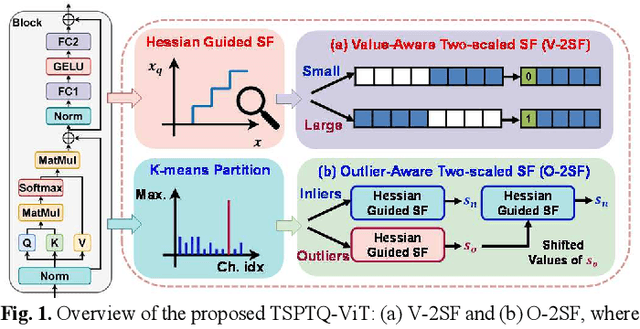
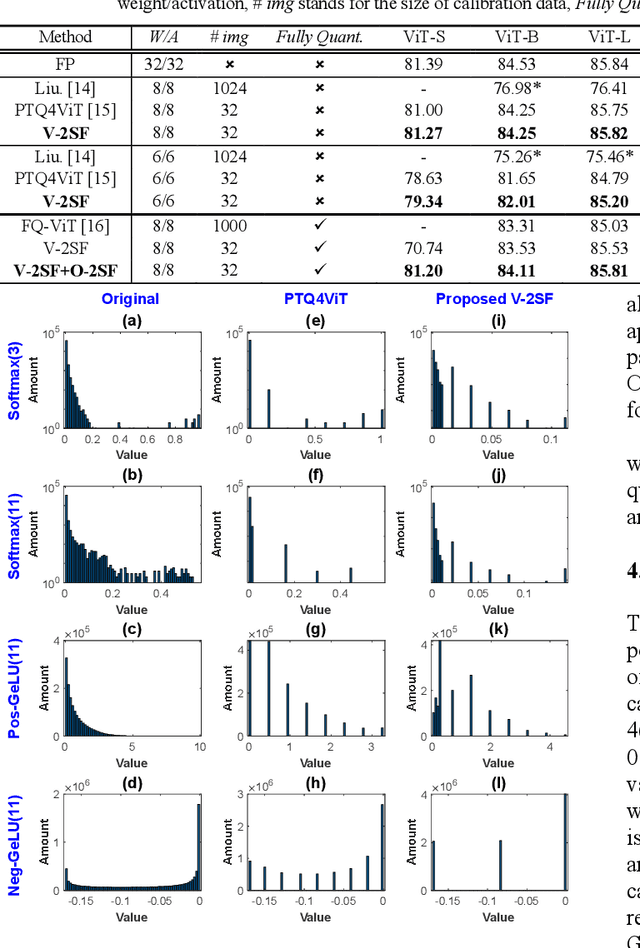
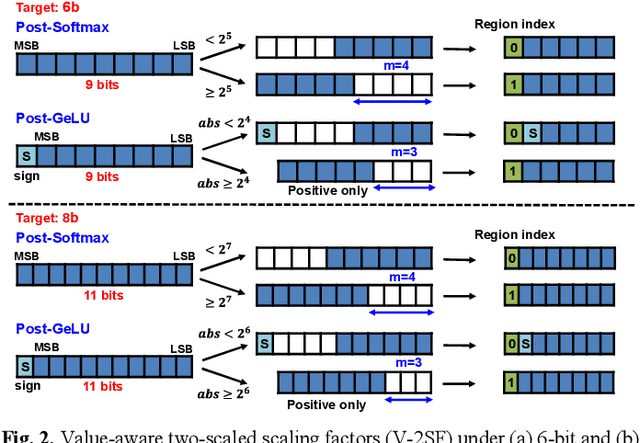
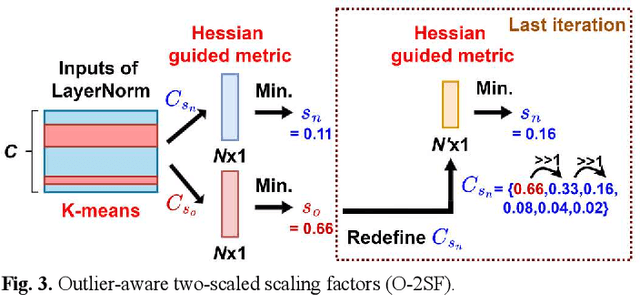
Vision transformers (ViTs) have achieved remarkable performance in various computer vision tasks. However, intensive memory and computation requirements impede ViTs from running on resource-constrained edge devices. Due to the non-normally distributed values after Softmax and GeLU, post-training quantization on ViTs results in severe accuracy degradation. Moreover, conventional methods fail to address the high channel-wise variance in LayerNorm. To reduce the quantization loss and improve classification accuracy, we propose a two-scaled post-training quantization scheme for vision transformer (TSPTQ-ViT). We design the value-aware two-scaled scaling factors (V-2SF) specialized for post-Softmax and post-GeLU values, which leverage the bit sparsity in non-normal distribution to save bit-widths. In addition, the outlier-aware two-scaled scaling factors (O-2SF) are introduced to LayerNorm, alleviating the dominant impacts from outlier values. Our experimental results show that the proposed methods reach near-lossless accuracy drops (<0.5%) on the ImageNet classification task under 8-bit fully quantized ViTs.
Learnable Mixed-precision and Dimension Reduction Co-design for Low-storage Activation
Jul 19, 2022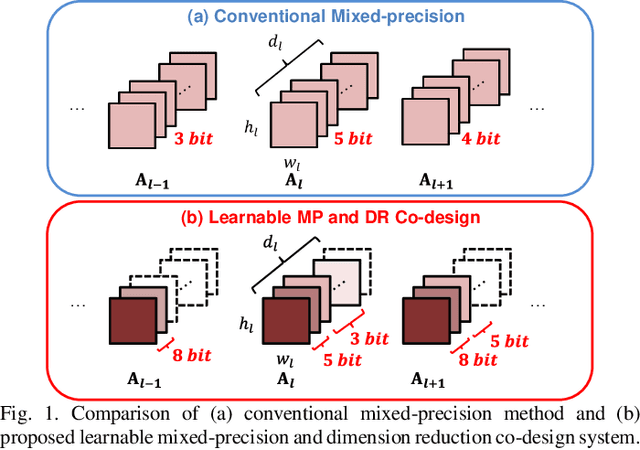
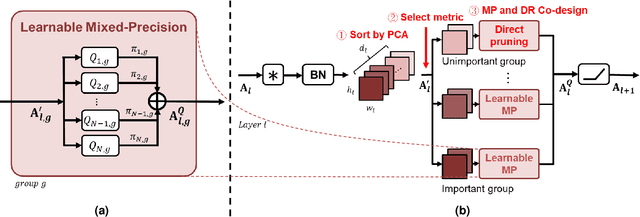
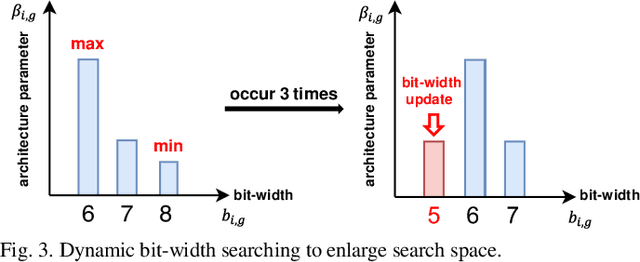
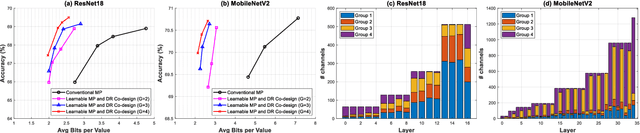
Recently, deep convolutional neural networks (CNNs) have achieved many eye-catching results. However, deploying CNNs on resource-constrained edge devices is constrained by limited memory bandwidth for transmitting large intermediated data during inference, i.e., activation. Existing research utilizes mixed-precision and dimension reduction to reduce computational complexity but pays less attention to its application for activation compression. To further exploit the redundancy in activation, we propose a learnable mixed-precision and dimension reduction co-design system, which separates channels into groups and allocates specific compression policies according to their importance. In addition, the proposed dynamic searching technique enlarges search space and finds out the optimal bit-width allocation automatically. Our experimental results show that the proposed methods improve 3.54%/1.27% in accuracy and save 0.18/2.02 bits per value over existing mixed-precision methods on ResNet18 and MobileNetv2, respectively.
Compression-aware Projection with Greedy Dimension Reduction for Convolutional Neural Network Activations
Oct 17, 2021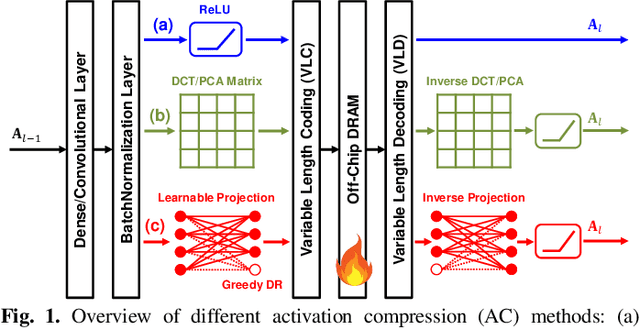
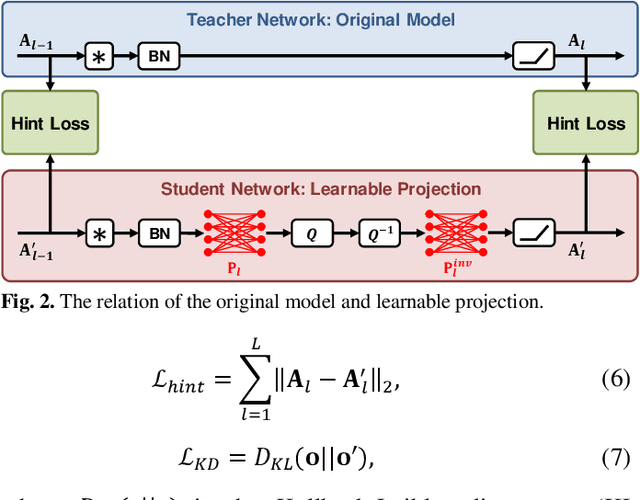
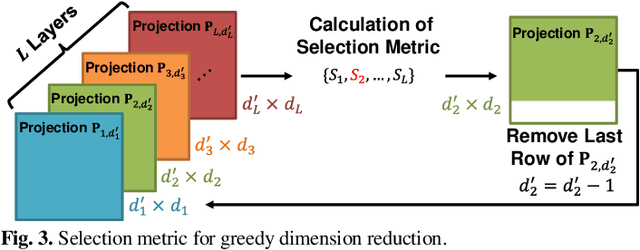
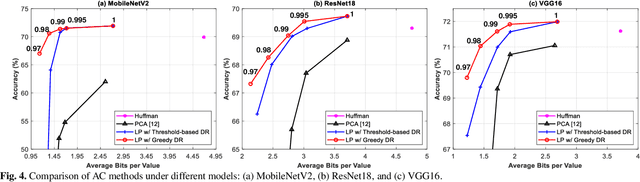
Convolutional neural networks (CNNs) achieve remarkable performance in a wide range of fields. However, intensive memory access of activations introduces considerable energy consumption, impeding deployment of CNNs on resourceconstrained edge devices. Existing works in activation compression propose to transform feature maps for higher compressibility, thus enabling dimension reduction. Nevertheless, in the case of aggressive dimension reduction, these methods lead to severe accuracy drop. To improve the trade-off between classification accuracy and compression ratio, we propose a compression-aware projection system, which employs a learnable projection to compensate for the reconstruction loss. In addition, a greedy selection metric is introduced to optimize the layer-wise compression ratio allocation by considering both accuracy and #bits reduction simultaneously. Our test results show that the proposed methods effectively reduce 2.91x~5.97x memory access with negligible accuracy drop on MobileNetV2/ResNet18/VGG16.