 Add to Chrome
 Add to Firefox
 Add to Edge
Hierarchical Proportion Models for Motion Generation via Integration of Motion Primitives
Feb 03, 2026
Imitation learning (IL) enables robots to acquire human-like motion skills from demonstrations, but it still requires extensive high-quality data and retraining to handle complex or long-horizon tasks. To improve data efficiency and adaptability, this study proposes a hierarchical IL framework that integrates motion primitives with proportion-based motion synthesis. The proposed method employs a two-layer architecture, where the upper layer performs long-term planning, while a set of lower-layer models learn individual motion primitives, which are combined according to specific proportions. Three model variants are introduced to explore different trade-offs between learning flexibility, computational cost, and adaptability: a learning-based proportion model, a sampling-based proportion model, and a playback-based proportion model, which differ in how the proportions are determined and whether the upper layer is trainable. Through real-robot pick-and-place experiments, the proposed models successfully generated complex motions not included in the primitive set. The sampling-based and playback-based proportion models achieved more stable and adaptable motion generation than the standard hierarchical model, demonstrating the effectiveness of proportion-based motion integration for practical robot learning.

Motion Generation for Food Topping Challenge 2024: Serving Salmon Roe Bowl and Picking Fried Chicken
Apr 30, 2025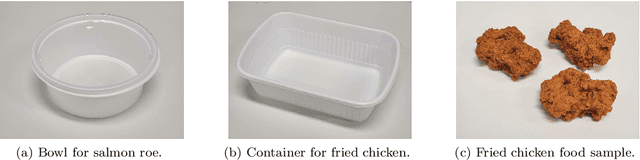
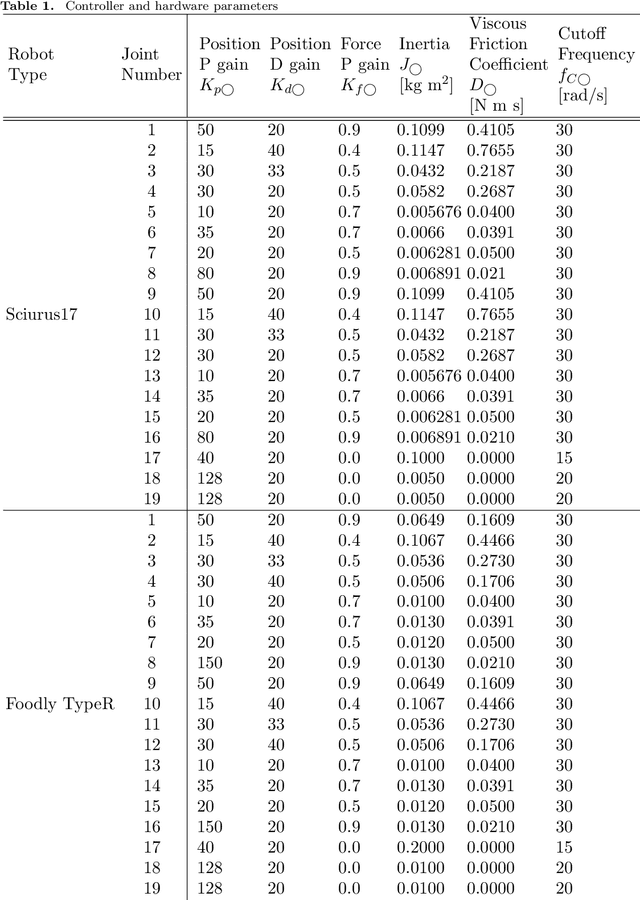
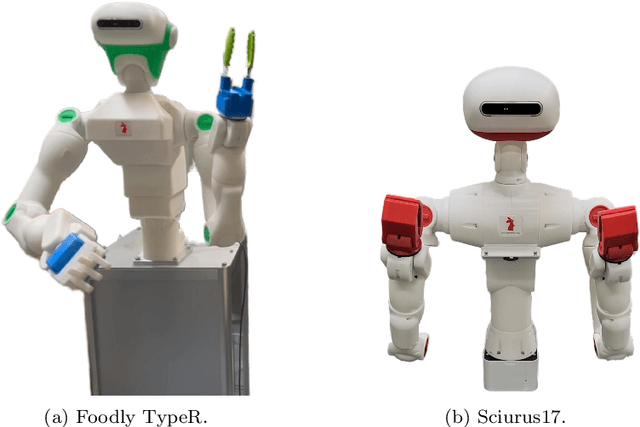
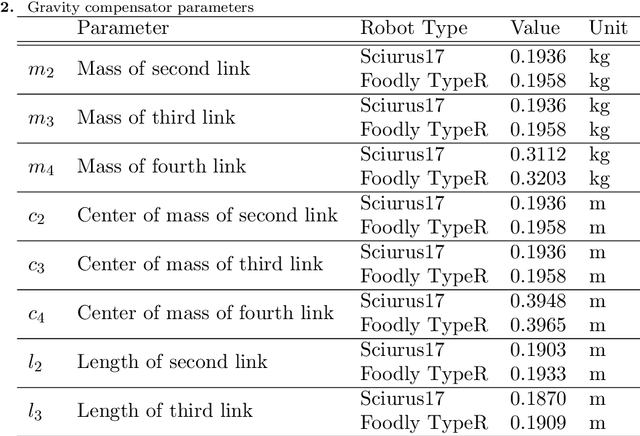
Although robots have been introduced in many industries, food production robots are yet to be widely employed because the food industry requires not only delicate movements to handle food but also complex movements that adapt to the environment. Force control is important for handling delicate objects such as food. In addition, achieving complex movements is possible by making robot motions based on human teachings. Four-channel bilateral control is proposed, which enables the simultaneous teaching of position and force information. Moreover, methods have been developed to reproduce motions obtained through human teachings and generate adaptive motions using learning. We demonstrated the effectiveness of these methods for food handling tasks in the Food Topping Challenge at the 2024 IEEE International Conference on Robotics and Automation (ICRA 2024). For the task of serving salmon roe on rice, we achieved the best performance because of the high reproducibility and quick motion of the proposed method. Further, for the task of picking fried chicken, we successfully picked the most pieces of fried chicken among all participating teams. This paper describes the implementation and performance of these methods.