 Add to Chrome
 Add to Firefox
 Add to Edge
Debiasing Text-to-Image Evaluation via Implicit Cultural Alignment Reward Modeling
Jul 17, 2026
As Text-to-Image (T2I) systems rapidly advance, evaluating the cultural authenticity of synthesized content has become increasingly important for fair and trustworthy generative AI. Existing T2I evaluation metrics and multimodal judges often rely on visual-semantic representations that underrepresent implicit cultural norms, leading to biased preference judgments and the omission of fine-grained cultural cues. In addition, visual question answering (VQA)-based evaluators typically depend on autoregressive text generation, which limits their scalability for real-time reward modeling. To address these limitations, we introduce an Implicit Cultural Alignment Reward Model built upon a lightweight 4.2-billion-parameter Multimodal Large Language Model (MLLM). Our framework integrates an Implicit Cultural Probe with a Skip-connection Cross-Attention (SkipCA) mechanism, enabling late-stage semantic features to directly attend to early-stage visual representations and better preserve culturally salient details. Evaluations on 3,323 challenging and carefully curated image pairs from the CulturalFrames benchmark show that our approach achieves 80.54% pairwise accuracy, with Pearson and Kendall correlation coefficients of 0.546 and 0.377, respectively, outperforming representative vision-language metrics and MLLM-based evaluators. Moreover, by bypassing autoregressive text generation, our model processes each evaluation in 0.21 seconds under our local inference setup, achieving a $10\times$ speedup over standard VQA-based evaluators. These results suggest that the proposed reward model can provide an efficient and culturally aware scalar signal for preference optimization pipelines such as Reinforcement Learning from Human Feedback and Direct Preference Optimization.

Bring Music The Horizon: Music-Driven 360$^\circ$ Video Generation
Jul 15, 2026Music visualization offers a powerful way to enhance listeners' understanding and experience of music by translating auditory signals into visual forms. However, most existing approaches either rely heavily on lyrics or generate flat, non-immersive videos similar to conventional music videos, which limits their ability to convey the emotional dynamics of music and provide an immersive listening experience. We propose Bring Music The Horizon, an emotion-aware pipeline for music-driven 360$^\circ$ video generation. Given an input song, our work first estimates its emotional trajectory by predicting valence-arousal values at the level of every four bars. These values are then converted into emotion-aware visual guidance using EmotiCrafter, and these guidance vectors can be manipulated by the SEGA framework, which provides fine-grained semantic control for keyframe generation. Finally, image-to-video models are applied to the generated keyframes to synthesize temporally continuous 360$^\circ$ videos for immersive music visualization. Our pipeline generates 360$^\circ$ music visualization videos that reflect the emotional progression and temporal structure of the input song. We demonstrate its capability using songs from different genres and provide qualitative comparisons with From-Sound-To-Sight, a representative audio-to-visual generation baseline, on our project page at https://etoile-et-toi-mp3.github.io/BMTH_Project_Page/.
Learning Perceptual Representations for Gaming NR-VQA with Multi-Task FR Signals
Feb 12, 2026No-reference video quality assessment (NR-VQA) for gaming videos is challenging due to limited human-rated datasets and unique content characteristics including fast motion, stylized graphics, and compression artifacts. We present MTL-VQA, a multi-task learning framework that uses full-reference metrics as supervisory signals to learn perceptually meaningful features without human labels for pretraining. By jointly optimizing multiple full-reference (FR) objectives with adaptive task weighting, our approach learns shared representations that transfer effectively to NR-VQA. Experiments on gaming video datasets show MTL-VQA achieves performance competitive with state-of-the-art NR-VQA methods across both MOS-supervised and label-efficient/self-supervised settings.
Stream-DiffVSR: Low-Latency Streamable Video Super-Resolution via Auto-Regressive Diffusion
Dec 29, 2025Diffusion-based video super-resolution (VSR) methods achieve strong perceptual quality but remain impractical for latency-sensitive settings due to reliance on future frames and expensive multi-step denoising. We propose Stream-DiffVSR, a causally conditioned diffusion framework for efficient online VSR. Operating strictly on past frames, it combines a four-step distilled denoiser for fast inference, an Auto-regressive Temporal Guidance (ARTG) module that injects motion-aligned cues during latent denoising, and a lightweight temporal-aware decoder with a Temporal Processor Module (TPM) that enhances detail and temporal coherence. Stream-DiffVSR processes 720p frames in 0.328 seconds on an RTX4090 GPU and significantly outperforms prior diffusion-based methods. Compared with the online SOTA TMP, it boosts perceptual quality (LPIPS +0.095) while reducing latency by over 130x. Stream-DiffVSR achieves the lowest latency reported for diffusion-based VSR, reducing initial delay from over 4600 seconds to 0.328 seconds, thereby making it the first diffusion VSR method suitable for low-latency online deployment. Project page: https://jamichss.github.io/stream-diffvsr-project-page/
Study of Subjective and Objective Quality Assessment of Mobile Cloud Gaming Videos
May 26, 2023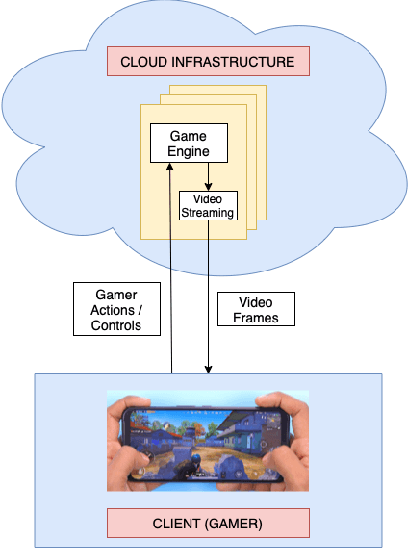
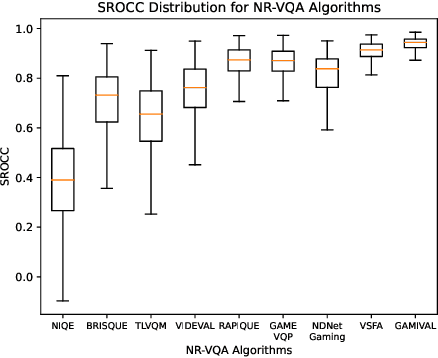
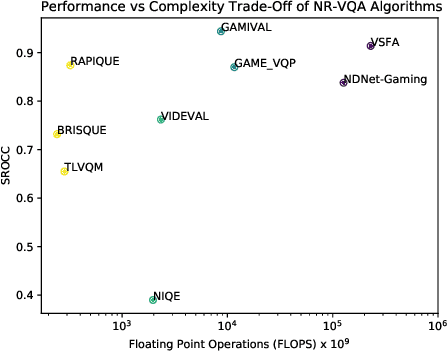
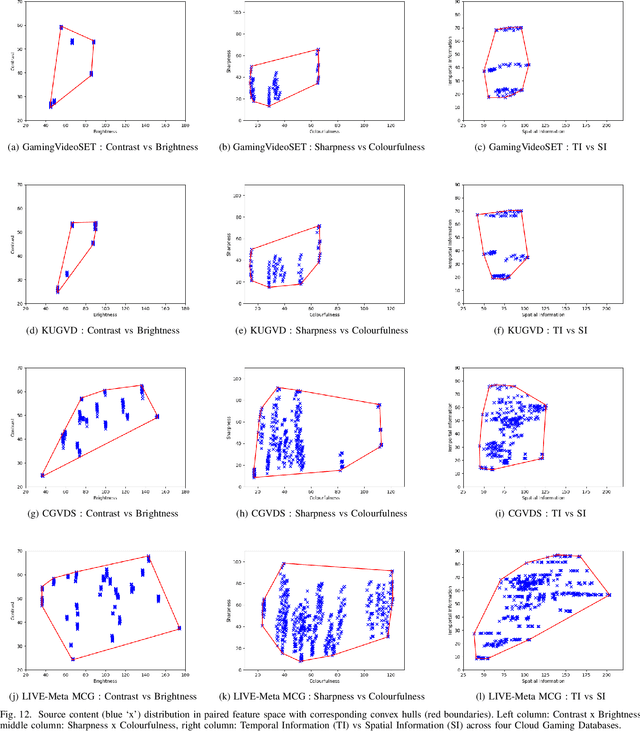
We present the outcomes of a recent large-scale subjective study of Mobile Cloud Gaming Video Quality Assessment (MCG-VQA) on a diverse set of gaming videos. Rapid advancements in cloud services, faster video encoding technologies, and increased access to high-speed, low-latency wireless internet have all contributed to the exponential growth of the Mobile Cloud Gaming industry. Consequently, the development of methods to assess the quality of real-time video feeds to end-users of cloud gaming platforms has become increasingly important. However, due to the lack of a large-scale public Mobile Cloud Gaming Video dataset containing a diverse set of distorted videos with corresponding subjective scores, there has been limited work on the development of MCG-VQA models. Towards accelerating progress towards these goals, we created a new dataset, named the LIVE-Meta Mobile Cloud Gaming (LIVE-Meta-MCG) video quality database, composed of 600 landscape and portrait gaming videos, on which we collected 14,400 subjective quality ratings from an in-lab subjective study. Additionally, to demonstrate the usefulness of the new resource, we benchmarked multiple state-of-the-art VQA algorithms on the database. The new database will be made publicly available on our website: \url{https://live.ece.utexas.edu/research/LIVE-Meta-Mobile-Cloud-Gaming/index.html}
GAMIVAL: Video Quality Prediction on Mobile Cloud Gaming Content
May 12, 2023The mobile cloud gaming industry has been rapidly growing over the last decade. When streaming gaming videos are transmitted to customers' client devices from cloud servers, algorithms that can monitor distorted video quality without having any reference video available are desirable tools. However, creating No-Reference Video Quality Assessment (NR VQA) models that can accurately predict the quality of streaming gaming videos rendered by computer graphics engines is a challenging problem, since gaming content generally differs statistically from naturalistic videos, often lacks detail, and contains many smooth regions. Until recently, the problem has been further complicated by the lack of adequate subjective quality databases of mobile gaming content. We have created a new gaming-specific NR VQA model called the Gaming Video Quality Evaluator (GAMIVAL), which combines and leverages the advantages of spatial and temporal gaming distorted scene statistics models, a neural noise model, and deep semantic features. Using a support vector regression (SVR) as a regressor, GAMIVAL achieves superior performance on the new LIVE-Meta Mobile Cloud Gaming (LIVE-Meta MCG) video quality database.
* Accepted to IEEE SPL 2023. The implementation of GAMIVAL has been made available online: https://github.com/lskdream/GAMIVAL