 Add to Chrome
 Add to Firefox
 Add to Edge
Cross-device Collaborative Test-time Adaptation with Zeroth-order Optimization and Model Merging
Jul 03, 2026
Test-time adaptation (TTA) mitigates domain shifts by using incoming test data to update a model on the fly. The majority of TTA methods require resource-intensive backpropagation (BP) for model updates, particularly demanding large memory sizes, which makes it infeasible to deploy them on resource-limited devices (e.g., edge devices). To address this issue, we integrate two different techniques, zeroth-order optimization (ZOO) and model merging, under the recently established cross-device collaborative TTA (CDC-TTA) framework, where the system is composed of a mixture of resource-abundant and resource-limited devices, and the model information (e.g., model weights obtained on each device) is shared across the devices. Our method is executable on resource-limited devices by introducing ZOO, which requires only forward processing and bypasses the resource-intensive BP optimization. Concurrently, to mitigate the high-dimensional optimization difficulty caused by the side effect of ZOO, we incorporate model merging of the shared multiple models and set the merge coefficients as the optimization objective, which successfully reduces the optimization dimension. In addition, to enhance the synergistic combination of ZOO and model merging, we propose a unique preprocessing strategy that trims intra-model non-influential weights and reduces the inter-model information redundancy. We empirically confirmed the effectiveness of our method using common corruption and style-transferred image benchmarks.

Generalized Domain Adaptation
Jun 03, 2021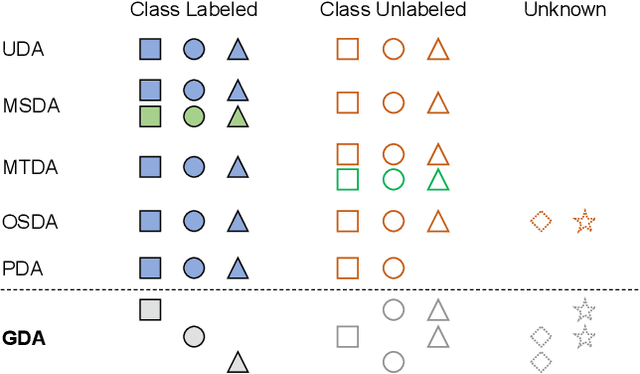
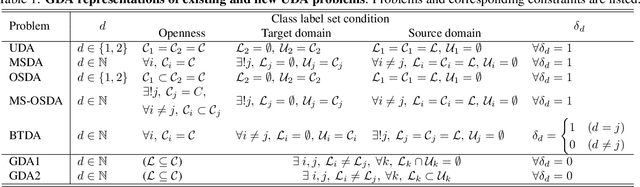
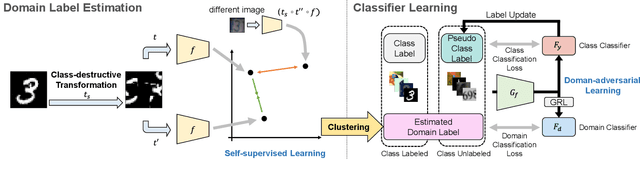
Many variants of unsupervised domain adaptation (UDA) problems have been proposed and solved individually. Its side effect is that a method that works for one variant is often ineffective for or not even applicable to another, which has prevented practical applications. In this paper, we give a general representation of UDA problems, named Generalized Domain Adaptation (GDA). GDA covers the major variants as special cases, which allows us to organize them in a comprehensive framework. Moreover, this generalization leads to a new challenging setting where existing methods fail, such as when domain labels are unknown, and class labels are only partially given to each domain. We propose a novel approach to the new setting. The key to our approach is self-supervised class-destructive learning, which enables the learning of class-invariant representations and domain-adversarial classifiers without using any domain labels. Extensive experiments using three benchmark datasets demonstrate that our method outperforms the state-of-the-art UDA methods in the new setting and that it is competitive in existing UDA variations as well.